
Is laser hair removal safe? Yes. Laser hair removal is considered safe when a trained provider uses a medical-grade laser matched to your skin tone and hair color. Most side effects are mild and temporary, such as redness or swelling. Risks rise with the wrong wavelength, tanned skin, or poor technique. A free consultation should screen for these.
By Sedona Laser
If you are asking this question, you are probably tired of razors and waxing. You may also be afraid of burns, dark or light patches, or scarring. Some readers have been told "we can't treat your skin," which makes the fear worse. Those worries are fair, and they deserve a direct answer instead of a sales pitch.
We offer laser hair removal at Sedona Laser Center in Edina, alongside our other Laser & Skin Treatments in Edina, MN. In our work across 150,000+ procedures over 17+ years, the same safety questions come up again and again. This guide answers them in plain English: how the technology works, what FDA clearance means, which risks are real, who should wait, and how to judge any clinic, including ours.
This guide is general education, not medical advice. Discuss your history with a qualified provider before you book.
Is laser hair removal safe?
Yes, for most healthy adults, when treatment is done by a trained provider with a medical-grade laser matched to your skin tone. Safety depends on the wavelength, your skin and hair, and the operator's screening. It is not the same across every device or clinic.
That last point is where most online advice goes wrong. "Laser hair removal" is a category, not a single product. A clinic with a dual-wavelength system and a careful screening process offers a very different safety profile than a device built for one skin tone or a handheld unit bought online.
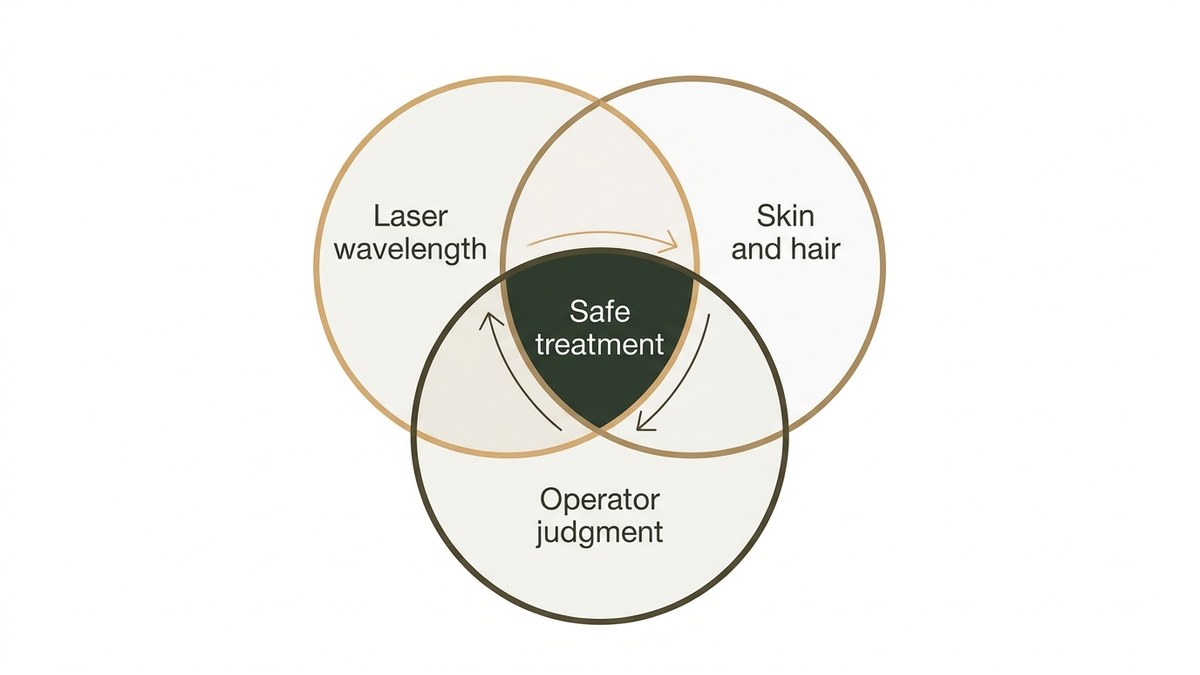
We think of safety as a three-part match:
- The laser: its wavelength and its cooling.
- Your skin and hair: your skin tone, hair color, recent sun, and medical history.
- The operator: training, judgment, and willingness to say "not today."
When all three line up, the treatment is predictable. When one is off, risk goes up. That is why we use the free consultation as our screening step. We ask about your skin tone, recent sun exposure, medications, and medical history before anyone picks up a handpiece. For Twin Cities readers, including those in Edina and the nearby suburbs, that conversation is the cheapest safety measure available.
Skin tone is the part of the match that worries readers most. If that is you, our guide to Laser Hair Removal for Dark Skin: Why 1064nm Nd:YAG Is the Safe, Effective Choice goes deeper, and we cover it again below.
Takeaway: Laser hair removal is safe as a match between laser, skin, and operator, not as a blanket promise about the technology.
Why does wavelength decide laser safety?
Laser hair removal works when the pigment in your hair follicle absorbs light and turns it into heat. That heat disables the follicle. Your skin holds the same pigment, called melanin, so the wavelength a clinic chooses is the main safety control.
Two wavelengths matter most:
- 755nm Alexandrite: melanin absorbs it strongly. It works well on lighter skin with darker hair, but more of the light is picked up by surface pigment.
- 1064nm Nd:YAG: it travels deeper and is absorbed less by melanin in the skin surface. That makes it the safer choice for melanin-rich skin.
Our Cynosure Elite™ system carries both wavelengths in one device. It lets us match the laser to the patient instead of matching the patient to the laser. We have also validated it across the full Fitzpatrick spectrum, which is the scale dermatologists use to describe skin tone and sun response. For a side-by-side breakdown, see Nd:YAG vs. Alexandrite: Which Wavelength Is Right for Your Skin Tone?
Timing is the other half of the science. Laser only affects hairs in their active growth phase, and not all of your hairs are in that phase on the same day. A peer-reviewed review from 2022 found greater long-term hair reduction on body sites with longer hair growth cycles. That is why our standard protocol is 8-12 sessions spaced 4-6 weeks apart. The spacing catches each wave of hair as it enters the growth phase.
Wavelength precision is also what separates a true laser from IPL. IPL emits broad-spectrum light rather than one targeted wavelength. We explain the difference in Laser Hair Removal vs. IPL: Medical-Grade Precision and Why Wavelength Matters.
Takeaway: Because skin and hair share the same pigment, choosing the right wavelength is the single biggest safety decision in treatment.
Is laser hair removal FDA approved?
Medical lasers are FDA-cleared, not "approved," for hair reduction. Clearance means the device met federal requirements for a stated use. It does not guarantee a safe treatment. Provider training, settings, and skin-tone matching decide that.
The wording matters. Many clinic websites say "FDA approved," and the phrase sounds stronger than it is. Most laser devices reach the market through a clearance pathway that compares them to devices already on the market. Approval is a separate, tougher process reserved for higher-risk products. [CITATION_NEEDED: FDA consumer guidance explaining the difference between "cleared" and "approved" for medical devices]
Clearance also covers the device, not the person using it. A cleared laser in untrained hands, at the wrong setting, or on the wrong skin tone can still burn. When you evaluate a clinic, ask for the exact device name and check it in the FDA's public 510(k) database yourself. We are glad to give you our model name for exactly that reason.
The same care applies to the word "permanent." The FDA's definition of permanent hair reduction is a long-term, stable reduction in the number of hairs that regrow. It does not mean every hair is gone forever. [CITATION_NEEDED: FDA definition of "permanent hair reduction" for laser devices]
We use the term permanent hair reduction, never "permanent removal." After a full series, most of our patients reach 80-90% permanent hair reduction. Some choose an occasional maintenance session for stray regrowth. Hormones, genetics, and hair color all influence the result. We would rather set that expectation at the consultation than have you find out later. Knowing which side effects are normal also helps, and Common Laser Hair Removal Side Effects and How to Minimize Them covers them.
Takeaway: "Cleared" describes the device, not the quality of your treatment, so judge the clinic and the settings as well as the label.
What are the side effects and risks?
Common side effects are redness, swelling, and tenderness that fade within hours to a few days. Rare risks include blistering, burns, and pigment changes. They are linked mostly to the wrong wavelength, tanned skin, or incorrect settings.
Common and temporary side effects
Most people feel warmth during a pulse and see mild redness afterward. Small raised bumps around each follicle are also normal. Skin can feel like a mild sunburn for a few hours, occasionally a day or two. [CITATION_NEEDED: Mayo Clinic or Cleveland Clinic patient page on common laser hair removal side effects]
Cooling reduces both discomfort and heat stress on the skin. We use Zimmer Cryo 5 cooling in real time during treatment, so skin is chilled while the laser pulses rather than before or after. Good preparation also lowers the odds of a reaction. Our guide, How to Prepare for Your First Professional Laser Hair Removal Session, walks through it step by step.
Rare but serious risks
Blisters, burns, lasting dark or light patches, and scarring are uncommon, but they are the outcomes people fear most. They usually trace back to a short list of causes:
- A wavelength that is too absorbable for your skin tone.
- Tanned or recently sun-exposed skin.
- Settings that are too aggressive for your skin and hair.
- Poor technique or inconsistent follow-up.
Every one of these is a decision made before or during treatment. That is why we frame safety as a match instead of a promise. No clinic can promise zero risk, and any clinic that does should raise a flag. We will not invent a complication rate for ourselves. What we can say is what we control: the wavelength, the cooling, the screening, and the same technician throughout your plan.
Does laser hair removal cause cancer?
Laser hair removal uses non-ionizing light, not X-rays or other ionizing radiation. Current clinical evidence does not show that it causes cancer. [CITATION_NEEDED: StatPearls (NCBI Bookshelf) laser hair removal chapter or equivalent clinical source on cancer risk]
If you have a mole, a changing spot, or a personal history of skin cancer, tell your provider. Treated areas should avoid pigmented lesions, and a doctor should evaluate any suspicious spot before laser is used nearby.
Can laser help with ingrown hairs?
Possibly, as a side benefit. Ingrown hairs happen when a hair curls back into the skin. Fewer hairs growing means fewer chances for that to happen. That is reasoning, not a promise, and results vary with hair type and area. For the published research, see this PubMed Central paper on ingrown hairs and laser treatment, and talk to your provider about what it means for your skin.
Takeaway: Most side effects are mild and short-lived, and the serious ones trace back to choices you can screen for in advance.
Is laser hair removal safe for dark skin?
Yes, with the right wavelength. The 1064nm Nd:YAG wavelength bypasses much of the melanin in the skin surface, which lowers burn risk. Single-wavelength lasers and IPL carry more risk for darker skin. Ask what wavelengths a clinic actually uses.
This is the question we hear most often, and the one with the most bad history behind it. Many people with melanin-rich skin have been turned away, told to try something else, or treated with a device that was never designed for them. That is a failure of equipment and screening, not a limit of laser itself.
The problem is melanin competition. A laser aims for pigment in the hair. When the skin around the hair holds a lot of pigment too, a short-wavelength laser can heat the skin instead of only the follicle. That raises the chance of burns and pigment changes. The Nd:YAG wavelength at 1064nm passes through surface pigment more easily, so more energy reaches the follicle and less is absorbed on the way in.
The Fitzpatrick scale gives this a common language. It sorts skin into six types, from very fair skin that burns easily to deeply pigmented skin that rarely burns. [CITATION_NEEDED: Fitzpatrick scale explainer from a dermatology source such as the AAD or a peer-reviewed review] Your type helps determine which wavelength and settings are appropriate, and a good clinic will assess it in person instead of guessing.
Our position is clear. We do not treat darker skin with IPL or single-wavelength technology. We use the Cynosure Elite™ dual-wavelength system, and for melanin-rich skin we rely on 1064nm Nd:YAG. Our consultation is built to welcome people who have been dismissed elsewhere, with no pressure to book. If you are worried about what the first visit looks like, read What to Expect at Your First Laser Hair Removal Appointment.
Questions worth asking any clinic about dark skin:
- Which exact laser and wavelengths do you use on my skin tone?
- Will you refuse to treat me with IPL or a single-wavelength device?
- How do you screen for recent sun and for pigment changes?
- Who will perform my treatment, and will it be the same person each time?
If the answers are vague, keep looking.
Takeaway: Darker skin is not a barrier to laser hair removal, but the wrong wavelength is a real hazard.
Who should wait or skip laser hair removal?
Wait or ask your provider first if you are pregnant, recently tanned, taking photosensitizing medication, or have an active infection or skin condition in the treatment area. Disclose your full medical history at the consultation.
Here is how to think about each situation:
- Pregnancy: Safety data on elective cosmetic lasers during pregnancy is limited, so the cautious path is to wait and defer to your OB. [CITATION_NEEDED: ACOG or equivalent OB/dermatology guidance on elective cosmetic lasers in pregnancy]
- Recent tanning or sun exposure: Tanned skin holds more melanin at the surface, which raises burn and pigment risk. Treatment usually needs to wait until your skin returns to its natural tone.
- Photosensitizing medications: Some medications make skin react more strongly to light. Tell us everything you take, including supplements and topical products.
- Active infection or skin conditions: Cold sores, open wounds, rashes, or flare-ups in the treatment area are reasons to postpone.
Sun is the most common reason a session gets rescheduled, and timing it well keeps you safe. Our guide, Can You Do Laser Hair Removal in Summer? Sun Exposure Rules, explains how to plan around it.
Hormone-driven hair is a different case. It is not a reason to skip treatment, but it changes your expectations. Hair driven by conditions like PCOS can keep responding to hormones, so regrowth may appear and maintenance sessions may be part of the plan. We cover what to expect in Laser Hair Removal on Hormonal Hair: How It Works for PCOS and Hormone-Driven Growth.
Takeaway: A good provider will sometimes tell you to wait, and that honesty is part of safe treatment.
Are at-home IPL devices as safe?
No, not in the same way. At-home IPL is not a medical-grade laser. It uses broad-spectrum light, delivers less precise energy, and carries more risk for darker skin. Results tend to be temporary reduction rather than permanent hair reduction.
This is the correction we make most often. Many home devices are sold as "laser" or described in a way that blurs the line. They are not lasers. A true laser sends a single wavelength chosen for a specific target. IPL sends a wide band of light, and the energy spreads across pigment in your hair and your skin alike. It is the same melanin-competition problem we described above, with less control built in. [CITATION_NEEDED: FDA or peer-reviewed source on at-home IPL energy limits and efficacy]
Home devices are also built with lower power for safety, and that limit is one reason results fade. You pay for a product that can reduce hair for a while but rarely delivers the lasting change a clinic series does. For our full explanation, see Why At-Home IPL Devices Aren't Lasers (And Why It Matters).

If you already tried a home device and were disappointed, you are in good company. That experience does not mean laser will fail for you. It usually means the tool was never the same thing. The next step is the same as for anyone else: a consultation and a proper skin assessment.
Takeaway: IPL and laser are different technologies, and the difference shows up in both precision and safety.
How can you spot a safe laser clinic?
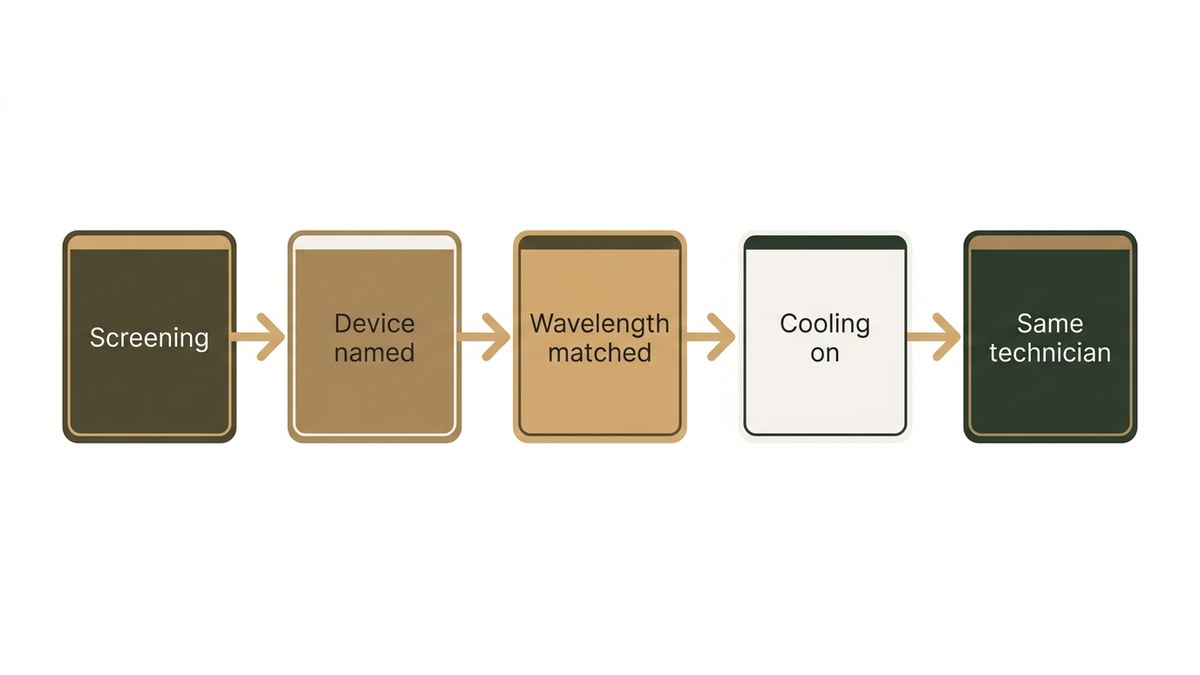
A safe clinic screens your skin tone and medical history, names the exact laser and wavelengths, uses cooling, explains risks plainly, and keeps the same trained technician on your plan. Be cautious of pressure sales and promises of total, one-and-done results.
Every clinic says it is safe, so use criteria you can check. Walk in with this list:
- They screen before they treat. You should be asked about skin tone, recent sun, medications, and medical history.
- They name the device. The brand, model, and wavelengths should be stated without hesitation.
- They match the wavelength to your skin. One laser for everyone is a warning sign.
- They use cooling. Active cooling protects the skin during each pulse.
- They explain risks in plain language. If you only hear benefits, ask again.
- The same technician treats you throughout. Consistency means someone who knows how your skin responds.
- There is no pressure. A free consultation should not turn into a sales funnel.
- Pricing is clear. You should know the cost of a full series before you commit.
- Eye protection and hygiene are visible. Protective eyewear and clean handpieces are basic standards. [CITATION_NEEDED: AAD, OSHA, or ANSI guidance on laser safety practices and eye protection]
We hold ourselves to this list too. We are independent and woman-owned, we keep the same technician on your plan, and our consultation is free and no-pressure. You can see how that works on our Laser Hair Removal in Edina, MN page.
Takeaway: Judge a clinic by checkable behavior, not by how often it says the word "safe."
How can you lower your risk?
You can lower your risk by avoiding sun, following shaving rules, skipping waxing, and sticking to aftercare instructions. Call your clinic if you see blistering, spreading redness, or worsening pain. Small habits before and after each session protect your skin.
Before treatment:
- Stay out of the sun and avoid tanning beds and self-tanner on the treatment area.
- Shave the area as your clinic instructs. Do not wax, pluck, or thread, because the laser needs the hair root in place.
- Tell your provider about new medications, products, or skin changes.
- Arrive with clean, product-free skin.
After treatment:
- Use cool compresses if the skin feels warm.
- Keep the area out of direct sun and wear sunscreen as directed.
- Skip hot tubs, harsh exfoliants, and heavy friction for the period your provider advises.
- Keep your appointments on schedule, since spacing is part of the protocol.
When to call the clinic: Blisters, increasing pain, redness that spreads instead of fading, or signs of infection need prompt attention. Do not wait for your next session.
If you tried an at-home device first, make sure the skin has fully recovered and tell your provider what you used. Our guide, At-Home IPL Didn't Work? What You Need to Know Before Trying Professional Laser, explains what to share and what to expect.
Takeaway: Most of your risk reduction happens in the weeks around treatment, and it is mostly in your hands.
What is the safest way to start?
Start with a conversation, not a commitment. Safe laser hair removal comes down to three things lining up: the right laser, a clear read on your skin and hair, and an operator who is willing to say no. Technology alone does not make treatment safe or unsafe.
Our answer to "is laser hair removal safe?" is yes, with conditions you can verify. Ask for the wavelength. Ask whether the clinic treats your skin tone with the right device. Ask who will hold the handpiece at every visit. A clinic that answers plainly is one worth considering.
Have a safety question about your skin tone or history? Ask us at a free, no-pressure consultation.