
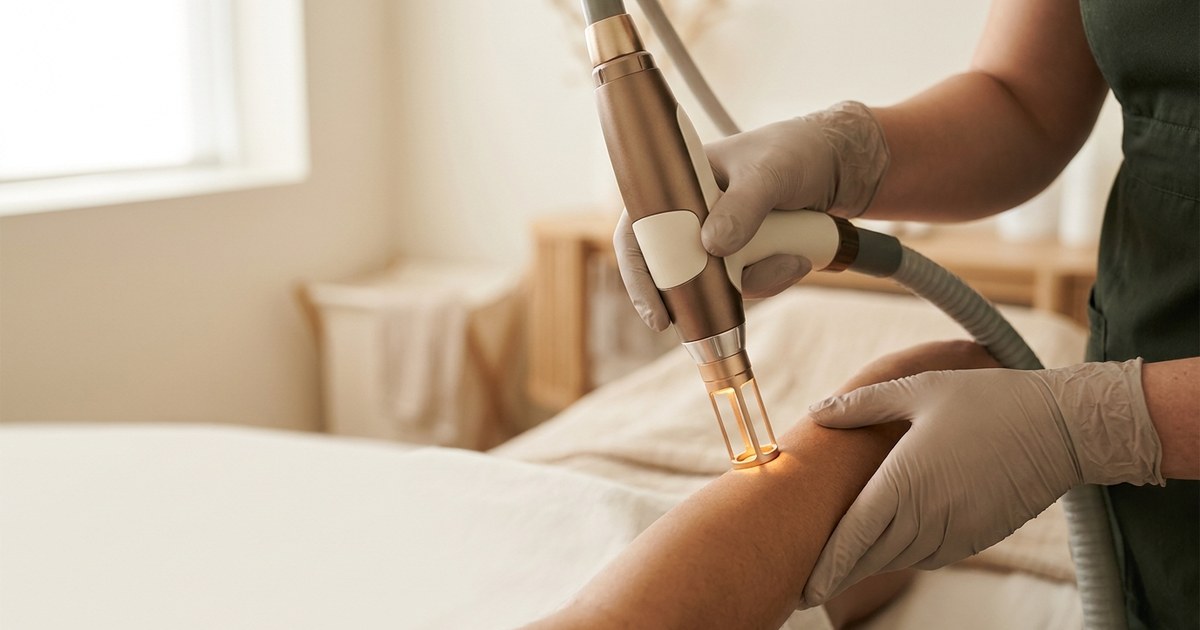
At-home IPL devices use broad-spectrum light with lower power output, making them less effective than medical-grade lasers. Most users see temporary reduction requiring ongoing maintenance instead of permanent results. Professional laser systems deliver focused wavelengths at higher energy levels, safely targeting follicles across all skin tones and achieving 80–90% permanent reduction according to clinical studies after a full series.
If you spent months using an at-home IPL device and saw minimal results, you're not alone. Understanding why at-home IPL didn't work and how professional laser works differently will help you make an informed decision about laser hair removal safe for all skin tones.
By Primary Contact, primary_contact at Sedona Laser
Why At-Home IPL Didn't Deliver the Results You Expected
At-home IPL (Intense Pulsed Light) devices promise permanent hair removal but typically deliver temporary reduction. The difference comes down to light physics and power constraints.
The Marketing vs. the Science: What IPL Actually Does
IPL is not laser. LASER stands for Light Amplification by Stimulated Emission of Radiation. A true laser emits a single, focused wavelength of light. IPL emits a broad spectrum of wavelengths scattered across a wide range.
When light hits your skin, only specific wavelengths target melanin in the hair follicle. A true laser delivers exactly that wavelength. IPL fires multiple wavelengths at once. Much of that energy misses the target, scatters into surrounding tissue, or gets absorbed by surface pigment instead of the follicle root. Less energy reaches the follicle, less permanent damage occurs, and hair regrows within weeks or months.
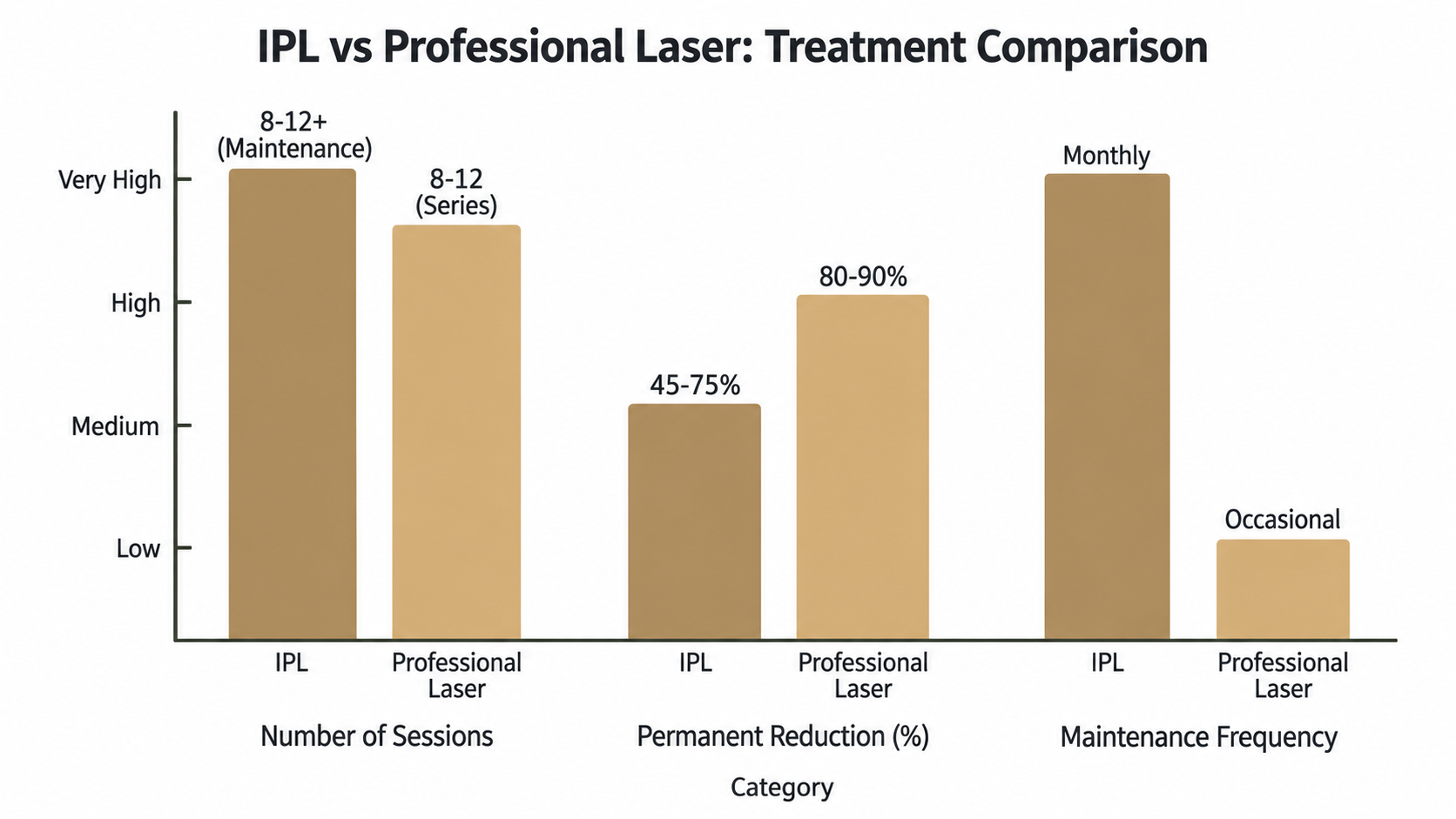
Clinical trials comparing IPL to medical-grade laser consistently show IPL achieves 45–75% temporary reduction versus 85–95% permanent reduction from professional laser systems. IPL failure reasons include wavelength imprecision, insufficient energy delivery, and inability to penetrate deeply enough to disable follicles permanently.
Power Output and Skin Tone Safety Limits
At-home IPL devices are legally capped at lower power to prevent burns in untrained hands. For darker skin tones, this creates a catch-22. Higher melanin levels in the skin compete with hair follicle melanin for light absorption. If the device delivers enough power to disable the follicle, it risks burning the skin. If power is dialed down for safety, the follicle receives insufficient energy and regrows.
That safety ceiling is why at-home devices often carry warnings against use on Fitzpatrick skin types IV through VI. Professional medical-grade lasers solve this with specific wavelengths designed for darker skin, paired with real-time cooling systems that protect the skin surface while delivering therapeutic energy to the follicle.
What Professional Laser Does Differently (And Why It Works)
Professional laser hair removal operates at a fundamentally different level of precision and power. The technology, settings, and clinical oversight combine to deliver outcomes at-home devices cannot match. For those considering professional laser after IPL, understanding these differences is crucial.
Dual-Wavelength Technology: Safe for Every Skin Tone
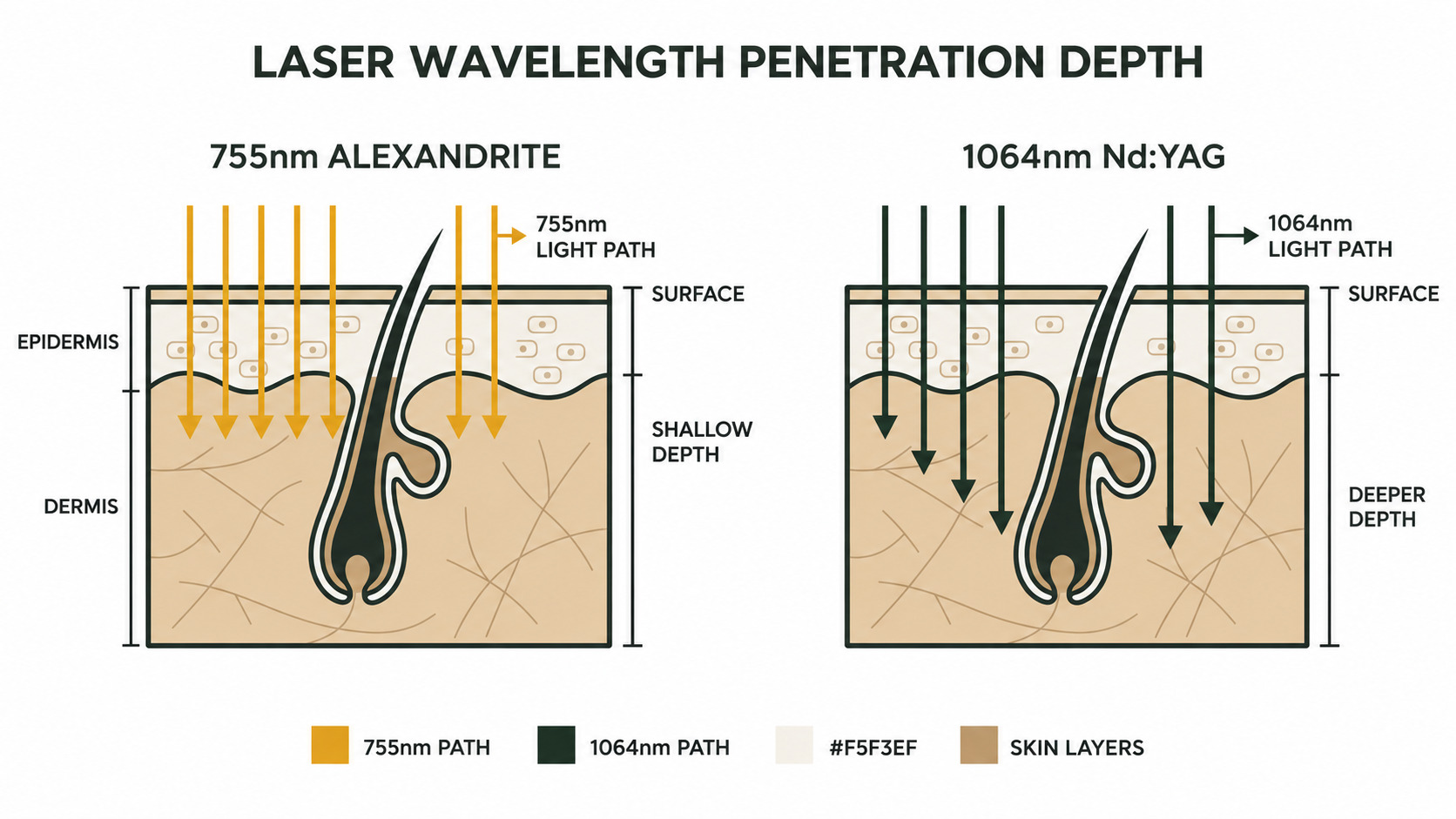
Medical-grade laser systems use single, focused wavelengths chosen for your specific skin tone and hair type. The Cynosure Elite™ platform combines two wavelengths in one system.
755nm Alexandrite targets lighter skin tones (Fitzpatrick I through III) and finer hair. 1064nm Nd:YAG safely treats darker skin tones (Fitzpatrick IV through VI) and coarser hair. The longer wavelength bypasses surface melanin and delivers energy deep into the follicle without burning the skin.
Over 17 years, we've safely performed more than 150,000 procedures across the full Fitzpatrick spectrum. That track record reflects the precision that dual-wavelength technology makes possible.
Zimmer Cryo Cooling: Power Without Pain
Higher power means more heat at the follicle. That heat permanently damages the follicle and prevents regrowth. At-home devices avoid pain by reducing power. Professional systems solve pain with advanced cooling.
The Zimmer Cryo system delivers chilled air onto the skin surface during treatment. The cooling numbs the treatment area and protects the epidermis. That protection allows the practitioner to safely increase laser energy to therapeutic levels without causing discomfort or surface damage. Most patients describe the sensation as a quick warm snap rather than prolonged burning.
Why the Hair Growth Cycle Matters (And Why You Can't Skip Sessions)
Hair grows in three distinct phases. Only one phase responds to laser.
Anagen is the active growth phase. The follicle is connected to the hair shaft, and melanin production is high. Laser energy travels down the shaft, heats the melanin, and damages the follicle structure. This is the only phase where permanent reduction occurs.
Catagen is the transition phase. The follicle shrinks and detaches from the hair shaft. Laser energy cannot reach the follicle.
Telogen is the resting phase. The old hair sheds and the follicle remains dormant. No melanin is present, so laser has no target.
At any given time, only 20–30% of your hair is in anagen phase. That's why a single session, even with perfect settings and equipment, can only treat a fraction of follicles. Understanding the hair growth cycle explains why multiple sessions spaced four to six weeks apart are required. This is one reason why IPL doesn't work long-term: inconsistent or insufficient sessions fail to catch all follicles as they cycle into anagen.
Research on laser hair removal mechanisms confirms that permanent reduction requires targeting follicles across multiple growth cycles.
What to Expect from a Full Professional Series (Realistic Outcomes)
A complete laser hair removal series typically requires eight to twelve sessions spaced four to six weeks apart. The exact number depends on treatment area, hair density, hair color, skin tone, and hormonal factors.
Clinical data from peer-reviewed studies shows that patients completing a full series achieve 80–90% permanent reduction. That outcome is reduction, not removal. A small percentage of follicles may remain active, producing fine, sparse hair that is less noticeable and easier to manage.
Hair shedding begins one to three weeks after each session as damaged follicles release the treated hair. Then, as dormant follicles cycle into anagen, new hair emerges. This is not regrowth from treated follicles. It is untreated follicles entering their active phase. Each subsequent session targets this new anagen-phase hair until the majority of follicles have been disabled.
For a detailed breakdown of session timelines, see how many laser hair removal sessions you need.
Why Technique, Settings, and Equipment Matter as Much as the Technology
Not all clinics deliver equal results, even when using the same laser platform. Three variables determine outcome quality: equipment capability, settings customization, and practitioner skill.
Equipment capability means the laser system itself. Single-wavelength systems limit the range of skin tones and hair types that can be treated safely. Older platforms lack the cooling integration and power control needed for consistent results.
Settings customization means adjusting fluence (energy level), pulse duration, and spot size for each patient's skin tone, hair type, and treatment area. A one-size-fits-all approach produces patchy results or unnecessary discomfort.
Practitioner skill means technique, pacing, and overlap. Proper treatment requires methodical pacing, consistent overlap of pulses, and attention to contour areas where hair growth patterns shift.
At Sedona Laser, the same technician treats you throughout your entire series. That consistency ensures familiarity with your skin response, treatment history, and any adjustments needed as sessions progress.
When Professional Laser May Still Fall Short: Hormones, Hair Color, and Medical Factors
Professional laser is highly effective for most patients, but specific factors can limit or prevent permanent reduction. Understanding these limitations prevents disappointment.
Hormonal conditions such as PCOS (polycystic ovary syndrome), thyroid disorders, or menopause can drive continuous new hair growth even during an active laser series. The laser disables existing follicles, but hormones activate dormant follicles or stimulate new growth in hormonally sensitive areas. Patients with PCOS may require extended series and periodic maintenance.
Hair color affects efficacy because laser targets melanin. Blonde, red, grey, or white hair contains minimal melanin, giving the laser little to no target. These hair colors respond poorly or not at all to laser treatment.
Photosensitizing medications such as certain antibiotics (tetracyclines, fluoroquinolones), retinoids, and some acne treatments increase skin sensitivity to laser energy. Patients on these medications may require lower settings, extended intervals between sessions, or temporary treatment suspension.
Clinical research on laser hair removal outcomes acknowledges these limitations. Transparency about who is not an ideal candidate builds trust and prevents disappointment.
How to Choose a Clinic That Will Deliver the Results IPL Couldn't
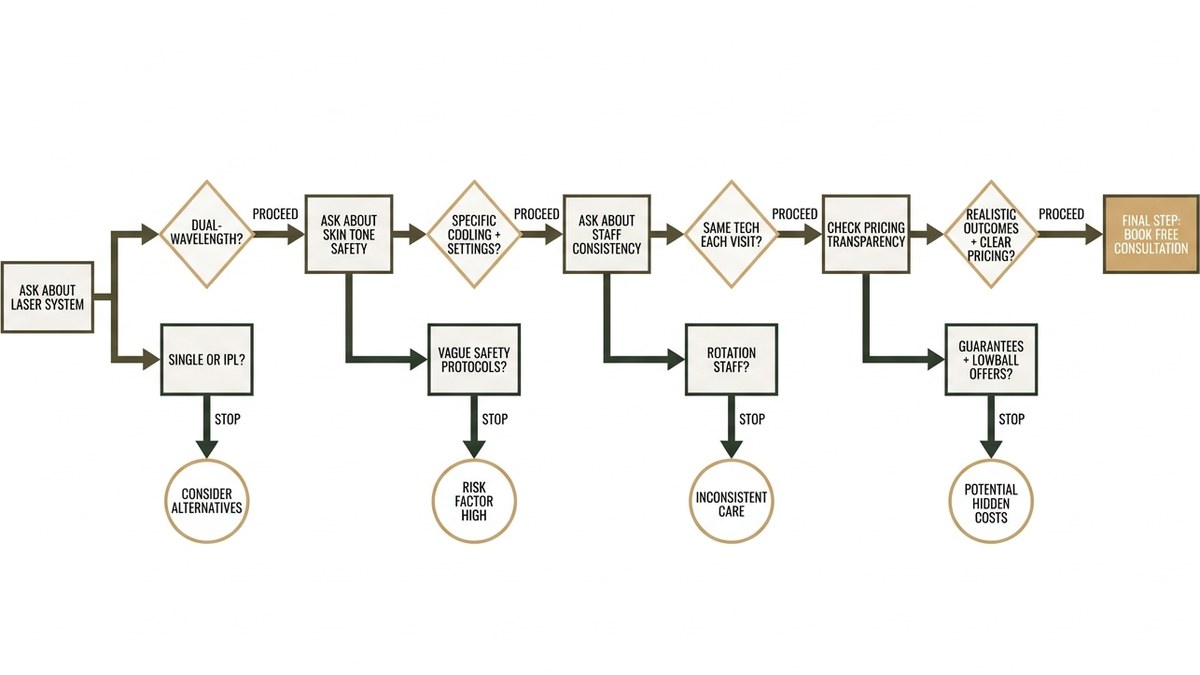
Vetting a laser hair removal provider before booking protects you from repeating the at-home IPL experience. Use this checklist.
Ask what laser system they use. Dual-wavelength platforms (755nm Alexandrite plus 1064nm Nd:YAG) are the current clinical standard for treating the full range of skin tones safely. Single-wavelength systems or IPL devices marketed as laser are red flags.
Confirm they treat your skin tone safely. Request specific details on settings and cooling systems used for darker skin tones. If the response is vague or dismissive, walk away.
Ask about staff consistency. Rotating technicians mean inconsistent technique and no continuity in your treatment plan. You want the same practitioner throughout your series.
Verify transparent pricing and realistic outcome promises. Look for providers who discuss reduction percentages, session ranges, and factors that affect results rather than guarantees that sound too good to be true.
Check for free consultation availability. A provider confident in their expertise and equipment will offer a no-pressure consultation to assess your candidacy, explain the process, and answer questions.
Sedona Laser offers all of the above: dual-wavelength Cynosure Elite™ technology, 17+ years of experience and 150,000+ procedures across all skin tones, the same technician throughout your plan, and a free consultation with no sales pressure. We specialize in two treatments done exceptionally well: laser hair removal and skin tightening. That focus delivers expertise general med spas cannot match. Explore our laser and skin treatments to see what clinical precision looks like.
Conclusion
The difference between temporary results and permanent reduction comes down to wavelength precision, clinical power, and a provider who treats your skin tone safely. At-home IPL uses scattered light and low power. Professional laser uses focused wavelengths and therapeutic energy levels.
You invested time and money in at-home IPL. That investment taught you what doesn't work. Now you have the information to choose what does: dual-wavelength technology, a complete treatment series respecting the hair growth cycle, and a clinic that prioritizes safety and expertise.