
By Sedona Laser
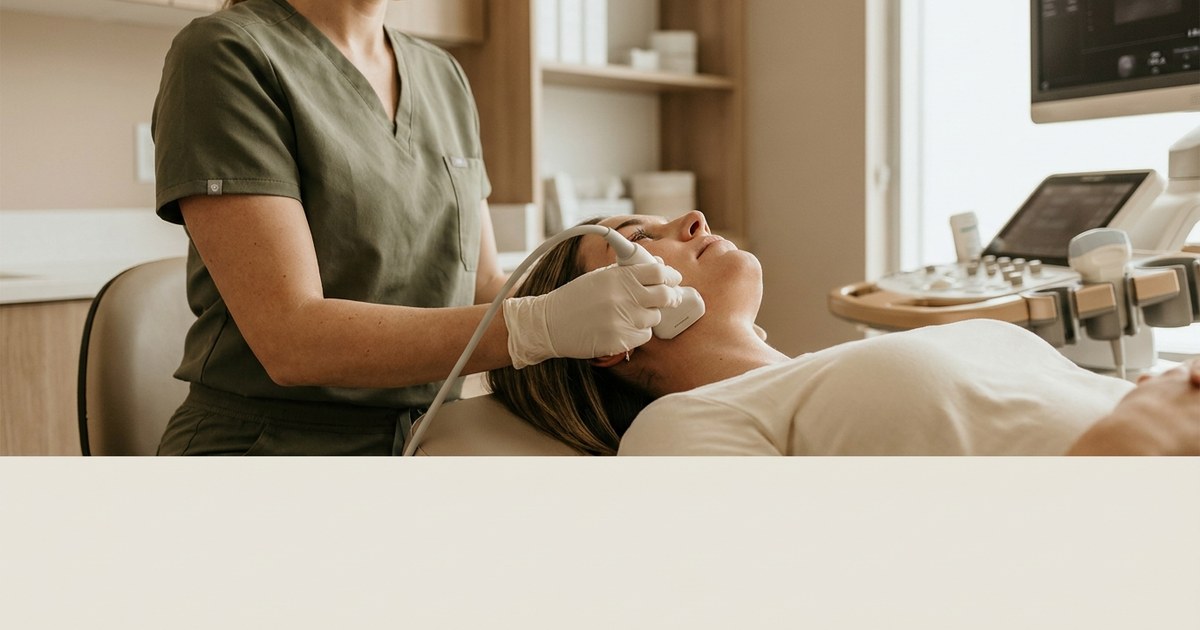
What is Sofwave treatment? Sofwave treatment is a non-invasive, FDA-cleared ultrasound procedure that tightens skin and softens fine lines. It delivers focused energy 1.5mm deep into the mid-dermis while a cooling system protects the surface. That heat prompts new collagen, so results build over about 12 weeks, with no incision, needles, or recovery time.
You look in the mirror and see it. The jawline is a little softer. The neck has lost some of its line. Fine lines stay put even when you are rested. Most people in this spot feel stuck between two choices: do nothing, or book a facelift or a syringe. If you want to keep looking like yourself, neither feels right.
This guide explains Sofwave skin tightening at our Edina clinic in plain terms. We cover how the technology works, how it compares with other tightening methods, what a realistic result looks like, and who should skip it and see a surgeon instead. We offer two treatments: laser hair removal and Sofwave. We do not perform surgery or injections, so we have no reason to push you toward either. We do sell Sofwave, and you should read everything below with that in mind.
One more thing before we start. The FDA's 510(k) premarket notification database, 2026 is the public record of what this device is cleared to do. The core clearance covers fine lines and wrinkles. Read the exact indications there before you rely on any clinic's claims, including ours.
What is Sofwave treatment and how does it work?
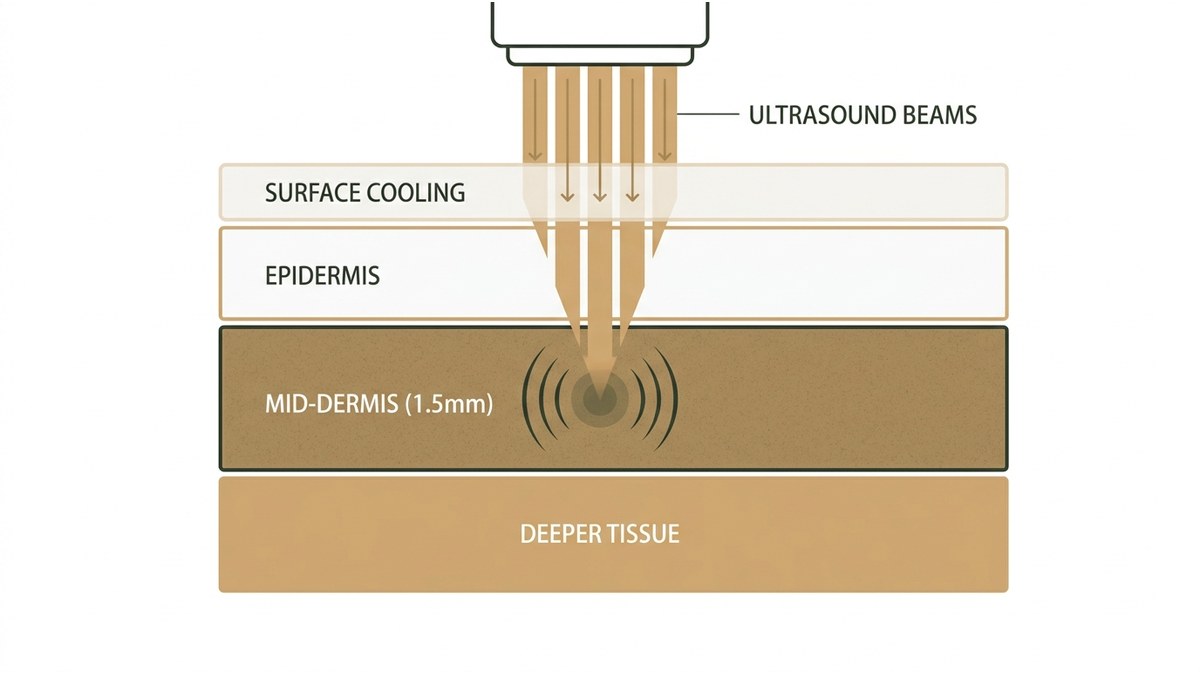
Sofwave treatment is a non-invasive ultrasound procedure for fine lines, wrinkles, and mild to moderate skin laxity. Its SUPERB™ technology (Synchronous Ultrasound Parallel Beam) sends parallel ultrasound beams to a depth of 1.5mm in the mid-dermis, while Sofcool™ protects the surface. The heat stimulates collagen remodeling, so skin firms gradually.
It is not a laser, and it is not a substitute for a facelift. Think of it as a precise way to heat one layer of skin so your body does the rebuilding itself. That is the idea behind clinical results without surgery: the device starts the process, and your own collagen finishes it.
Ultrasound at 1.5mm depth
Skin has layers. The outer layer (epidermis) is thin and protective. Below it sits the dermis, which holds collagen and elastin, the proteins that keep skin firm and springy. Sofwave aims at the middle of the dermis, 1.5mm down.
The SUPERB™ system delivers several parallel ultrasound beams at the same time. Each beam heats a tiny zone at a controlled depth. The device does not depend on light, so it works differently from a laser. The goal is to heat tissue enough to prompt a repair response without harming the surface above it.
Why cooling matters
Heat is only useful where you want it. Sofcool™ cools the skin surface during treatment so energy can build in the mid-dermis without overheating the top layer. This is a large part of why Sofwave asks for no required downtime.
You will usually feel warmth during a session. How strongly varies from person to person, and your technician adjusts to what you tell them.
How collagen builds over time
Skin loses firmness as collagen declines with age, sun exposure, and other factors. The [American Academy of Dermatology on skin aging and collagen loss] [CITATION_NEEDED: American Academy of Dermatology page explaining collagen decline and skin aging] explains why lines and laxity develop gradually rather than overnight.
Sofwave works in the same slow way, in reverse. The controlled heat acts as a signal. Over the following weeks, your skin's repair cells produce new collagen. There is no instant effect. Peer-reviewed research on the technology exists, and you can browse it through PubMed's Sofwave listings, 2026. Check each study's funding disclosures. Early work on many aesthetic devices is manufacturer-supported, and you should weigh it accordingly.
If you want to know what happens week by week, we wrote Sofwave Results Timeline: When You'll See Collagen Regeneration as a companion to this guide.
Takeaway: Sofwave heats the mid-dermis at 1.5mm while the surface stays cooled, and your own collagen does the slow work of tightening.
How does Sofwave differ from other tightening technology?
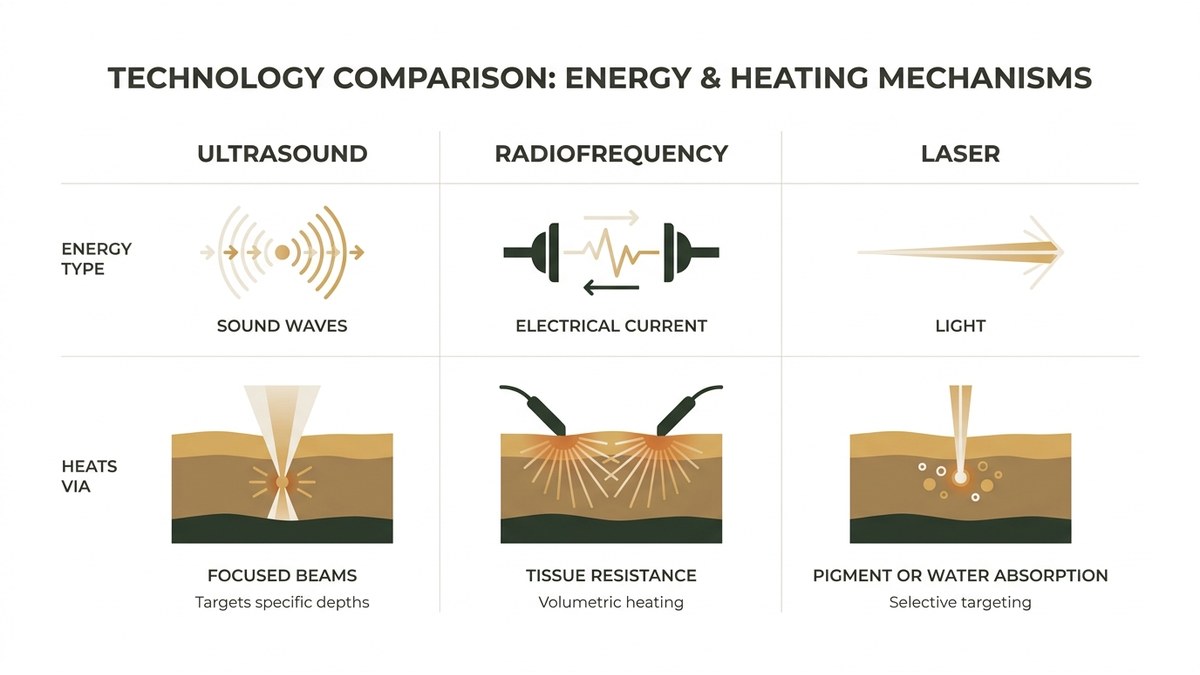
Most skin tightening technologies heat the dermis so the body builds new collagen. They differ in how the heat is delivered, how deep it goes, and how much control the operator has. Sofwave uses ultrasound at a set depth of 1.5mm with built-in surface cooling.
If you have searched for non-invasive skin tightening, you have seen three broad families: radiofrequency, laser-based, and ultrasound. They are not interchangeable.
Ultrasound vs radiofrequency
Radiofrequency (RF) devices pass electrical current through tissue. Heat builds where the tissue resists that current. The depth and spread of heating depend on the device, the settings, and the tissue in the path.
RF has a long track record in aesthetics. The [Cleveland Clinic or Mayo Clinic explainer on radiofrequency skin tightening] [CITATION_NEEDED: Cleveland Clinic or Mayo Clinic consumer explainer on radiofrequency skin tightening and how it heats tissue] is a neutral place to read the basics. Ultrasound takes a different route. It delivers mechanical energy in focused beams to a defined depth.
For a head-to-head look, read Sofwave vs. RF and Laser Skin Tightening: Which Technology Is Right for You? We keep the deep comparison there so this guide stays broad.
Ultrasound vs laser-based tightening
Lasers use light. That light is absorbed by something in the skin, usually water or pigment. Non-ablative lasers heat the tissue below the surface. Ablative lasers remove layers of skin, which can mean a longer recovery.
Ultrasound is not light, so it does not rely on pigment absorption in the same way. Skin type still gets assessed at consultation. We would rather confirm fit with you in person than make a blanket promise in an article.
What ultrasound skin tightening technology means for you
Not every ultrasound skin tightening technology is built for the same job. Some systems are designed to reach deeper tissue layers. Sofwave is designed for the mid-dermis, which suits fine lines, texture, and mild to moderate laxity.
So "which technology is best" is the wrong question. A better one is "which problem do I have?" If you search for Sofwave in the Twin Cities, you will find very few providers. That scarcity can make the technology sound more magical than it is. It is a well-built tool with a defined job, and we describe it that way.
Takeaway: Ultrasound, RF, and lasers each heat skin differently, and the right choice depends on the problem you want to treat.
Can Sofwave replace a facelift or injectables?
For fine lines and mild to moderate laxity, Sofwave is a reasonable non-surgical alternative to a facelift. It does not remove excess skin or reposition deeper tissue, so it cannot match a surgical facelift. A consultation should tell you honestly which side of that line your skin falls on.
Plenty of pages online oversell this. They imply that ultrasound can do what a surgeon does. It cannot. What it can do is firm and smooth skin that has not yet reached the point where surgery is the right answer, with no recovery period.
We have a plain position here. We do not sell surgery or injectables, so we gain nothing by steering you away from them. We do sell Sofwave, so we gain something if you choose it. That is why we lay out the full map below.
Match the problem to the tool
This is the framework we use in consultations. Start with what you see, then match it to what is usually behind it.
| What you see | Usually behind it | Common tools | Where Sofwave fits |
|---|---|---|---|
| Hollow cheeks or temples | Volume loss | Filler, fat transfer, surgery | Does not replace volume |
| Lines that deepen when you frown or squint | Muscle movement | Neuromodulators such as Botox | Not a substitute |
| Fine lines, crepey or dull texture | Collagen decline in the dermis | Energy-based treatments | Good fit |
| Soft jawline, early laxity | Collagen decline, mild looseness | Energy-based tightening | Reasonable fit |
| Heavy jowls, visible excess skin, neck bands | Tissue descent and excess skin | Surgery | Not a substitute |
Many people have more than one of these at once. That is normal, and it is why one tool rarely does the whole job.
Where surgery still wins
Surgery wins when there is a lot of loose skin or when deeper tissue has dropped. A facelift lifts and repositions tissue and removes excess skin. No ultrasound device does that.
Surgery also comes with real trade-offs: incisions, anesthesia, and a recovery period measured in weeks. The [Cleveland Clinic overview of facelift (rhytidectomy) recovery and risks] [CITATION_NEEDED: Cleveland Clinic Health Library page on facelift (rhytidectomy), what it involves, recovery and risks] is a neutral place to read what that involves.
Surgery remains a large category. The American Society of Plastic Surgeons' annual statistics, 2026 track facelift and non-surgical procedure trends year to year. If your concern is advanced laxity, a surgical opinion is worth getting before you spend money on anything else.
Can you combine Sofwave with Botox or filler?
Yes, many people do. Energy-based tightening, neuromodulators, and filler solve different problems, so they can complement each other. We do not perform injections. If you already see an injector, your two providers can coordinate timing.
Injectables carry their own risks. The FDA's consumer page on dermal fillers, 2026 lists risks that range from swelling and bruising to rare but serious complications if product enters a blood vessel. Choose a qualified injector, and ask them how they would sequence treatments around Sofwave.
If you want to understand how combined plans are usually structured, we cover it in the FAQ below.
So the honest answer to "can Sofwave replace surgery or injectables?" is: sometimes, for the right problem. Fine lines and mild laxity respond to Sofwave. Volume loss and heavy excess skin do not. See the laser and skin treatments we offer in Edina, MN to understand what we do and do not provide.
Takeaway: Sofwave is a credible non-surgical option for fine lines and mild to moderate laxity, but it does not replace a facelift or filler for the problems those treatments solve.
How long does Sofwave take to work?
Results build gradually as collagen regenerates and are typically judged at about 12 weeks. A session runs roughly 30 to 45 minutes, and most patients need one or two. Outcomes vary with age, skin condition, and the area treated.
That 12-week window is the part people dislike most. You do not walk out looking different. You wait, and the change shows up quietly.
Here is a realistic way to think about it. Early on, your skin may feel the same. Over the following weeks, collagen regeneration continues. By about 12 weeks, you and your technician compare photos to judge what changed. Published studies commonly assess outcomes at around the three-month mark [CITATION_NEEDED: peer-reviewed Sofwave study (e.g., Journal of Cosmetic Dermatology or Lasers in Surgery and Medicine) with 12-week follow-up, noting any manufacturer funding].
Photos matter here. We take baseline photos so you are not relying on memory, which is unreliable when changes are gradual. If you want to see what real results can look like, read Sofwave Before and After: Real Jawline, Neck, Fine Line Results.
What can results do? Expect firmer-feeling skin, smoother texture, and softer fine lines. What can they not do? They will not erase deep creases, remove loose skin, or restore lost volume. We make no guarantees, and any clinic that does is selling hype. Results vary by person, and skin continues to age after treatment.
If your skin is at the stage where Sofwave fits, the subtle, gradual change is the point. People often say they look rested rather than "done." That is a fair goal for a non-invasive treatment.
Takeaway: Plan for a gradual change judged at about 12 weeks, and use baseline photos so you can see it.
Sofwave session: what happens, and is there downtime?
Sofwave has no required downtime. Sessions run about 30 to 45 minutes, and patients return to normal activity afterward. Some feel warmth during treatment, and mild, temporary redness is possible. Your technician explains what to expect at your consultation.
Here is the typical flow.
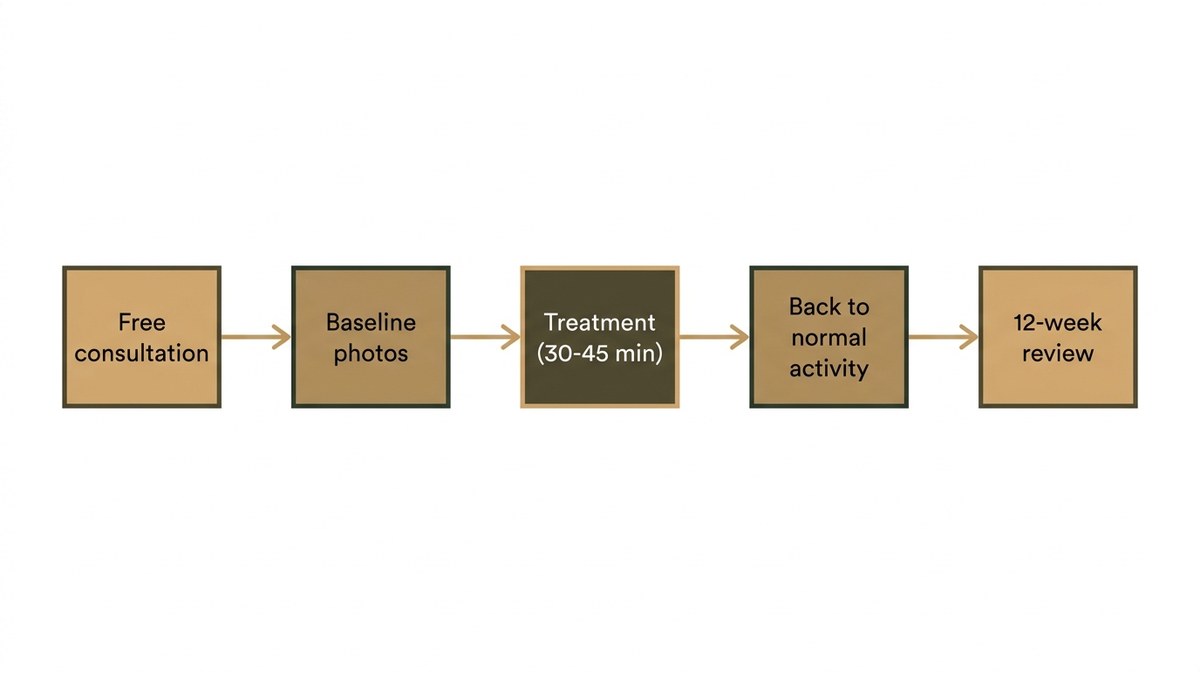
Before. You meet your technician, talk through your goals, and review your history. We take baseline photos and mark the areas to treat. Treatable areas include the mid-face, brow, neck, and jawline.
During. The handpiece moves across the treatment area. Most people feel warmth. Sensation varies, so tell your technician how it feels and they will adjust.
After. You go back to your day. Mild, temporary redness is possible. There is no recovery period to plan around.
How many sessions. Most patients need one or two. Your technician will tell you honestly whether a second session makes sense after your skin has had time to respond.
Consistency matters to us. In our experience, treatment goes better when the same technician sees you throughout, because they know your skin and your baseline. We have been operating since 2008, with more than 17 years in practice and more than 150,000 procedures completed. Most of those are laser hair removal, and we do not imply otherwise. What carries over is the discipline: precise protocols, careful documentation, and honest recommendations.
If you already visit us for laser hair removal, you may be able to pair appointments. We describe how the two fit together in Sofwave Skin Tightening in Edina: Complement Your Laser Hair Removal Results. It is an option, not a pitch.
Takeaway: A Sofwave session is short, comfortable for most people, and leaves no recovery period to plan around.
Who should consider Sofwave, and who shouldn't?
Good candidates are adults with fine lines and mild to moderate laxity in the mid-face, brow, neck, or jawline who want to avoid surgery. People with significant loose or excess skin may need a surgical opinion. Suitability depends on skin type and condition, confirmed at consultation.
Use this quick self-check as a starting point, not a diagnosis.
Sofwave may be worth discussing if:
- You see fine lines or crepey texture and want them softer.
- Your jawline or neck has loosened slightly, but skin still has some elasticity.
- You want no incision, no needles, and no recovery period.
- You are comfortable waiting about 12 weeks for gradual change.
A surgical opinion is worth getting first if:
- You have heavy jowls or a lot of visible excess skin.
- You want results that show immediately.
- Your main concern is lost volume in the cheeks or temples.
- You want a result comparable to a facelift.
We want to be honest about the second list. If your skin falls there, we will tell you at the consultation and point you toward the right kind of provider. A free consultation is only useful if it ends in an honest answer, including "this is not for you."
Skin type and medical history matter. We review your history, any implants or devices, medications, and skin conditions in the treatment area before recommending anything. Our clinic is inclusive of all skin tones, genders, and sexualities. We assess each person individually and do not make blanket calls from a web page. The [American Academy of Dermatology's guidance on choosing a qualified provider] [CITATION_NEEDED: American Academy of Dermatology guidance on how to choose a qualified provider for cosmetic procedures] is a good neutral checklist for any treatment.
For a fuller breakdown, see Is Sofwave Right for You? Honest Candidate Assessment and Skin Type Fit Guide.
Takeaway: Sofwave suits fine lines and mild to moderate laxity, and anyone with heavy excess skin should get a surgical opinion first.
Why is Sofwave rare in the Twin Cities?
Sofwave systems need a major capital investment and manufacturer training, and the patient base for a premium non-invasive treatment is narrow, so few clinics carry one. Sedona Laser is one of very few local providers.
You may have asked yourself why you have never seen this offered near you. The answer is not mystery. It is economics and expertise.
The device costs a lot. A clinic must buy the system before treating a single patient. A practice that cannot fill a schedule with the right patients will not take that risk.
Training takes time. A technician needs manufacturer training to use the device well. We would rather invest in that than offer a service we have not mastered. It fits how we work. We focus on two treatments and do them carefully, rather than adding every new device that arrives.
The audience is specific. A premium, non-invasive treatment with gradual results appeals to a narrower group than a quick-fix service. Many clinics decide the math does not work.
For the Twin Cities angle, read why we offer Sofwave locally in the Twin Cities.
Scarcity is not a quality signal on its own. If a clinic offers Sofwave, ask who performs the treatment, what training they have completed, and how many sessions they have delivered. Ask whether they will tell you when you are not a good candidate. Those answers matter more than whether a device is rare. For the deeper business side, see Sofwave Scarcity: Capital Cost and Training Barriers Explained.
Takeaway: Sofwave is rare locally because of device cost, training, and a narrow patient base, and rarity alone is not a reason to trust a provider.
What does Sofwave cost, and how do you start?
Sofwave pricing depends on the area treated and the number of sessions recommended. We cover exact pricing openly and in person at a free consultation, with no package pressure. You leave with a plan and a number, and you decide on your own time.
We keep pricing in the consultation for a reason. A fair price depends on what you need, and what you need depends on your skin. Quoting a flat figure online without seeing you would be guesswork, and we would rather give you a number that applies to you.
Here is how starting works.
- Book a free consultation. Call us or request an appointment online. It is a conversation, not a sales presentation.
- Get an honest assessment. Your technician reviews your goals, history, and skin, then tells you whether Sofwave fits. If it does not, we say so.
- Receive a plan. You hear how many sessions we recommend, what areas we would treat, and what it costs.
- Decide. Take the time you need. There is no obligation.
- Treat and review. If you go ahead, treatment is one or two short sessions, followed by a review at about 12 weeks.
To see what the first visit looks like in detail, read What Happens During Your Sofwave Consultation at Sedona.
Bring your questions, including the awkward ones. Ask what Sofwave cannot do for you. A good consultation should make you more informed, even if you walk out without booking.
Takeaway: Start with a free, zero-pressure consultation where you get an honest assessment and a clear price before deciding anything.
Sofwave FAQs
Does Sofwave actually work?
For fine lines and mild to moderate laxity, Sofwave can produce visible improvement as collagen builds over about 12 weeks. It does not remove excess skin or restore lost volume. Results vary by person, which is why we set expectations at consultation.
How long do Sofwave results last?
Skin keeps aging after treatment, so results are not permanent. How long improvement lasts varies by person, age, and skin condition. Your technician can talk through what follow-up might make sense for you.
Is Sofwave safe, and does it hurt?
Sofwave is FDA-cleared, and the surface is cooled during treatment. Most people feel warmth, and sensation varies. Mild, temporary redness is possible. Tell your technician if anything feels uncomfortable, and they will adjust.
Can I combine Sofwave with Botox or filler?
Often yes, because the treatments solve different problems. We do not perform injections, so your injector and our team would coordinate timing. For one approach to sequencing, read Sofwave with Botox & Filler: Can You Combine Them Safely?
Takeaway: Honest answers to common questions come down to the same point: Sofwave works well within its limits, and your consultation sets the right expectations.
The honest bottom line
Sofwave treatment is a good option if your concern is fine lines, texture, or mild to moderate laxity and you want to avoid surgery. It is not a facelift, and it will not fix volume loss or heavy excess skin. If that is your situation, a surgeon is the right next call, and we will tell you so.
If you fall in the middle, Sofwave gives you a way to firm skin with no incision, no needles, and no recovery time. The trade-off is patience: results build over about 12 weeks.
This article is educational and is not medical advice. Individual results vary, and a consultation is the right way to find out what fits your skin.
If you want an honest read on whether Sofwave fits your skin, start with a free consultation. Book now