

Nd:YAG (1064nm) is the safe, FDA-cleared standard for medium-dark to dark skin tones (Fitzpatrick IV–VI) because its longer wavelength reduces melanin absorption in the epidermis, minimizing burn risk. Alexandrite (755nm) is highly effective for light to medium skin (Fitzpatrick I–III) due to faster melanin targeting, but poses injury risk on darker skin. Dual-wavelength systems treat all skin types safely.
When researching laser hair removal, you will encounter two wavelengths repeatedly: 755nm (Alexandrite) and 1064nm (Nd:YAG). Clinics make competing claims about which laser "works best," but rarely explain why wavelength matters or what it means for your specific skin tone. The truth is simple. Wavelength determines safety and results for your melanin density. Choose wrong, and you risk burns or ineffective treatment. Choose right, and you achieve permanent hair reduction with minimal risk. This guide explains how wavelength interacts with skin melanin, which Nd:YAG vs. Alexandrite laser is safe for your skin tone, and why dual-wavelength systems are the clinical standard for medical-grade laser and skin treatments.
How Laser Wavelength Interacts With Skin Melanin
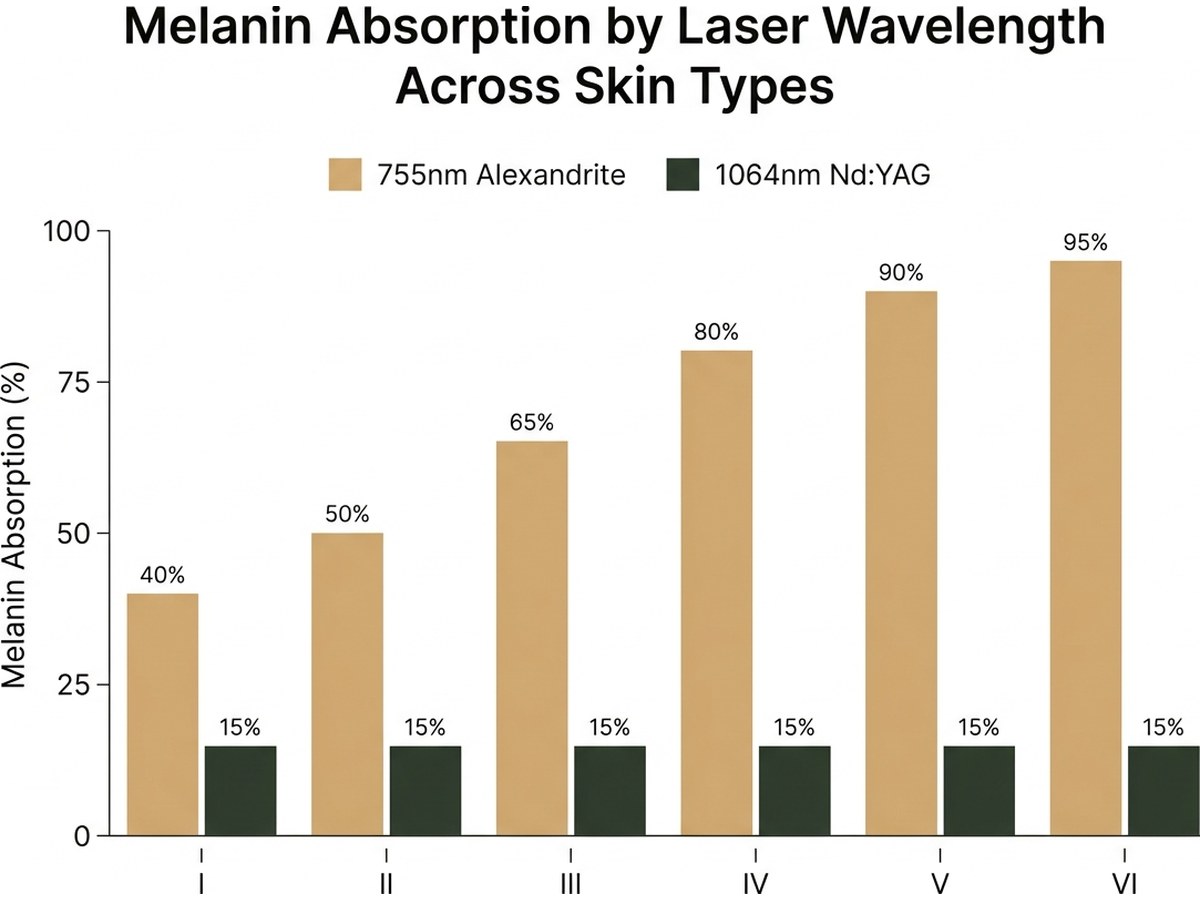
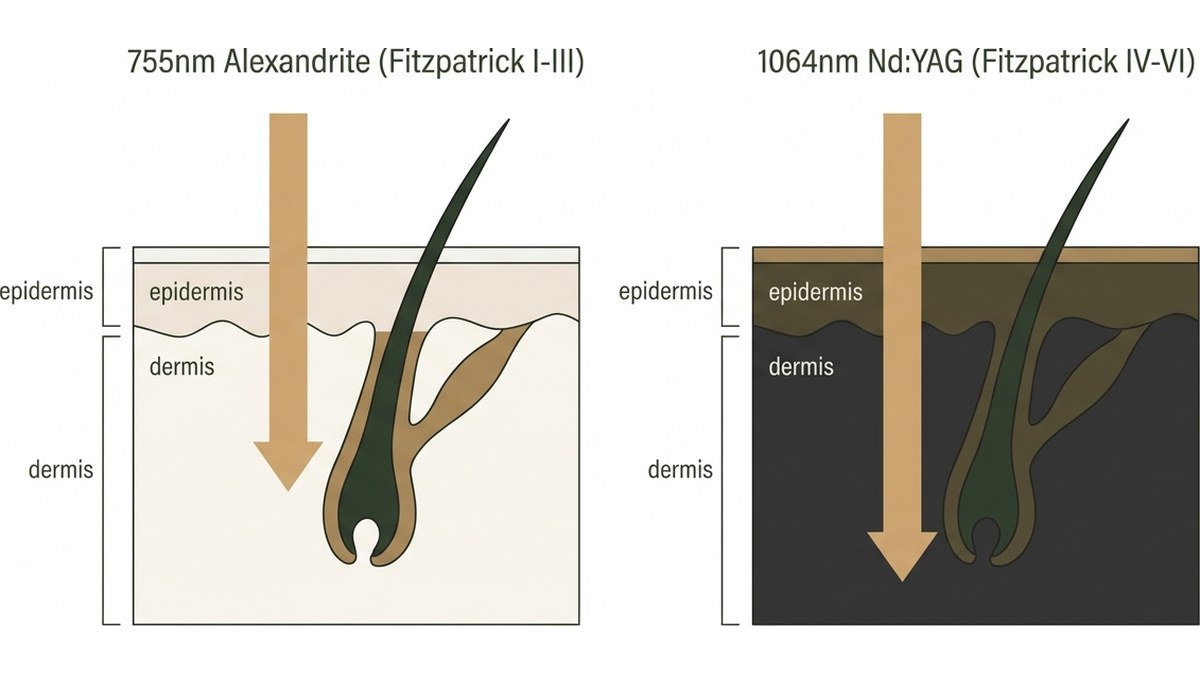
Laser wavelength is measured in nanometers (nm). It determines how deeply energy enters skin and how much melanin absorbs that energy. Shorter wavelengths are absorbed more readily by melanin in the outer layer of skin (the epidermis). Longer wavelengths go deeper and are absorbed less by surface melanin. This means more energy reaches the hair follicle itself.
These physics drive safety. When you have more melanin in your epidermis (as with medium to dark skin tones), a shorter wavelength delivers too much energy to the skin surface. This can cause burns and dark spots. A longer wavelength passes through surface melanin. It targets the pigmented hair follicle without overheating surrounding tissue. According to peer-reviewed research on laser interaction with skin, wavelength selection is the main variable that determines safety for patients with darker skin tones.
The hair follicle contains melanin (pigment). It absorbs laser energy and converts it to heat. This destroys the follicle's ability to produce hair. The goal is selective photothermolysis: heat the follicle while leaving surrounding skin intact. Wavelength determines whether you achieve that selectivity or overheat the epidermis. This is why matching wavelength to skin tone is not a preference. It is a medical safety requirement for effective laser hair removal.
Alexandrite Laser (755nm): Fast and Effective for Light to Medium Skin Tones
The 755nm Alexandrite wavelength is highly effective for patients with light to medium skin tones (Fitzpatrick I through III). Its shorter wavelength is absorbed readily by melanin. This makes it fast and precise when the hair follicle contains more pigment than the surrounding skin. Treatment sessions are faster than longer-wavelength lasers because the energy is absorbed quickly.
Alexandrite works well on these skin tones because the contrast between hair pigment and skin melanin is high. The laser targets the darker follicle without overheating lighter skin. Clinical studies confirm Alexandrite's strong results on lighter skin. Many patients achieve 80 to 90 percent permanent reduction after a full treatment series when treated with the proper wavelength for their skin type.
The limitation is clear. Alexandrite poses burn risk on Fitzpatrick IV and darker skin. Surface melanin absorbs too much energy. This can cause dark spots, blistering, or scarring. Clinics that only offer Alexandrite cannot safely treat medium-dark to dark skin tones. If you have darker skin and a provider recommends Alexandrite, ask which wavelength they use and whether they have Nd:YAG capability. If the answer is no, find a clinic that does. Understanding the differences between laser systems for dark skin is critical for safety.
Nd:YAG Laser (1064nm): The Safe Standard for Medium-Dark to Dark Skin Tones
The 1064nm Nd:YAG wavelength is the FDA-cleared standard for safe hair removal on medium-dark to dark skin tones (Fitzpatrick IV through VI). Its longer wavelength goes deeper into the dermis. It is absorbed less by surface melanin, allowing energy to reach the hair follicle without overheating the epidermis. Research on laser safety confirms Nd:YAG as the safe choice for darker skin. When used at appropriate settings, it carries minimal risk of burns or dark spots.
Nd:YAG works by passing through melanin-rich skin and delivering energy to the pigmented follicle at the dermal level. The lower melanin absorption in the epidermis means the skin surface stays cooler. This reduces injury risk significantly. This is critical for patients who have been turned away by other clinics or told that laser "won't work" for them. It will work when the correct wavelength is used. Knowing when Nd:YAG is required prevents unnecessary injury and delivers results other wavelengths cannot.
The trade-off is treatment speed. Nd:YAG sessions take slightly longer per area than Alexandrite because the wavelength is absorbed less readily. But this is the clinical standard for inclusive care. A few extra minutes per session is a minor inconvenience compared to the safety margin Nd:YAG provides. If you have medium-dark to dark skin and a clinic does not offer Nd:YAG, they cannot treat you safely.
Why Dual-Wavelength Systems Are the Clinical Best Practice
The false choice between speed and safety disappears when a clinic uses a dual-wavelength platform. The Cynosure Elite™ system combines 755nm Alexandrite and 1064nm Nd:YAG in one device. This allows the clinician to match the wavelength to the patient's skin tone on the same visit. Light skin receives Alexandrite for fast treatment. Medium-dark to dark skin receives Nd:YAG for safe treatment. No patient is turned away.
At Sedona Laser Center, we use the Cynosure Elite™ dual-wavelength system across all 150,000+ procedures performed over 17+ years. This allows us to treat every skin tone safely (from Fitzpatrick I through VI) without turning patients away. This is the specialist standard. Single-wavelength clinics either limit their patient population or put darker-skinned patients at risk. Dual-wavelength systems solve both problems.
Contrast this with IPL providers or single-wavelength clinics. IPL devices use broad-spectrum light (not a true laser). They are less effective and less safe, particularly on darker skin. Cleveland Clinic research confirms medical-grade laser delivers superior results compared to at-home IPL devices. These lack the precision and energy control required for permanent reduction. Single-wavelength clinics can serve one segment well but exclude others. Dual-wavelength systems are the inclusive standard when comparing Nd:YAG vs. Alexandrite laser options for professional treatments in Edina, MN.
Common Misconceptions: Why "All Lasers Are the Same" Is False (and Dangerous)
You will encounter claims that all professional lasers deliver the same results. You may also hear that IPL is equivalent to medical-grade laser. Both are false. Wavelength is the defining variable. A clinic using only Alexandrite cannot safely treat darker skin. A clinic using only IPL cannot deliver the precision required for permanent reduction on any skin tone.
IPL devices emit broad-spectrum light across multiple wavelengths (500 to 1200nm). This makes them less precise than single-wavelength lasers. They lack the energy density and wavelength control required for selective photothermolysis. This is why at-home IPL devices often fail to deliver permanent results. They cannot generate the energy or precision needed to destroy the follicle without overheating skin.
Some clinics promote diode lasers (typically 810nm) as versatile across skin types. Diode sits between Alexandrite and Nd:YAG in wavelength. It can treat a broader range than Alexandrite alone. But dual-wavelength systems remain the specialist standard because they allow precise matching: Alexandrite for speed on light skin, Nd:YAG for safety on dark skin. A single middle-ground wavelength is a compromise, not an optimization.
Ask any provider: "Which wavelength do you use, and do you have dual-wavelength capability?" If they cannot answer or claim all lasers are equivalent, find a clinic that understands the physics.
How to Choose the Right Wavelength for Your Skin Tone
Use this decision framework. If you have light to medium skin (Fitzpatrick I through III), Alexandrite (755nm) is safe and effective. If you have medium-dark to dark skin (Fitzpatrick IV through VI), Nd:YAG (1064nm) is required for safety. If a clinic offers only one wavelength, they cannot serve all patients safely. The choice between Nd:YAG vs. Alexandrite laser should be based on clinical assessment of your skin tone.
When evaluating providers, ask three questions. Which wavelength do you use? Do you have dual-wavelength capability? How many procedures have you performed on my skin tone? A clinic with dual-wavelength technology and deep experience across all Fitzpatrick types can match the right laser to your melanin density without guesswork. Understanding how many sessions you'll need for your specific skin and hair type also helps you evaluate provider expertise.
Avoid clinics that make vague claims about "advanced technology" without naming the wavelength or model. Precision matters. The Cynosure Elite™ dual-wavelength system is the clinical standard for a reason: it eliminates the false choice between speed and safety.
Conclusion
Wavelength determines safety and results. Nd:YAG (1064nm) is the safe, FDA-cleared standard for medium-dark to dark skin tones because it reduces melanin absorption in the epidermis and minimizes burn risk. Alexandrite (755nm) is highly effective for light to medium skin due to faster melanin targeting, but poses injury risk on darker skin. Dual-wavelength systems like the Cynosure Elite™ allow clinics to treat all skin types safely, without turning patients away or compromising on safety.
At Sedona Laser Center, we have performed 150,000+ procedures over 17+ years using dual-wavelength technology. We match the wavelength to your skin tone on the first visit. We deliver permanent reduction with minimal risk. We educate you on what to expect at every step. No vague promises. No exclusions. Just clinical precision and honest answers.
Book Your Free Consultation or call (952) 929-4404 to determine which wavelength is right for your skin tone.