
By Sedona Laser
Laser hair removal and IPL (Intense Pulsed Light) are not the same technology. Laser systems emit a single, focused wavelength (755nm or 1064nm) that targets melanin in the hair follicle with clinical precision, delivering 80–90% permanent reduction after a full series. IPL devices use broad-spectrum light across multiple wavelengths, making them less precise, less effective on coarse or light hair, and riskier for darker skin tones. Medical-grade lasers require trained operators and FDA-cleared equipment; most IPL devices are sold for home use with minimal regulatory oversight.
You bought the at-home IPL device because it looked like a shortcut. Two hundred dollars, no appointments, no commitment. Eight weeks later, your bikini line still grows back every three days. The device manual said "laser hair removal," but the results don't match the promise. That's because it isn't a laser at all.
The difference between true laser hair removal and IPL isn't marketing spin. It's wavelength physics. And wavelength determines everything: safety, permanence, skin-tone compatibility, and whether you're still shaving six months from now.
What Laser Hair Removal and IPL Actually Are (and Why the Terms Aren't Interchangeable)
The confusion starts with the word "laser." Home IPL devices use it on their packaging. Influencers use it in reviews. Even some med spas blur the line. But laser and IPL are fundamentally different energy sources.
A true laser emits a single, coherent wavelength of light. That wavelength is chosen specifically to match the absorption spectrum of melanin in the hair follicle. The beam travels in one direction, penetrates to a precise depth, and converts to heat only when it encounters melanin. This is called selective photothermolysis: the laser selectively targets the pigment in the follicle without scattering energy into surrounding tissue.
IPL emits a broad spectrum of wavelengths (400nm to 1200nm) all at once. It's filtered light, not a laser beam. Because multiple wavelengths are present, the energy scatters. Some wavelengths are absorbed by surface melanin in the skin. Some bounce off. Some penetrate to the follicle. The result is lower precision, higher risk of burns on darker skin, and inconsistent reduction outcomes. Wavelength specificity is the clinical variable that directly determines follicle damage efficacy, and professional laser systems consistently outperform IPL on that measure.
How True Laser Technology Works
A medical-grade laser (Alexandrite, Nd:YAG, or diode) produces a single wavelength at a controlled energy level called fluence (joules per square centimeter). The wavelength is chosen based on the patient's skin tone. The pulse duration is set to match the thermal relaxation time of the hair follicle. Cooling is applied before, during, or after the pulse to protect the epidermis.
The melanin in the hair shaft absorbs the laser energy. The energy converts to heat. The heat destroys the hair follicle's ability to produce new hair. Surrounding skin remains cool because the wavelength doesn't target it. A 2010 study published in PMC confirmed that precise wavelength selection (particularly 755nm Alexandrite for lighter skin and 1064nm Nd:YAG for darker skin) is the clinical variable that predicts permanent reduction outcomes.
The entire treatment is adjusted per patient, per session. Skin tone changes with sun exposure. Hormone shifts affect hair growth cycles. A trained operator recalibrates fluence, spot size, and pulse duration every time. That's not possible with a consumer device.
How IPL Technology Works
IPL devices use a xenon flash lamp to emit a broad band of light. Filters block some wavelengths, but hundreds of nanometers are still present in the pulse. The energy spreads over the treatment area. Because there is no single wavelength, there is no selective absorption. Melanin in the epidermis (skin surface) competes with melanin in the follicle for that energy.
On lighter skin tones, IPL can produce some temporary hair reduction. On darker skin tones, the broad spectrum increases the risk of burns, hyperpigmentation, and uneven results. The device has no way to differentiate between melanin you want to target (follicle) and melanin you want to protect (skin).
Most at-home IPL devices operate at 3 to 6 joules per square centimeter. Medical-grade lasers operate at 10 to 40 joules depending on skin tone and treatment area. Lower fluence means less energy reaching the follicle. Less energy means temporary reduction instead of permanent destruction.
Why Wavelength Precision Determines Permanent Reduction
Wavelength is not a detail. It's the mechanism. Melanin absorbs light most efficiently at specific wavelengths. The right wavelength delivers energy to the follicle without damaging the skin. The wrong wavelength scatters, burns, or does nothing.
Medical-grade laser systems use one of three wavelengths: 755nm (Alexandrite), 810nm (diode), or 1064nm (Nd:YAG). Each wavelength penetrates to a different depth and has a different affinity for melanin. A patient with pale skin and dark hair responds best to 755nm. A patient with dark skin requires 1064nm to avoid epidermal damage.
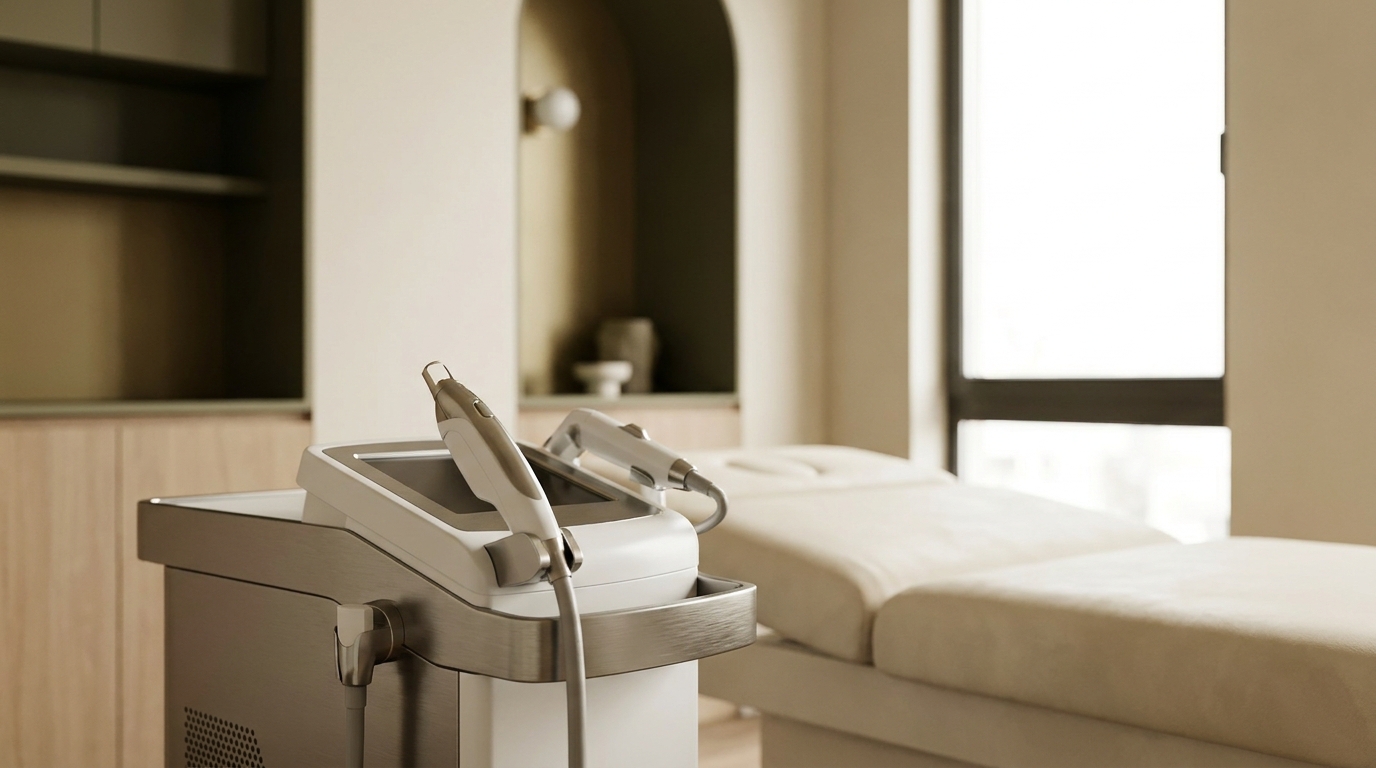
Sedona Laser uses the Cynosure Elite™ dual-wavelength system. One handpiece emits 755nm Alexandrite. The other emits 1064nm Nd:YAG. That allows the same device to treat Fitzpatrick skin types I through VI safely. IPL devices cannot replicate that adaptability because they don't operate at discrete wavelengths.
755nm Alexandrite: High Absorption for Light-to-Medium Skin Tones
The 755nm Alexandrite wavelength is the gold standard for patients with Fitzpatrick skin types I through III (pale to light brown skin with minimal sun exposure). This wavelength has the highest melanin absorption coefficient of any hair-removal laser. It penetrates 1 to 2 millimeters into the dermis, deep enough to reach the hair bulb.
Because melanin absorption is so efficient at 755nm, less total energy is required to disable the follicle. Sessions are faster. Side effects are minimal. The tradeoff is that this wavelength cannot be used safely on darker skin tones. The melanin in the epidermis absorbs too much energy, creating a burn risk.
Alexandrite lasers also have the fastest repetition rate (up to 2 pulses per second). That makes them ideal for large treatment areas like legs or back.
1064nm Nd:YAG: Deep Penetration for Dark Skin Tones
The 1064nm Nd:YAG wavelength is the only laser wavelength safe for Fitzpatrick skin types IV through VI (medium brown to deep brown/black skin). This longer wavelength penetrates 3 to 4 millimeters into the dermis, bypassing the melanin-rich epidermis entirely.
Because the wavelength is longer, melanin absorption is lower. That means higher fluence is required to achieve the same follicle damage. Sessions take longer. More energy is needed per pulse. But the tradeoff is safety. The 1064nm wavelength does not heat the skin surface, so there is no burn risk and no post-inflammatory hyperpigmentation.
A 2025 study in PubMed compared laser hair removal outcomes across skin tones and found that 1064nm Nd:YAG is the only wavelength that delivers permanent reduction on dark skin without adverse events. IPL devices operating across a broad spectrum cannot make that claim.
At Sedona Laser, over 20 years and 150,000 procedures, we've treated every skin tone safely using the dual-wavelength Cynosure Elite™. Patients with darker skin don't need to accept lower efficacy or higher risk. They need the right wavelength.
Medical-Grade Systems vs. At-Home IPL: What You're Actually Buying
An at-home IPL device costs $200 to $400. A professional laser hair removal package costs $1,500 to $3,000 depending on treatment area and session count. The price gap is real. So is the technology gap.
When you buy a home IPL device, you're buying a consumer electronic. When you book a professional laser series, you're buying a Class II medical device operated by a trained technician under clinical protocols — part of the full range of medical-grade treatments offered at a licensed clinic. Those are not comparable purchases.
FDA Clearance and Clinical Validation
Medical-grade lasers are regulated as Class II medical devices by the FDA. That classification requires the manufacturer to submit clinical evidence of safety and efficacy. The device must demonstrate permanent hair reduction in controlled trials. Operators must be trained and credentialed. Facilities must meet safety standards.
Most at-home IPL devices are not FDA-cleared for permanent reduction. They're cleared (if at all) for "temporary hair removal" or sold as general wellness devices with no therapeutic claim. The majority of home devices on the market lack peer-reviewed efficacy data and operate well below the fluence threshold required for permanent follicle destruction.
The regulatory distinction is not bureaucratic. It's a clinical reality check. A device that doesn't claim permanent reduction isn't being modest. It's being accurate.
Why Professional Treatment Requires a Trained Operator
A professional laser session is not a one-size-fits-all protocol. The operator evaluates your skin tone using the Fitzpatrick scale. They select the appropriate wavelength. They calibrate fluence based on your hair color, thickness, and treatment area. They adjust spot size to balance coverage and penetration depth. They set pulse duration to match the thermal relaxation time of your follicles.
During the session, they monitor your skin's response. If erythema (redness) appears, they lower the fluence. If you report discomfort, they adjust cooling. After the session, they document settings and outcomes so the next session can be optimized.
At Sedona Laser, the same team treats you every session. No staff rotation. No part-time technicians covering weekend shifts. Consistency matters because each session builds on the last. Your treatment plan is not a template. It's a clinical progression tailored to your biology.
What "Permanent Reduction" Actually Means (and What IPL Delivers Instead)
The FDA defines permanent hair reduction as a stable reduction in the number of terminal hairs after a complete treatment series. Not zero hair forever. Not complete removal. A measurable, lasting decrease that holds over time.
After a full laser series (typically six to eight sessions spaced four to eight weeks apart), most patients achieve 80 to 90 percent permanent reduction. Some hairs will regrow, usually finer and lighter. Hormonal changes (pregnancy, menopause, PCOS) can trigger new growth that wasn't present during treatment. An occasional maintenance session addresses that regrowth.
IPL devices market themselves using vague language: "hair removal," "reduced hair," "smooth skin." They don't claim permanent reduction because they can't support that claim with data.
The difference is follicle destruction. A true laser heats the follicle to 70 degrees Celsius or higher, denaturing the proteins in the germinal matrix. That's permanent damage. IPL heats the follicle inconsistently because the energy is scattered. The follicle slows down. It doesn't stop.
If you want permanent reduction, you need a wavelength that can deliver lethal thermal injury to the follicle. IPL cannot.
Cost Reality: Short-Term Savings vs. Long-Term Results
A $300 home IPL device looks like a bargain until you factor in the time cost. Eight weeks of twice-weekly sessions is 16 hours of your life holding a handheld wand against your bikini line. Then you repeat the cycle every few months because the hair grows back.
A professional laser package costs more upfront. Six sessions over six months. Forty-five minutes per session. After that, 80 to 90 percent of the hair is gone permanently. No weekly maintenance. No battery charges. No wondering if you're doing it right.
If you're considering professional laser, the question isn't whether it's worth more than an at-home device. The question is whether permanent reduction is worth the price of temporary convenience.
At Sedona Laser, we've treated over 150,000 procedures in 20-plus years. Patients come back for maintenance sessions, not repeat series. That's the outcome permanence buys.
When At-Home IPL Might Make Sense (and When It Won't)
There are scenarios where home IPL delivers acceptable results. They're narrow, but they exist.
If your hair is very fine, light brown or blonde, and you're aiming for temporary thinning (not permanent reduction), an IPL device may reduce growth for a few weeks at a time. If you have Fitzpatrick skin type I or II and your hair is dark, you may see modest reduction on arms or legs where hair is less coarse.
But IPL will not work on:
If you fall into any of those categories, an IPL device is not a budget alternative. It's money spent on a tool that cannot deliver the outcome you want.
How to Choose: Questions to Ask Before You Book (or Buy)
Whether you're evaluating a professional laser provider or a home device, these questions separate clinical systems from marketing claims.
What wavelength does the device emit? If the answer is "broad spectrum" or "400 to 1200nm," it's IPL. If the answer is a single number (755nm, 810nm, 1064nm), it's a true laser.
What is the device's FDA clearance status? If it's cleared for "permanent hair reduction," it's a medical device. If it's cleared for "temporary hair removal" or not cleared at all, it's a consumer product.
What fluence (energy per pulse) does the device deliver? Home IPL devices operate at 3 to 6 joules per square centimeter. Medical-grade lasers operate at 10 to 40 joules. Lower fluence means lower efficacy.
Is the wavelength safe for my skin tone? If you have Fitzpatrick skin type IV or darker, only 1064nm Nd:YAG is safe. IPL and 755nm Alexandrite are not.
Who operates the device, and what is their training? At-home devices are self-operated with no training. Professional laser requires a state-licensed technician with device-specific certification.
What outcome data supports the claim? Ask for peer-reviewed studies, clinical trial results, or named efficacy benchmarks. If the provider or manufacturer can't cite data, the claim is marketing.
At Sedona Laser, we answer all of these questions before the consultation ends. You'll know the wavelength, the device model, the expected reduction percentage, the session count, and the total cost. Transparency is not optional. It's how informed consent works. Book a consultation and we'll walk through your skin tone, hair type, and treatment plan before you commit to anything..
Wavelength Is the Variable That Matters
Laser hair removal and IPL are not different brands of the same service. They're different technologies with different mechanisms, different safety profiles, and different outcomes.
A true laser emits a single wavelength that targets the hair follicle with clinical precision. An IPL device emits scattered light that competes with surface melanin and delivers inconsistent results.
The 755nm Alexandrite wavelength is the gold standard for lighter skin tones. The 1064nm Nd:YAG wavelength is the only safe option for darker skin tones. IPL devices operate across hundreds of wavelengths and cannot replicate either.
Medical-grade systems like the Cynosure Elite™ dual-wavelength laser deliver 80 to 90 percent permanent reduction after a full series. At-home IPL devices deliver temporary thinning at best, burns and disappointment at worst.
If you're ready to invest in permanent reduction with a system that's safe for your skin tone, explore Sedona Laser's laser hair removal treatments with the Cynosure Elite™ dual-wavelength laser — the clinical standard. Same team. Same device. Real results.
Talk to Sedona Laser — Book Now