
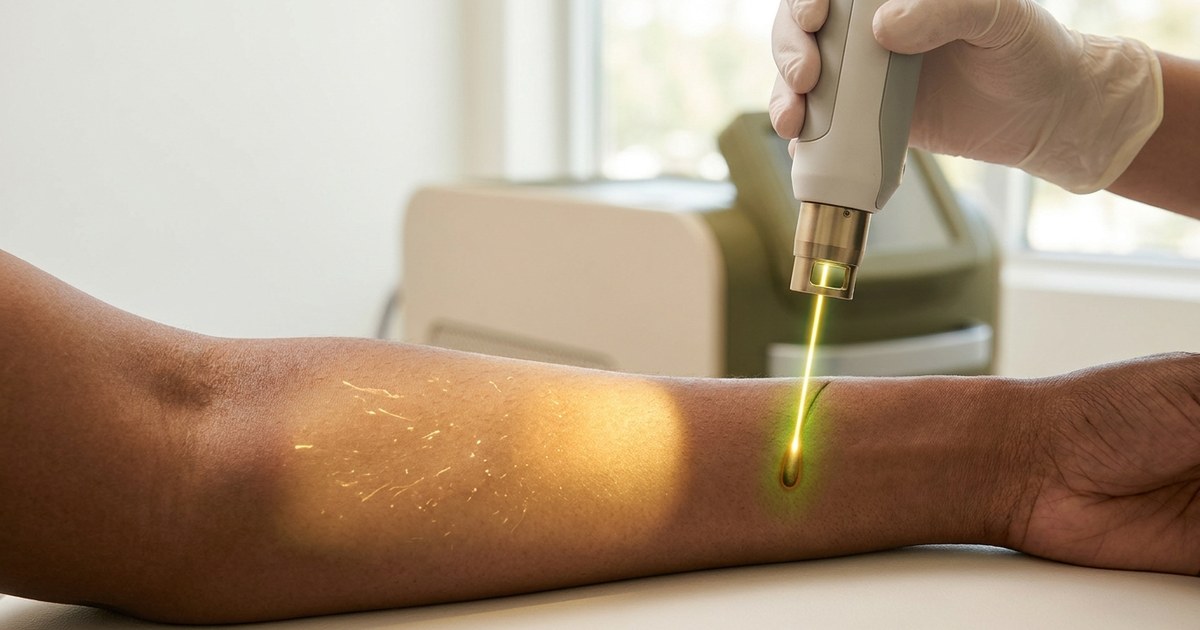
At-home IPL devices are not lasers. IPL (Intense Pulsed Light) uses broad-spectrum flashlamp technology that scatters multiple wavelengths across the skin. Professional laser hair removal uses a single, precise wavelength that targets melanin in the hair follicle with clinical accuracy. According to peer-reviewed clinical research, that wavelength precision is why professional lasers achieve 80–90% permanent reduction while at-home IPL devices deliver temporary results requiring indefinite maintenance.
If you've bought an at-home IPL device expecting permanent hair reduction but are seeing only temporary results or inconsistent outcomes, you're not alone. The marketing often uses "laser" when the technology is fundamentally different. Understanding that difference explains why your device isn't delivering the promised results.
This guide explains the clinical difference between at-home IPL and professional laser wavelengths, what evidence shows about real-world outcomes, and when each technology makes sense.
What IPL Actually Is (And Why It's Not a Laser)
IPL stands for Intense Pulsed Light. It uses a xenon flashlamp that emits a broad spectrum of light wavelengths, typically 500nm to 1200nm. This differs fundamentally from laser technology, which produces a single, concentrated wavelength.
Broad-Spectrum Light vs. Single-Wavelength Precision
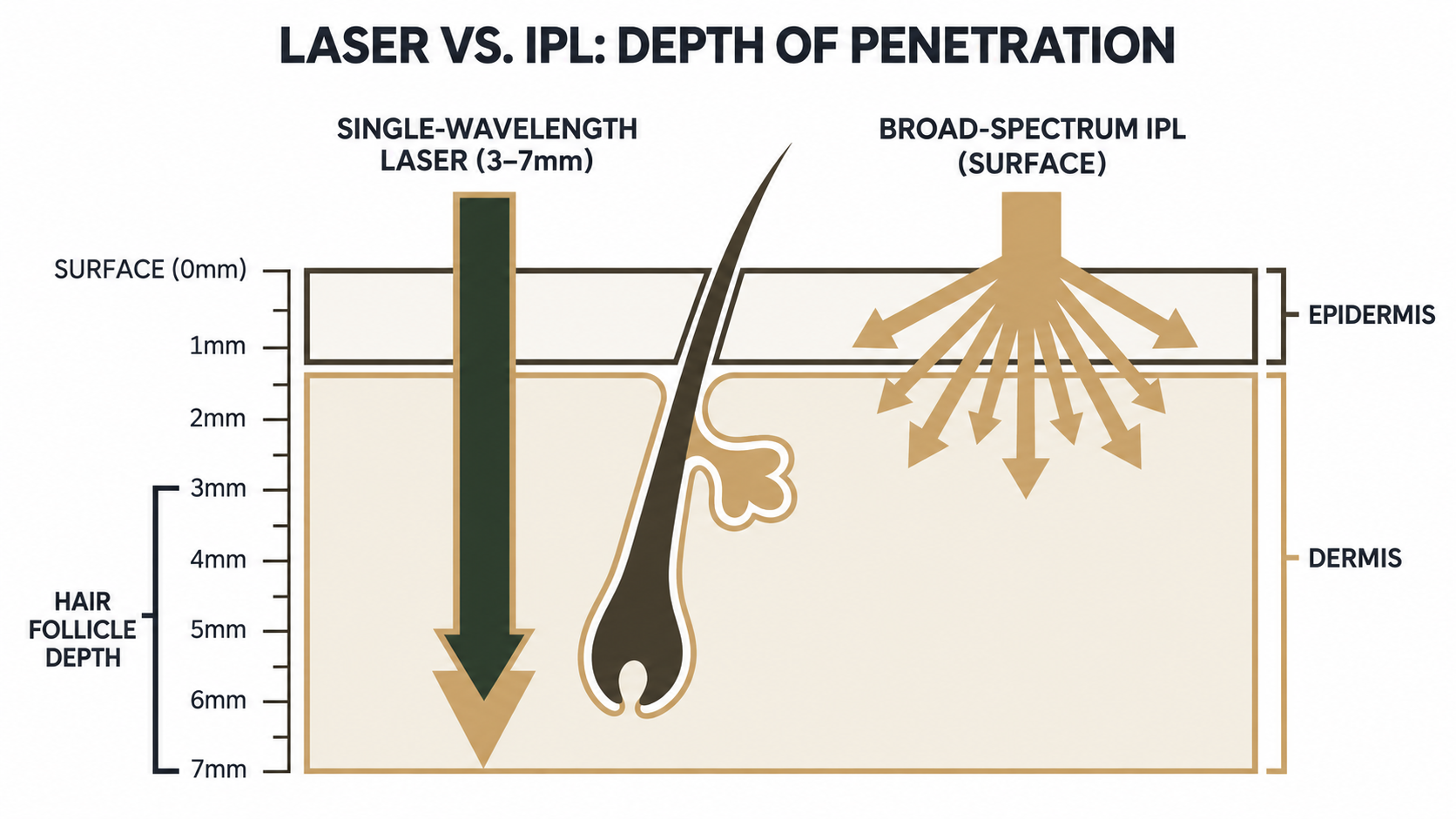
When an IPL device fires, it releases multiple wavelengths simultaneously. That broad spectrum scatters across the skin surface, delivering energy to melanin in hair follicles but also to surrounding tissue, blood vessels, and surface pigmentation. Professional laser systems achieve superior targeting precision because they emit only one wavelength, chosen specifically to match melanin's absorption peak in hair follicles.
Medical-grade lasers for hair removal operate at either 755nm (Alexandrite) or 1064nm (Nd:YAG). These wavelengths are selected because melanin absorbs them efficiently while surrounding tissue does not. The result is selective photothermolysis: heat transfer to the follicle without collateral damage.
IPL cannot achieve that precision. The scattered wavelengths hit multiple chromophores (melanin, hemoglobin, water), diluting energy that reaches the follicle and increasing burn or pigmentation risk.
Why the Marketing Uses the Word "Laser" (And Why That's Misleading)
Many at-home IPL devices are marketed as "at-home laser hair removal systems." This is technically inaccurate. The FDA regulates these as IPL systems, not lasers, because they don't produce coherent, monochromatic light.
The word "laser" sells. It implies medical-grade technology and permanent results. But IPL is a different technology with different outcomes. Regulators allow "laser" in marketing when the product is positioned as cosmetic rather than medical, which is why consumers often believe they're buying clinic-grade technology.
The Clinical Difference: Wavelength Precision and Follicle Targeting
The reason professional laser hair removal achieves permanent reduction while at-home IPL delivers temporary results comes down to how deeply and precisely energy reaches the hair follicle.
How Medical-Grade Lasers Disable the Follicle
Permanent hair reduction requires selective destruction of the hair follicle's stem cells, located in the bulge region approximately 3–7mm below the skin surface. A single-wavelength laser beam penetrates to that depth because it's not scattered by surface pigmentation or other chromophores.
The laser energy is absorbed by melanin in the hair shaft, converted to heat, and conducted down to the follicle base. When temperature reaches 70°C or higher for sufficient duration, stem cells are thermally damaged. The follicle cannot regenerate. That hair is permanently reduced.
This process is called selective photothermolysis. The wavelength, pulse duration, and fluence are calibrated to target melanin in hair while sparing surrounding tissue. Professional systems use both 755nm Alexandrite (for lighter skin with dark hair) and 1064nm Nd:YAG (for darker skin tones) to safely treat all Fitzpatrick skin types.
Why IPL Can't Match That Depth or Precision
IPL's broad-spectrum light scatters before reaching follicle depth. Some wavelengths are absorbed by surface melanin. Others are absorbed by hemoglobin in capillaries. The energy that does reach the follicle is diluted across multiple targets, reducing heat concentration needed to disable stem cells.
IPL typically damages the hair shaft and temporarily slows regrowth, but doesn't reliably destroy the follicle's regenerative capacity. Hair returns after weeks or months. Patients must repeat treatments indefinitely to maintain results.
The lack of wavelength precision also means IPL can't be safely calibrated for darker skin tones. The broad spectrum hits surface melanin indiscriminately, increasing burn and hyperpigmentation risk on Fitzpatrick types III–VI.
What the Clinical Evidence Shows: At-Home IPL vs. Professional Laser Outcomes
The difference in medical-grade laser technology versus flashlamp IPL technology translates to measurable differences in outcomes.
Recent Clinical Trial Data (2023–2025)
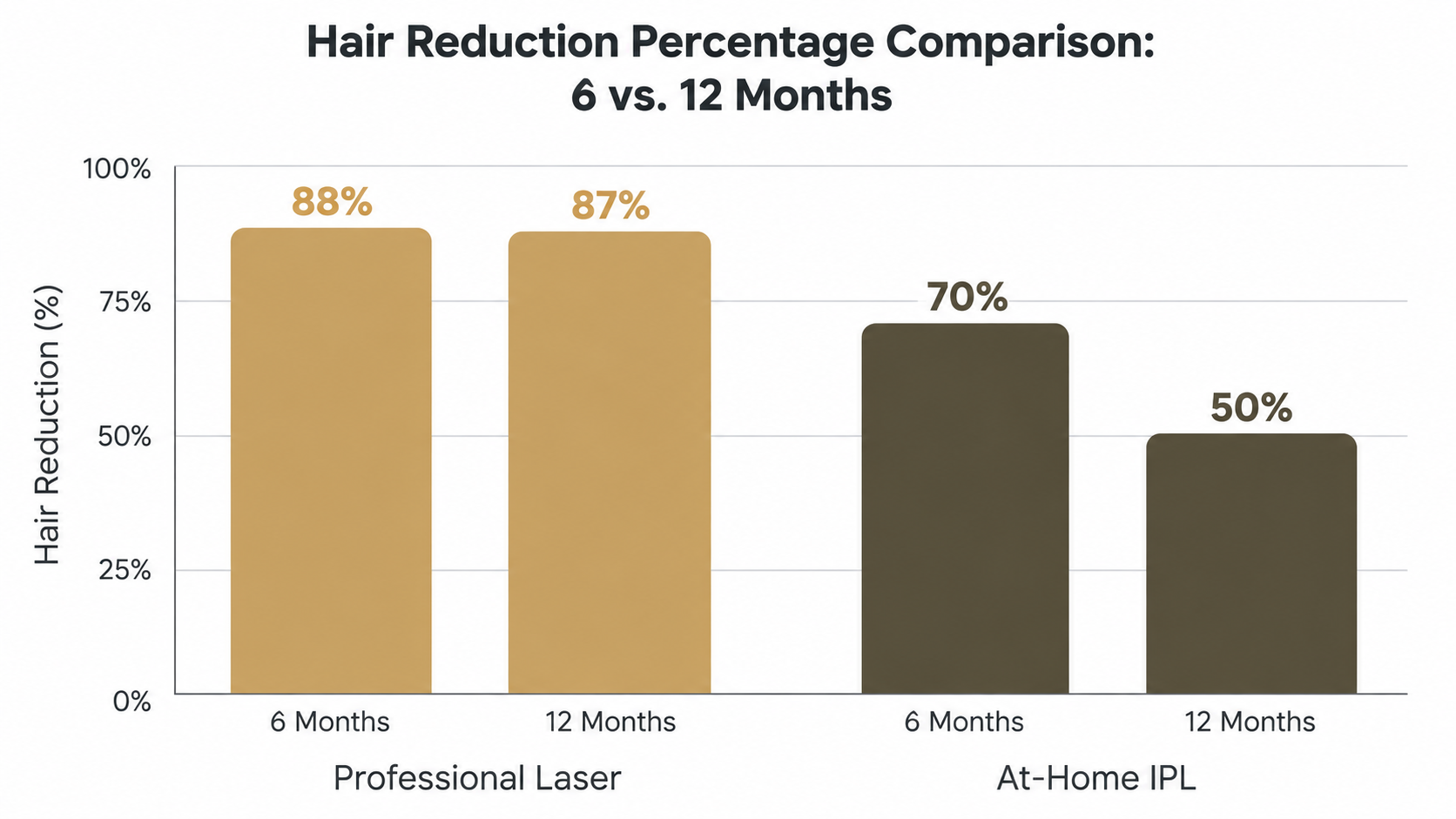
A 2023 clinical trial published in PLOS ONE compared professional laser hair removal to at-home IPL devices over 12 months. Professional laser achieved 85–90% hair reduction after six to eight sessions. At-home IPL achieved 45–75% reduction after 12 sessions, with significant regrowth at six-month follow-up.
Additional 2025 research in JMIR Dermatology confirmed these findings across multiple device brands. At-home IPL users required ongoing monthly maintenance to sustain even the reduced 45–75% results, while professional laser patients maintained their 80–90% reduction with only occasional touch-ups.
Over 20 years and 150,000+ procedures at Sedona Laser Center, we've seen firsthand that patients who start with at-home IPL devices and switch to professional laser report dramatically better results, often after just three sessions with the Cynosure Elite. The difference is wavelength precision.
The Maintenance Trap: Why IPL Requires Indefinite Upkeep
Because IPL doesn't reliably destroy follicle stem cells, hair regrowth continues. Most at-home device manufacturers recommend monthly maintenance sessions indefinitely to keep hair from returning to baseline.
Compare that to professional laser: after completing a series of six to eight sessions spaced four to six weeks apart, patients achieve sustained permanent reduction. The long-term cost and time commitment of indefinite IPL maintenance often exceeds the upfront investment in professional laser treatment.
Safety Risks: Why IPL Is Higher-Risk on Darker Skin and Tanned Skin
The same wavelength scatter that limits IPL's efficacy creates safety risks, particularly on darker or tanned skin.
Burns, Hyperpigmentation, and the Broad-Spectrum Problem
IPL's broad-spectrum light can't distinguish between melanin in the hair follicle and melanin in the epidermis. On darker skin tones (Fitzpatrick types III–VI), surface melanin absorbs significant energy, leading to burns, blistering, or post-inflammatory hyperpigmentation.
Even on lighter skin, IPL poses risks if the skin is tanned. UV exposure increases melanin production in the epidermis, turning the skin surface into a competing target. Cleveland Clinic's dermatology review notes that at-home IPL devices carry higher burn rates than professional laser systems because users can't adjust energy settings or wavelength selection for individual skin conditions.
Most at-home IPL devices include skin tone sensors that prevent firing on darker skin. This is a safety feature, but it also means the device is unusable for a significant portion of potential users.
Why Professional Nd:YAG Systems Are the Safe Choice for Darker Skin
Professional laser systems use 1064nm Nd:YAG wavelength specifically for darker skin tones. This longer wavelength penetrates deeper and is less absorbed by surface melanin, allowing safe treatment of Fitzpatrick types IV–VI without burn risk. For more on safe laser hair removal for darker skin, see our guide on Laser Hair Removal for Dark Skin: Why 1064nm Nd:YAG Is the Safe, Effective Choice.
At Sedona Laser Center, we use the Cynosure Elite dual-wavelength system, which combines 755nm Alexandrite for lighter skin and 1064nm Nd:YAG for darker skin. This allows us to safely treat all skin tones with precision at-home IPL devices can't match.
When At-Home IPL Might Make Sense (And When It Doesn't)
At-home IPL isn't universally ineffective. There's a narrow use case where it can be useful, but it's important to understand the limits.
The Narrow Use Case for IPL Devices
At-home IPL works best for very light maintenance touch-ups on pale skin (Fitzpatrick I–II) with dark, coarse hair. If you've already completed professional laser treatment and are managing occasional hormonal regrowth, an IPL device can delay the need for a maintenance session at the clinic.
It's also a reasonable option for someone who can't access professional laser treatment due to cost constraints or geographic limitations, and who understands they're committing to indefinite monthly sessions for temporary reduction, not permanent results.
Hair Types and Skin Tones IPL Can't Treat Safely
At-home IPL doesn't work on blonde, red, or grey hair because these colors contain little to no melanin. The light has no target to absorb. IPL isn't safe for tanned skin or darker skin tones (Fitzpatrick III–VI) due to burn and hyperpigmentation risk. IPL isn't effective on fine or light-brown hair because limited melanin content reduces energy absorption.
If you fall into any of these categories, at-home IPL won't deliver results and may cause skin damage. Professional laser hair removal with appropriate wavelength selection is the only safe and effective option.
How to Recognize Real Laser Hair Removal (And What to Ask)
If you're considering switching from at-home IPL to professional treatment, you need to know how to identify a real medical-grade laser system.
The Wavelength Test: 755nm Alexandrite and 1064nm Nd:YAG
Ask the clinic what wavelength their laser operates at. Medical-grade hair removal lasers use one of two wavelengths: 755nm (Alexandrite) or 1064nm (Nd:YAG). Some systems, like the Cynosure Elite, offer both wavelengths in a single platform.
If the clinic can't tell you the wavelength, or if they describe the technology as "IPL" or "broad-spectrum," they're not using a true laser system. To understand more about the technical differences between these technologies, read Laser Hair Removal vs. IPL: Medical-Grade Precision and Why Wavelength Matters.
FDA Clearance and the Clinical Standard
All medical-grade laser systems used for hair removal must have FDA 510(k) clearance for permanent hair reduction. Ask to see the device's FDA clearance documentation.
At-home IPL devices marketed for home use are regulated as cosmetic devices, not medical devices. They carry FDA clearance for temporary hair reduction or hair growth delay, not permanent reduction. That regulatory distinction reflects the difference in clinical outcomes.
What to Expect from Professional Laser Hair Removal (The Honest Timeline)
If you're switching from at-home IPL to professional laser, here's what the process actually looks like.
You'll need six to eight sessions spaced four to six weeks apart. Each session treats only the hair follicles currently in their active growth phase (anagen). Hair grows in three phases: anagen, catagen, and telogen. Only anagen-phase follicles respond to laser treatment. That's why multiple sessions are necessary to catch every follicle as it cycles into active growth. For a detailed explanation, see Hair Growth Cycles Explained: Why You Need Multiple Sessions to Catch Every Follicle.
According to published clinical outcomes data, after completing the series, most patients achieve 80–90% permanent reduction. This isn't 100% removal. Some follicles may regrow due to hormonal factors (PCOS, menopause, testosterone therapy). You may need an occasional maintenance session (one per year or less) to manage hormonal regrowth.
Results are visible after the third or fourth session. You'll see progressive reduction in hair density, thickness, and regrowth speed. Full results take four to six months from start to finish.
At Sedona Laser Center, your free consultation includes a skin tone assessment, hair type evaluation, and a customized treatment plan based on your goals. Explore our full range of laser and skin treatments.
Conclusion
At-home IPL devices are not lasers. They use broad-spectrum flashlamp technology that scatters multiple wavelengths across the skin, limiting depth, precision, and safety. Professional laser systems use a single wavelength (755nm or 1064nm) chosen specifically to target melanin in hair follicles without damaging surrounding tissue. That wavelength precision is why professional laser achieves permanent reduction while at-home IPL delivers temporary results requiring indefinite maintenance.
If you've invested time and money in an at-home IPL device and aren't seeing results, you're not doing anything wrong. The technology simply can't deliver the outcomes you were promised. Professional laser hair removal, performed with the right wavelength for your skin tone and hair type, is the only proven method for permanent hair reduction.
At Sedona Laser Center, we use the Cynosure Elite dual-wavelength system to safely treat all skin tones with clinical precision backed by 20+ years of experience and 150,000+ procedures. Your free consultation is no-pressure, and we'll map a treatment plan based on your hair type, skin tone, and goals.