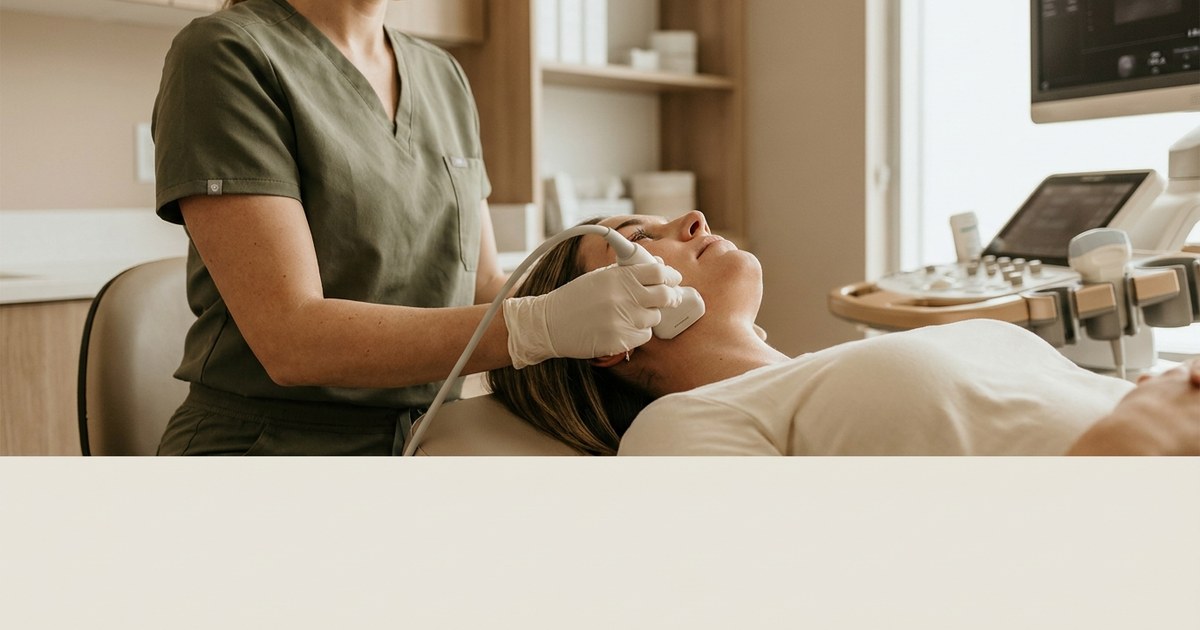

Sofwave uses focused ultrasound at 1.5mm depth to stimulate collagen in the mid-dermis; radiofrequency (e.g., Thermage) heats tissue broadly at 3–4.5mm for deeper remodeling; fractional lasers resurface the epidermis and upper dermis. Each technology targets different tissue layers. The right choice depends on your concern (fine lines vs. deeper laxity), skin tone, and downtime tolerance. Sofwave delivers mid-depth tightening with zero downtime; RF treats deeper sagging with mild swelling; fractional lasers improve texture but require recovery days. Learn which modality suits your goals through Laser & Skin Treatments in Edina, MN.
If you're researching facial skin tightening, you've encountered multiple technologies with overlapping claims: Sofwave, Thermage, RF microneedling, fractional CO2 laser. Clinics often present these as interchangeable, but they're not. Each modality targets a different tissue depth and stimulates collagen through a different mechanism. The result: confusion about which treatment matches your specific concern, whether the technology is safe for your skin tone, and how much recovery time you'll need.
Sedona Laser Center is one of the only Sofwave providers in the Twin Cities. We've completed over 150,000 procedures across laser hair removal and Sofwave skin tightening in 17+ years. This piece compares ultrasound (Sofwave SUPERB™), radiofrequency (monopolar and microneedling RF), and fractional laser resurfacing by depth, mechanism, safety profile, and clinical outcomes. You'll leave knowing which technology suits your goals and skin tone, and what to expect from each.
How Each Technology Works: Depth, Mechanism, and Target Tissue
Skin tightening technologies differ by three variables: the type of energy delivered, the tissue depth reached, and the mechanism that stimulates collagen. Understanding these variables clarifies which modality treats which concern.
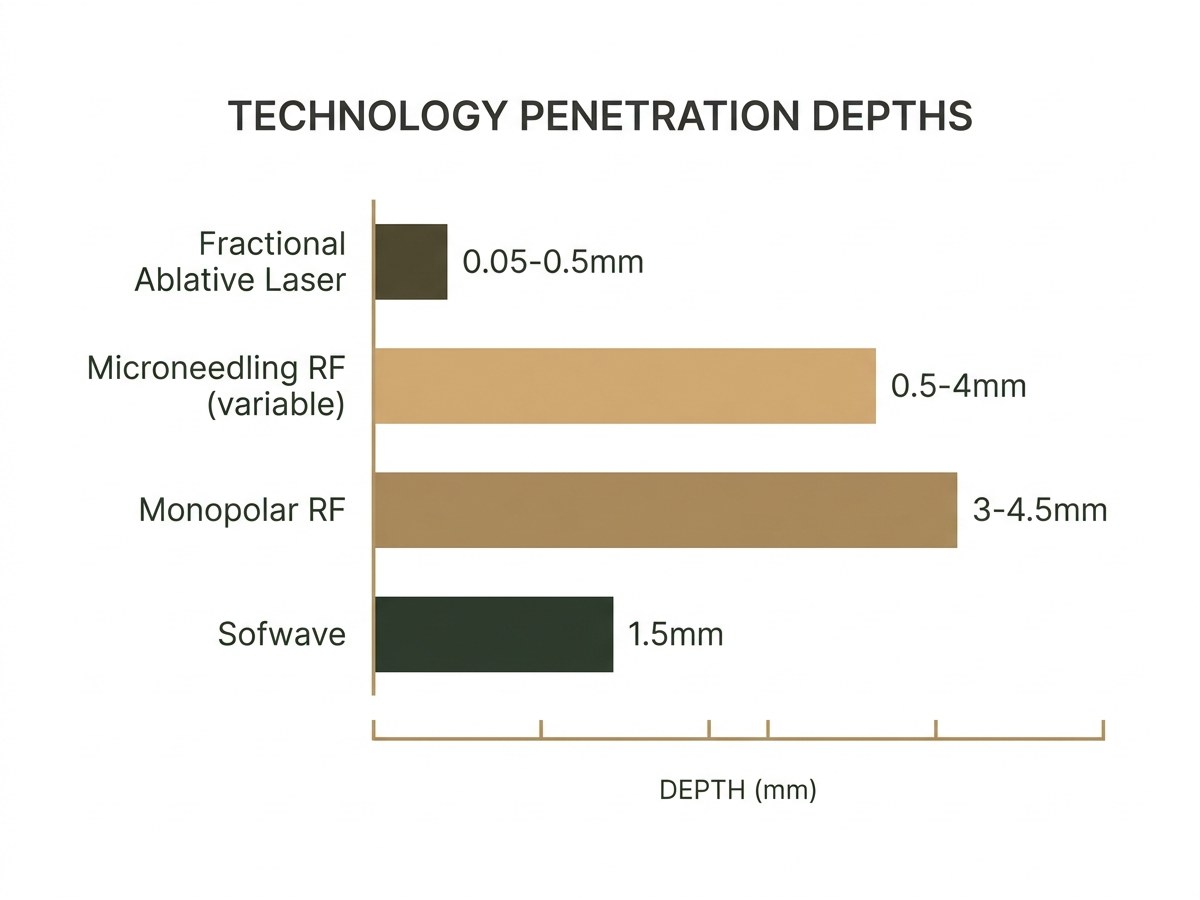
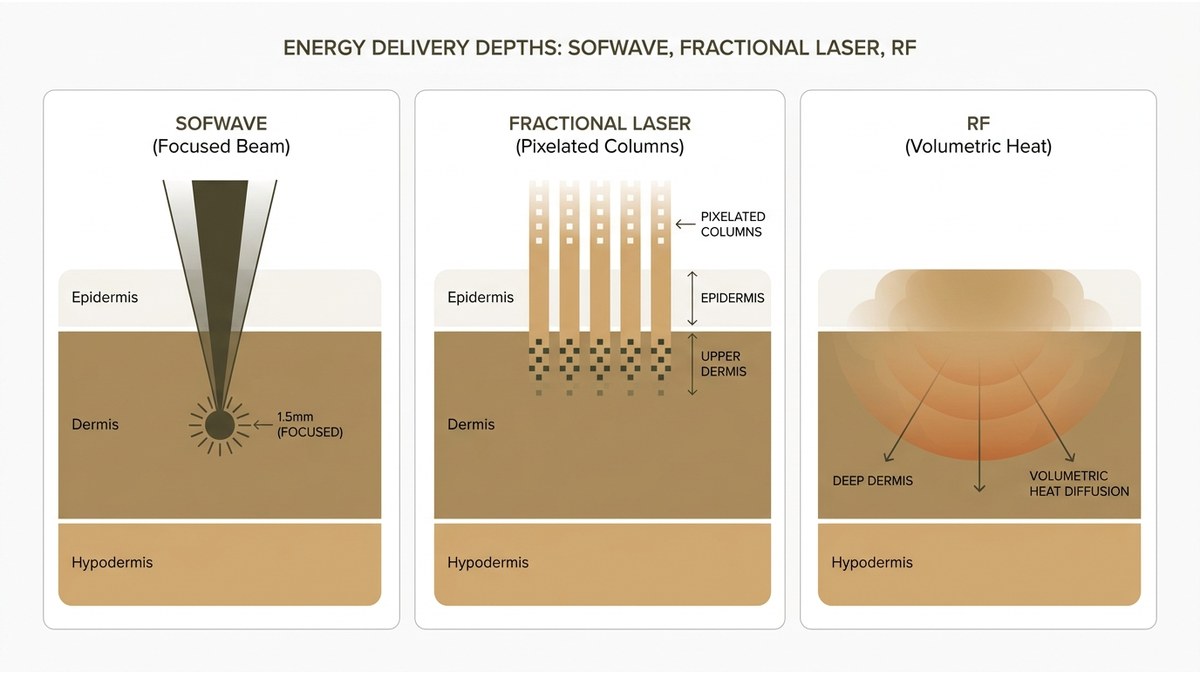
Sofwave SUPERB™ (focused ultrasound): Delivers precise ultrasound energy at exactly 1.5mm depth into the mid-dermis. The SUPERB™ transducer uses seven synchronized ultrasound beams to create controlled thermal injury in the collagen network while the integrated Sofcool™ cooling layer protects the epidermis. The FDA cleared Sofwave in 2019 for lifting the eyebrow and submental tissue, and in 2021 for treating fine lines and wrinkles. The heat induces immediate collagen contraction and triggers neocollagenesis (new collagen production) over the following 12 weeks.
Radiofrequency (RF): Heats tissue volumetrically through electrical current rather than light or sound. Three RF variants exist:
- Monopolar RF (e.g., Thermage FLX): Delivers RF energy 3–4.5mm deep into the reticular dermis and superficial fat layer. The energy heats tissue broadly, stimulating both collagen and elastin remodeling. Thermage received FDA clearance in 2002 and remains the longest-studied RF modality. One session typically delivers results that progress over 3–6 months. Patients describe moderate discomfort during treatment and mild-to-moderate swelling for 2–5 days post-procedure.
- Microneedling RF (e.g., Morpheus8, Profound RF): Combines fractional microneedles with RF energy. The needles penetrate to a set depth (0.5–4mm depending on the device), then deliver RF pulses at each needle tip. This creates fractional zones of thermal injury rather than volumetric heating. Recovery resembles microneedling: redness and micro-crusting for 3–5 days. Results appear over 3–4 months.
Fractional laser resurfacing: Uses laser energy to create controlled micro-injuries in the skin. Two categories exist:
- Ablative (e.g., CO2, Erbium:YAG): Vaporizes columns of skin tissue, removing the epidermis and penetrating the upper dermis (50–500 microns deep depending on settings). Stimulates aggressive collagen remodeling but requires 5–10 days of recovery (redness, peeling, oozing). Results visible within 2–4 weeks as the skin resurfaces.
- Non-ablative (e.g., Fraxel Dual, Nd:YAG 1064nm): Heats the dermis without removing surface tissue. Less aggressive than ablative lasers; requires 2–3 days of redness and mild swelling. Results progress over 2–4 weeks.
Fractional lasers primarily improve texture, pigmentation, pore size, and fine lines. They do not lift or tighten deeper laxity in the way ultrasound or RF do.
Sofwave Ultrasound: Mid-Dermis Precision With Zero Downtime
Sofwave targets the mid-dermis at 1.5mm, the layer where collagen fibers form the structural scaffolding that supports skin firmness. As we age, collagen production declines and existing fibers fragment, causing fine lines, mild laxity, and loss of definition in areas like the jawline, brow, and neck. Understanding how hair growth cycles work demonstrates similar principles of timing and tissue-level biology that apply to collagen remodeling timelines.
The SUPERB™ (Synchronous Ultrasound Parallel Beam) technology delivers seven focused ultrasound beams simultaneously. Each beam converges at the 1.5mm depth, creating a thermal coagulation zone that reaches 60–70°C. This controlled injury triggers fibroblasts (collagen-producing cells) to synthesize new collagen and remodel existing fibers. The Sofcool™ cooling mechanism sits between the transducer and the skin, maintaining surface temperature at a safe level while the ultrasound energy heats the target layer below.
The FDA cleared Sofwave for lifting the eyebrow and submental tissue (under the chin) in 2019, and for reducing fine lines and wrinkles of the face in 2021. In 2022, Sofwave received an additional clearance for short-term improvement in the appearance of cellulite on the buttocks and thighs. Clinical studies show visible improvement at 12 weeks post-treatment, with results continuing to develop through collagen remodeling for up to six months.
Most patients complete treatment in one 30–45 minute session. Some opt for a second session at 12–18 months for additional tightening. There is no recovery period. Patients return to normal activities immediately, with occasional mild redness that resolves within hours.
Sofwave treats:
- Mild-to-moderate skin laxity on the lower face and jawline
- Brow ptosis (drooping brow)
- Fine lines and wrinkles on the cheeks, forehead, and around the eyes
- Early neck laxity (not severe crepey skin or advanced sagging)
Sofwave does not replace a surgical facelift or neck lift for patients with severe jowls, deep folds, or significant volume loss. It also does not address pigmentation, redness, or textural concerns; those require laser resurfacing. Our Sofwave Skin Tightening in Edina, MN service integrates into Sedona's depth-over-breadth model: two core treatments delivered by the same clinical team, with no rotating staff or delegated procedures.
Radiofrequency (RF): Deeper Heating for Volumetric Tightening
Radiofrequency devices heat tissue through electrical resistance rather than light or sound. As RF current passes through skin, the tissue resists the flow, converting electrical energy into heat. This volumetric heating stimulates collagen and elastin remodeling at deeper layers than ultrasound or laser modalities reach.
Monopolar RF (Thermage FLX): The most studied RF device, FDA-cleared since 2002. Thermage delivers RF energy 3–4.5mm deep, heating the reticular dermis (the thick lower layer of the dermis) and the uppermost layer of subcutaneous fat. The device uses a single electrode on the skin surface and a grounding pad elsewhere on the body to complete the circuit. A cooling spray protects the epidermis during each RF pulse. Treatment takes 60–90 minutes for a full face and neck. Patients describe the sensation as intermittent deep warmth or brief snapping. Some providers use topical anesthesia or oral anxiolytics to improve comfort.
Results appear gradually over 3–6 months as collagen and elastin fibers contract and remodel. Thermage typically requires one session, with effects lasting 1–2 years. Mild-to-moderate swelling and tenderness last 2–5 days post-treatment. Some patients see no visible change; response rates vary based on age, baseline laxity, and individual collagen production capacity.
Microneedling RF (Morpheus8, Profound RF, Genius RF): Combines microneedles with RF pulses. The needles penetrate to a preset depth (adjustable from 0.5mm to 4mm depending on the device), then deliver RF energy directly into the tissue at each needle point. This fractional approach creates zones of thermal injury surrounded by untreated tissue, accelerating healing while stimulating collagen production.
Microneedling RF treats moderate jowl laxity and lower face sagging, nasolabial folds, neck laxity, and acne scars. Recovery resembles traditional microneedling: redness, pinpoint bleeding, and mild swelling for 3–5 days, with flaking skin for up to one week. Patients typically complete 2–3 sessions spaced 4–6 weeks apart. Results develop over 3–4 months.
Sedona Laser Center does not offer RF treatments. Our two-treatment focus reflects a depth-over-breadth model designed to deliver clinical mastery in specific modalities rather than catalog breadth. For patients whose laxity exceeds the 1.5mm depth Sofwave targets, RF may be a valid alternative, but it requires accepting swelling recovery and the uncertainty of variable response rates.
Fractional Laser Resurfacing: Surface and Upper Dermis Renewal
Fractional lasers improve skin texture, pigmentation, pore size, and fine lines by creating controlled micro-injuries in the epidermis and upper dermis. They do not lift or tighten deeper structural laxity. The term "fractional" means the laser treats a fraction of the skin surface in a pixelated pattern, leaving untreated tissue between the laser columns to accelerate healing.
Ablative fractional lasers (CO2, Erbium:YAG): Vaporize columns of tissue from the surface down into the papillary dermis (the upper layer of the dermis). CO2 lasers (10,600nm wavelength) penetrate deeper and deliver more aggressive collagen remodeling than Erbium:YAG lasers (2940nm wavelength). Erbium lasers remove less tissue per pass, making them better for lighter resurfacing with faster recovery.
Ablative fractional lasers treat deep wrinkles and creases (especially around the mouth and eyes), acne scars, surgical scars, textural irregularities, pigmentation, and rough, uneven skin texture. Recovery requires 5–10 days of oozing, crusting, redness, and peeling. Patients must avoid sun exposure for 4–6 weeks post-treatment and use prescription topical medications to prevent infection and hyperpigmentation. Results are visible within 2–4 weeks as the new epidermis forms.
Non-ablative fractional lasers (Fraxel Dual 1550nm, Nd:YAG 1064nm): Heat the dermis without removing the epidermis. The laser creates microscopic thermal injury columns that stimulate collagen remodeling without open wounds. Recovery is faster: 2–3 days of redness and swelling, with bronzed or darkened skin that flakes off over 5–7 days.
Non-ablative lasers treat fine lines and early textural changes, mild pigmentation and sun damage, and pore size irregularities. Results are subtler than ablative lasers and require 3–5 sessions spaced 4–6 weeks apart. For those exploring whether professional laser treatments offer advantages over consumer devices, understanding why at-home IPL didn't work versus professional laser clarifies the difference between retail technology and medical-grade precision.
Fractional lasers complement ultrasound and RF tightening but do not replace them. A patient with both texture concerns (pigmentation, roughness) and laxity concerns (sagging jawline, drooping brow) may benefit from layering treatments: Sofwave for tightening the jawline and brow, then fractional laser for texture months later.
Safety and Skin Tone Considerations Across Technologies
Not all skin-tightening technologies carry the same safety profile across skin tones. The risk of burns, hyperpigmentation, and scarring depends on whether the device targets melanin (pigment in the epidermis) or delivers energy to deeper tissue independent of surface pigment.
Sofwave and RF are safe across all Fitzpatrick skin types (I–VI). Neither technology targets melanin. Sofwave's ultrasound energy passes through the epidermis without interacting with pigment; the Sofcool™ cooling layer protects the surface regardless of melanin concentration. RF devices heat tissue through electrical resistance, not light absorption, so melanin does not increase burn risk. Clinical studies of Sofwave and Thermage include patients with darker skin tones (Fitzpatrick IV–VI) with no elevated adverse event rates.
Fractional ablative lasers carry higher risk for darker skin. CO2 and Erbium:YAG lasers create open wounds in the epidermis. Darker skin (Fitzpatrick IV–VI) has a higher risk of post-inflammatory hyperpigmentation (PIH): dark spots that form as the skin heals. The risk increases if the laser settings are too aggressive, if the patient has active inflammation or infection, or if the patient exposes treated skin to sun during healing. Experienced providers mitigate this risk by lowering fluence (energy per pulse), using longer pulse durations, and prescribing pre-treatment and post-treatment topical regimens (hydroquinone, tretinoin, corticosteroids). Even with expert calibration, some patients develop PIH that requires months of treatment to resolve.
Non-ablative fractional lasers (e.g., Fraxel 1550nm) carry moderate risk on darker skin. Because the epidermis remains intact, the PIH risk is lower than with ablative lasers, but not zero. Darker skin still produces more melanin during the healing response, and some patients develop patchy hyperpigmentation even after non-ablative treatment. Pre-treatment skin preparation and strict sun avoidance reduce this risk.
This safety distinction parallels wavelength selection in laser hair removal for dark skin. Longer wavelengths (1064nm) bypass melanin in the epidermis and target the hair follicle in the dermis, reducing burn risk. Similarly, ultrasound and RF bypass surface pigment entirely, making them the safer choice for patients with melanin-rich skin who want tightening without hyperpigmentation risk.
Sedona's dual-wavelength platform (755nm Alexandrite and 1064nm Nd:YAG) reflects the same clinical principle: match the technology to the patient's skin tone rather than forcing every patient through a one-size-fits-all device. We apply the same principle to Sofwave: ultrasound works safely on every skin tone because it doesn't interact with melanin.
Choosing the Right Technology for Your Goals
Which skin-tightening technology fits your concern depends on three factors: the depth of laxity, the type of improvement you want (tightening vs. texture), and your tolerance for downtime.
If you have fine lines, mild laxity, and want zero downtime: Sofwave. The 1.5mm mid-dermis target treats the layer where early sagging begins. One session delivers progressive tightening over 12 weeks. No recovery period. Safe on all skin tones. Ideal for patients noticing jawline blurring, early brow descent, or fine lines around the eyes who cannot take time off work or social commitments.
If you have moderate-to-severe sagging, deeper jowls or neck laxity, and can tolerate swelling: RF (Thermage or Profound). The 3–4.5mm depth reaches the structural layers where advanced laxity originates. Expect 2–5 days of visible swelling and tenderness. Results progress over 3–6 months. Safe on all skin tones. Ideal for patients who tried Sofwave or filler and need more aggressive tightening without surgery.
If you have texture concerns (roughness, pore size, pigmentation) and can recover 5–10 days: Fractional ablative laser (CO2 or Erbium). These devices resurface the epidermis and stimulate upper dermis collagen. They do not lift sagging skin. Expect crusting, peeling, and redness. Results visible in 2–4 weeks. Higher risk for hyperpigmentation on darker skin; requires expert provider and strict pre/post-treatment protocols.
If you want subtle texture improvement with less downtime: Non-ablative fractional laser (Fraxel 1550nm). Requires 2–3 days of redness and 3–5 sessions spaced 4–6 weeks apart. Improves fine lines, pore size, and mild pigmentation. Does not tighten deeper laxity.
Layered approach: Some patients address multiple concerns by sequencing treatments. For example: Sofwave for tightening the jawline and brow, then fractional laser 6–12 months later for texture and pigmentation. These are separate procedures, not one modality. The cost and recovery timelines add up.
No device does everything. Many clinics oversell single-modality results to avoid losing a patient to a competitor who offers a different technology. The honest answer: ultrasound tightens the mid-dermis with no downtime but won't tighten severe jowls like a surgical lift. RF treats deeper laxity but requires swelling recovery and variable response rates. Fractional lasers improve texture but don't lift sagging skin.
The best outcome starts with a transparent consultation where the provider maps your specific concern to the right technology or acknowledges when the concern exceeds what noninvasive devices can deliver.
Conclusion
Sofwave delivers mid-dermis precision at 1.5mm with zero downtime. RF heats deeper tissue (3–4.5mm) for volumetric tightening but requires 2–5 days of swelling. Fractional lasers resurface the epidermis and upper dermis to improve texture, not structural laxity. Each technology stimulates collagen through a different mechanism at a different depth. The right choice depends on your concern (fine lines vs. deeper sagging), skin tone (ultrasound and RF work safely on all tones; lasers carry hyperpigmentation risk on darker skin), and downtime tolerance (zero vs. days vs. a week).
Sedona Laser Center is one of the only Sofwave providers in the Twin Cities. We've completed over 150,000 procedures in 17+ years, and every consultation is free and pressure-free. We don't upsell. If your concern exceeds what Sofwave can treat, we'll tell you and we'll recommend the right alternative or refer you to a provider who specializes in it. Our depth-over-breadth model means you see the same clinical team every visit, not rotating staff or delegated procedures.
Book a free consultation to map your skin-tightening goals to the right technology: honest answers, no upsell, clinical clarity from a team with 17+ years of evidence-based practice. Call (952) 929-4404 today.