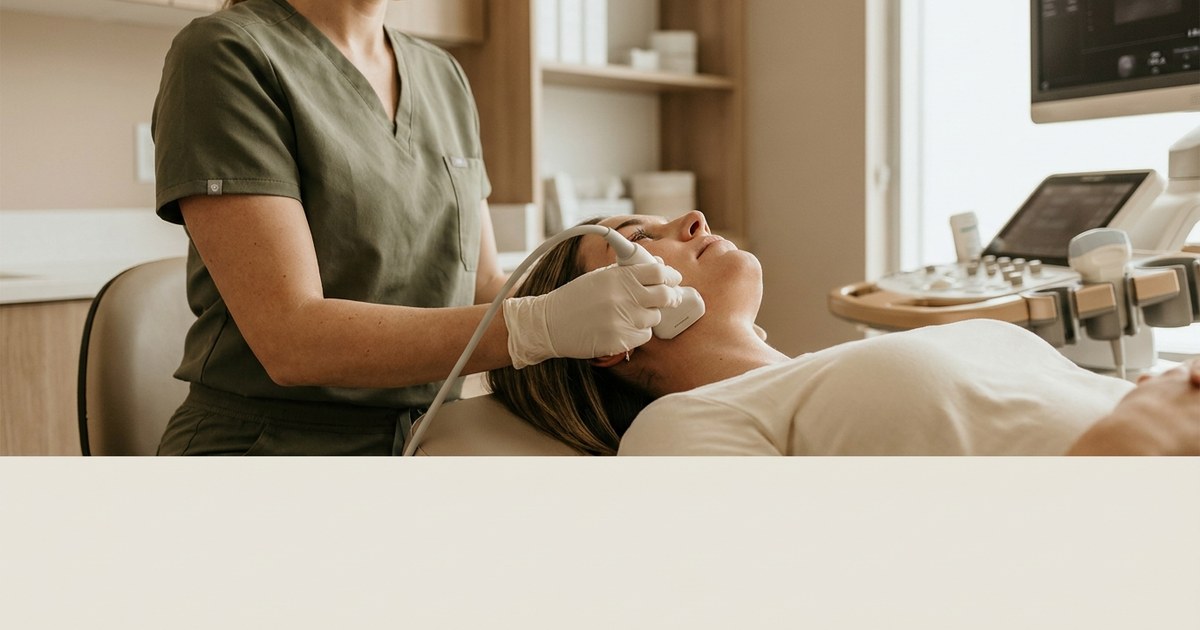

How long does it take to see Sofwave results? Sofwave results appear progressively over 12 weeks as your body produces new collagen in response to ultrasound energy. Most patients notice subtle texture improvement by week 4, visible lifting and fine-line softening by week 8, and peak results at week 12. Collagen regeneration continues in the mid-dermis throughout this period. One to two sessions are typically recommended, with maintenance sessions every six to 12 months to sustain results.
If you're considering Sofwave skin tightening in the Twin Cities for facial tightening, neck laxity, or fine-line softening, understanding the Sofwave results timeline and collagen regeneration process is essential. Unlike injectables that deliver instant volume or surgery that produces immediate structural change, Sofwave triggers a biological process. Your body synthesizes new collagen fibers over three months. The wait is not a delay tactic: it is evidence that the treatment works at the cellular level, producing lasting structural improvement rather than temporary cosmetic change. At Laser & Skin Treatments in Edina, MN, we focus on treatments that create real biological change, and Sofwave represents that principle at its best.
This guide maps the 12-week Sofwave collagen regeneration timeline week by week, explaining what happens in your skin and what you will see at each phase. Whether you're researching how long to see Sofwave results or exploring noninvasive skin tightening options, this breakdown will help you set realistic expectations and track your progress with clinical confidence.
By Sedona Laser
How Sofwave Triggers Collagen Production (The Science Before the Timeline)
Sofwave uses SUPERB ultrasound technology to deliver focused energy at 1.5mm depth in the mid-dermis, the layer where collagen fibers provide structural support to the skin. The ultrasound beam creates controlled micro-injuries at precise depths that trigger fibroblasts (the cells responsible for collagen production) to synthesize new collagen type I and type III. The Sofcool cooling layer protects the epidermis simultaneously, keeping the surface comfortable while the energy works below.
The biological process has a known cadence. Histology studies show new collagen fibers visible in biopsy samples at 90 days post-ultrasound microfocused treatment, confirming that the 12-week timeline reflects actual protein synthesis, not arbitrary waiting. Your body does not produce mature collagen overnight. Fibroblasts require weeks to manufacture and organize new protein structures. The 12-week mark represents peak collagen deposition, the point at which new fibers have matured and organized into supportive bundles.
Why this matters: collagen regeneration is real structural change. New protein fibers physically lift sagging tissue and fill fine lines from within. Compare this to hyaluronic acid filler, which adds instant volume but dissolves within six to 18 months, or surgery, which repositions tissue but does not trigger new collagen synthesis. Sofwave produces lasting results because your body builds new support structures. The timeline you wait through is the timeline your body needs to manufacture those structures.
Sedona Laser Center offers Sofwave as one of two treatments we specialize in, delivering clinical results without surgery. Your options for noninvasive skin tightening are limited locally in the Twin Cities metro. Sofwave's focused ultrasound energy at 1.5mm depth reaches the mid-dermis without the discomfort or recovery associated with deeper treatments or ablative lasers. This depth is the sweet spot for collagen production: deep enough to trigger meaningful fibroblast activity, shallow enough to avoid SMAS-layer pain. For more detail on our clinical approach, explore Sofwave Skin Tightening in Edina, MN.
Just as wavelength precision matters in Laser Hair Removal vs. IPL: Medical-Grade Precision and Why Wavelength Matters to target melanin without damaging surrounding tissue, Sofwave's ultrasound energy is focused at 1.5mm depth to trigger collagen production in the mid-dermis. Broad-spectrum energy disperses and wastes heat. Focused energy delivers results. This principle applies across modalities. When energy is focused at the correct depth with the correct parameters, the biological response is predictable and measurable.
One comparison: Ultherapy targets deeper layers (3mm to 4.5mm), reaching the SMAS layer beneath the dermis. This produces lift but causes significant discomfort during treatment. Microneedling creates collagen-induction injury at 0.5mm to 2mm, which improves texture but does not produce the structural lift that Sofwave achieves. Sofwave occupies the middle ground: deeper than microneedling, shallower (and more comfortable) than Ultherapy, with a collagen regeneration timeline that validates its biological mechanism.
Week 0 to 2: The Treatment and Immediate Aftermath (What You'll Feel and See Right Away)
The Sofwave treatment takes 30 to 45 minutes. Most patients describe warmth and mild pressure as the ultrasound energy is delivered in overlapping passes across the treatment area. The integrated Sofcool layer protects the skin surface continuously, so anesthesia is not required. Some patients experience slight redness immediately after treatment, similar to a mild sunburn. This fades within hours, not days.
What you will not see: dramatic lift on day one. Your skin may look slightly flushed or feel warm to the touch for the first few hours, but visible structural change does not occur yet. Collagen production begins at the cellular level immediately after the micro-injuries are created, but it takes weeks for new fibers to mature and create visible lift. Expecting instant results sets you up for disappointment. Understanding the biological timeline sets you up for confidence.
This is the expectation-setting window. Patients who expect instant results feel disappointed and question whether the treatment worked. Patients who understand the biological timeline feel confident and trust the process. The first 48 hours are recovery, not transformation. Avoid hot showers, intense exercise, and direct sun exposure during this period. Your skin is healing at the micro-injury sites where ultrasound energy was delivered.
No swelling. No bruising. No downtime that prevents you from returning to work or daily activities. Sofwave is designed for patients who want results without the recovery period that surgical facelifts or ablative lasers require. The tradeoff is time. Your body needs 12 weeks to produce the collagen that creates visible lift. This is not a flaw in the technology: it is evidence that the process is biological and lasting, not superficial and temporary.
By week two, most patients report no lingering sensations. The skin feels normal. No visible change has occurred yet. This is expected. The reassurance is simple: collagen production is a biological timeline, not a light switch. The cellular machinery is already engaged. You simply cannot see it yet because the collagen fibers are immature and not yet organized into bundles that provide structural support.
Week 3 to 6: Early Collagen Synthesis (Subtle Texture Improvement)
Between weeks three and six, fibroblasts are producing new collagen type I and type III at the micro-injury sites. These are immature fibers, not yet organized into the dense, cross-linked bundles that create lift. At the cellular level, collagen deposition is underway. Histology samples taken during this window show early-stage collagen formation, but the fibers have not yet matured into the structural proteins that produce visible skin tightening.

What you will notice: skin feels smoother to the touch. Fine lines may soften slightly, particularly around the eyes and upper lip. These are subtle changes. Most patients do not see dramatic improvement yet, but texture quality improves. The skin surface feels more refined when you wash your face or apply moisturizer. This is the first signal that collagen regeneration is progressing, even though lift is not yet visible.
This is the "trust the process" window. You know collagen production is happening because histology proves it. You cannot see it yet because immature collagen fibers do not provide structural lift. Patience here separates patients who complete the full timeline from those who lose confidence and abandon treatment prematurely. The biological process does not accelerate because you are impatient. It follows the timeline your fibroblasts require to manufacture and organize new protein.
Biological processes follow individual timelines. Just as Hair Growth Cycles Explained: Why You Need Multiple Sessions to Catch Every Follicle teaches us that treatment outcomes vary by individual biology, Sofwave collagen regeneration follows your body's protein synthesis rate. Younger patients with robust baseline collagen production may notice texture improvement at week three. Older patients or those with significant sun damage may not see changes until week five or six. Both outcomes are normal.
During this window, protect the collagen your body is producing. Consistent SPF prevents UV degradation of new fibers. Smoking impairs collagen production and wound healing, which can delay visible results from collagen-induction treatments. If you smoke, the timeline extends. If you prioritize hydration, sleep, and sun protection, the timeline proceeds as expected.
Week 7 to 10: Visible Lifting and Fine-Line Softening (The Confidence-Building Phase)
Week seven to ten is the turning point. Mature collagen fibers are now providing structural lift. Patients see jawline definition, brow elevation, and softening of nasolabial folds. Crow's feet around the eyes appear less pronounced. The mid-face looks fuller without filler. This is when before-and-after photos start to make sense. The improvement is progressive, not binary. You are not "done" at week eight, but you are visibly different from week zero.
Collagen synthesis slows with age, which is why younger patients may see results slightly earlier than older patients. A 35-year-old with minimal sun damage may notice lifting by week six. A 55-year-old with decades of sun exposure may require the full 12 weeks to reach this phase. The biological process is the same. The rate varies based on baseline collagen production capacity, skin quality, lifestyle factors (smoking, sun exposure, hydration), and treatment parameters (energy level, pass density, number of sessions).
This phase is validation. The 12-week timeline is not theoretical. You can see the lift in the mirror. Friends and family notice without knowing you had a treatment. The mid-face looks fuller. The jawline is sharper. Crow's feet are softer. These are the outcomes ultrasound-induced collagen remodeling produces.
Sedona's exclusive focus on two treatments (Laser Hair Removal in Edina, MN and Sofwave skin tightening) means the same team treats you from consultation through the full 12-week timeline. Continuity of care matters during this phase. The same provider who treated you at week zero sees your face at week eight and knows what to look for. They can assess your collagen response, track progress against your baseline photos, and recommend whether a second session will deliver meaningful additional improvement. This is not a one-size-fits-all protocol: it is personalized medicine based on your individual collagen regeneration rate.
By week ten, most patients report that strangers notice. A coworker asks if you changed your hair. A friend asks if you lost weight. The lift is visible to people who do not know you had a treatment. This is the outcome noninvasive skin tightening aims for: noticeable improvement that looks like you, refreshed, not surgically altered.
Week 11 to 12: Peak Results and Long-Term Maintenance (What Happens at the Finish Line)
Collagen regeneration peaks around week 12. This is the "final reveal." The mid-face is lifted. The jawline is defined. Fine lines around the eyes and mouth are softened. Skin texture is smoother. The cumulative improvement from 84 days of collagen synthesis is now fully visible.

What maintenance looks like: Sofwave does not stop aging. It gives your skin a collagen boost that lasts six to 12 months. Natural aging, sun exposure, and collagen degradation continue. Maintenance sessions sustain results. Most patients schedule one session per year. Some schedule two if they notice laxity returning sooner. The maintenance timeline depends on your age, lifestyle, and how quickly your body degrades the new collagen it produced.
Be honest about what the treatment achieves. Sofwave produces noticeable lift and fine-line softening. It does not replicate surgical facelift results. If you have severe jowling or significant neck laxity, surgery may be the better option. If you have moderate laxity and want to avoid surgery, Sofwave is the noninvasive alternative that produces real structural change.
Realistic timeline expectations drive satisfaction. Patients who understand that one to two sessions over 12 weeks produce moderate lift and fine-line softening are satisfied. Patients who expect surgical-level results from a 45-minute ultrasound treatment are disappointed. Transparency about the timeline, the mechanism, and the outcome is the foundation of trust. This is why Sedona's consultation process focuses on education before commitment.
The maintenance timeline is equally transparent. Sofwave results last six to 12 months. After that, a maintenance session sustains the improvement. Your body continues aging. The new collagen degrades. Maintenance sessions keep your skin at the improved baseline. If you want permanent results, surgery is the only option. If you want noninvasive results with predictable maintenance, Sofwave is the answer.
Factors That Influence Your Sofwave Timeline (Why Results Vary)
Age affects collagen synthesis speed and capacity. A 35-year-old with minimal sun damage may notice lifting by week six. A 55-year-old with decades of sun exposure may require the full 12 weeks. The biological difference is baseline fibroblast activity. Younger fibroblasts respond faster to ultrasound-induced micro-injury. Older fibroblasts produce collagen more slowly.
Baseline skin quality matters. Patients with significant photodamage, smoking history, or poor skin elasticity produce collagen more slowly. Smoking impairs collagen production and wound healing, which can delay visible results from collagen-induction treatments. If you smoke, quit before treatment to maximize collagen regeneration. If you cannot quit, expect a slower timeline and less dramatic results.
Sun damage also slows the timeline. UV exposure degrades collagen fibers and impairs fibroblast function. Patients with extensive sun damage (visible in the form of leathery texture, deep wrinkles, or hyperpigmentation) start with a lower collagen baseline. The ultrasound energy must work harder to trigger meaningful regeneration. The timeline extends because the fibroblasts are starting from a compromised state.
Lifestyle factors influence the timeline beyond the treatment itself. Consistent SPF protects new collagen from UV degradation. Hydration supports cellular repair and protein synthesis. Sleep allows growth hormone to drive collagen production. These are not marketing claims: they are biological realities. Patients who prioritize post-treatment care see results on schedule. Patients who neglect SPF, hydration, and sleep extend the timeline.
Treatment parameters also vary. One session produces noticeable improvement. Two sessions produce more dramatic results. The provider adjusts energy levels and pass density based on your skin thickness, laxity severity, and tolerance. Thicker skin tolerates higher energy. Thinner skin requires gentler parameters. Severe laxity benefits from a second session. Mild laxity may achieve desired results with one session.
Hormonal factors influence collagen synthesis timelines. PCOS affects testosterone and oestrogen balance, causing hirsutism, and hormonal imbalances similarly affect collagen production. Menopause reduces estrogen, which slows collagen synthesis. Patients on hormone replacement therapy may see results closer to the standard 12-week timeline. Patients with untreated hormonal imbalances may experience slower collagen regeneration.
Realistic timeline expectations account for these variables. No two patients follow identical collagen regeneration timelines. A provider who understands these variables can give you a realistic personal timeline during the consultation. Sedona's consultation assesses your age, skin quality, lifestyle factors, and goals to set expectations before treatment begins.
Sofwave vs. Other Collagen-Induction Treatments (How This Timeline Compares)
Microneedling creates collagen-induction injury at 0.5mm to 2mm depth. Results appear at four to six weeks, faster than Sofwave's 12-week timeline. However, the depth is shallower than Sofwave's 1.5mm mid-dermal target. Microneedling treats surface texture and fine lines effectively but does not produce the structural lift Sofwave achieves.
Ultherapy uses ultrasound energy at 3mm to 4.5mm depth, targeting the SMAS layer beneath the dermis. The timeline is similar to Sofwave (results over 12 weeks), but Ultherapy causes more discomfort because deeper penetration requires higher energy. Sofwave's 1.5mm depth produces collagen regeneration with minimal discomfort, a profile that makes it accessible to patients who cannot tolerate Ultherapy.
Fraxel and CO2 lasers use ablation to trigger collagen remodeling. Results appear at three to six months, slower than Sofwave's 12-week timeline. However, recovery time is measured in days to weeks (redness, peeling, downtime), not hours. Sofwave's zero-downtime profile makes it the better choice for patients who cannot afford recovery time.
Injectables (hyaluronic acid filler, Botox) produce instant results but no collagen regeneration. Filler adds volume temporarily. Botox relaxes muscles temporarily. Neither treatment triggers your body to produce new structural proteins. The results dissolve within months (Botox) or six to 18 months (filler). Sofwave's 12-week timeline is longer than injectables, but the results are based on collagen synthesis, not temporary volume.
Sofwave's 12-week timeline is evidence of a biological process, not a delay tactic. Comparing timelines without comparing mechanisms is misleading. Instant results (injectables) are temporary. Slow results (collagen regeneration) are structural and lasting.
Radiofrequency (RF) skin tightening delivers energy to the dermis to heat collagen and trigger contraction. The timeline is similar to Sofwave (results over 8 to 12 weeks), but RF requires multiple sessions (typically four to six) spaced weeks apart. Sofwave achieves comparable results in one to two sessions. The convenience factor matters. Patients who cannot commit to six sessions over three months prefer Sofwave's condensed protocol.
How to Track Your Results (Photos, Journaling, and Setting Realistic Expectations)
Take same-angle, same-lighting photos every two weeks. Use the same mirror, the same distance from the camera, and the same facial expression. Natural light at the same time of day eliminates variables that skew comparison. Compare week zero to week 12, not day-to-day. Day-to-day changes are imperceptible because collagen production is gradual.

Take three angles: front view, left 45-degree profile, right 45-degree profile. These angles capture mid-face lift, jawline definition, and nasolabial fold softening, the three most common improvement zones. Mark your standing position with tape so every photo is taken from the same distance. Consistency is the foundation of accurate tracking.
Journal what you notice. At week four, write "skin feels smoother when I wash my face." At week eight, write "jawline looks more defined in the mirror." At week 10, write "coworker asked if I changed my hair." These qualitative observations validate the process. The journal creates a narrative of progression that photos alone do not capture.
Set realistic expectations before you start tracking. Sofwave produces noticeable lift and fine-line softening, not facelift-level transformation. If you expect dramatic change, you will be disappointed. If you expect progressive improvement over 12 weeks, you will be satisfied.
Avoid comparing your timeline to another patient's timeline. Collagen synthesis rates vary based on age, skin quality, lifestyle, and treatment parameters. Your friend may see results at week six. You may see results at week ten. Both timelines are normal. Comparison creates anxiety and erodes confidence. Focus on your own progression, week by week, against your own baseline.
Use a simple spreadsheet or notebook to log your observations. Date each entry. Note specific changes (texture, lines, lift) rather than vague impressions ("looks better"). Specific observations are easier to track and validate. They also help your provider assess your collagen response during follow-up appointments.
Common Questions About the Sofwave Timeline
Can I accelerate the timeline with a second session at week six? No. Collagen synthesis follows a biological timeline that cannot be accelerated by stacking sessions prematurely. Spacing sessions six to 12 weeks apart allows the initial collagen regeneration to complete before adding a second stimulus.
What if I see no improvement at week eight? Schedule a follow-up with your provider. Late responders exist, particularly among older patients or those with significant sun damage. Some patients do not see visible improvement until week 10 or 12. The provider can assess your collagen response, review your baseline photos, and determine whether a second session will help.
Do results continue improving after week 12? Collagen regeneration peaks at 12 weeks, but some patients report continued subtle improvement up to six months post-treatment. This is likely due to collagen remodeling (the organization of fibers into more efficient bundles) rather than new synthesis. The dramatic improvement happens between week zero and week 12.
How long do Sofwave results last? Six to 12 months for most patients. Natural aging, sun exposure, and collagen degradation continue after treatment. Maintenance sessions every six to 12 months sustain the improvement. Understanding the full clinical series helps track your results with realistic expectations.
Can I combine Sofwave with other treatments to accelerate results? Combining Sofwave with microneedling, retinoids, or growth-factor serums may support collagen synthesis, but the core timeline (12 weeks for peak results) does not change. Discuss combination approaches with your provider during the consultation, but do not expect to compress 12 weeks into six.
Is the timeline different for neck vs. face treatments? The collagen regeneration timeline is the same regardless of treatment area. However, neck skin tends to be thinner and has less baseline collagen density than facial skin. This can make the timeline slightly longer for visible neck tightening. Some patients see facial improvement by week eight but do not notice neck improvement until week 10 or 12.
Can I get Sofwave if I've had filler or Botox recently? Yes, but timing matters. Wait at least two weeks after Botox before Sofwave to allow the neurotoxin to settle. Wait at least four weeks after filler to ensure the hyaluronic acid has integrated and swelling has resolved. If you want to track collagen regeneration accurately, space your treatments appropriately.
The Bottom Line: Patience Pays Off, and the Biology Is Real
Sofwave results take 12 weeks because collagen synthesis is a biological process, not an instant cosmetic fix. The timeline is evidence of depth. Fibroblasts produce new collagen fibers gradually. Immature fibers mature into organized bundles. The mid-dermis thickens. The skin lifts. This is histology, not marketing language.
Patients who understand the week-by-week progression stay confident, compliant, and satisfied. Week four brings subtle texture improvement. Week eight brings visible lifting. Week 12 brings peak results. The process is predictable. The biology is real. The timeline is transparent.
Sedona Laser Center specializes in clinical results without surgery. Sofwave is one of two treatments we do exceptionally well, with 20-plus years of expertise and the same trusted team every visit. If you want noninvasive skin tightening with a transparent timeline, no inflated promises, and local accountability, Sofwave at Sedona is the option. We are one of the only providers in the Twin Cities offering Sofwave, which means you have a focused expert rather than a generalist menu. For more context on our clinical approach to laser treatments, see Laser Hair Removal in Edina, Minnesota: Clinical Precision and 20+ Years of Expertise.
For reference on how histology supports collagen regeneration timelines, the Ovid platform provides access to dermatology research and clinical studies on ultrasound-induced collagen remodeling.
Ready to start your collagen regeneration timeline? Sedona Laser Center offers Sofwave Skin Tightening Treatments in Edina with transparent education, realistic expectations, and continuity of care through the full 12-week process. Schedule your consultation online to discuss your goals and get a personalized timeline based on your skin, your age, and your expected outcomes.