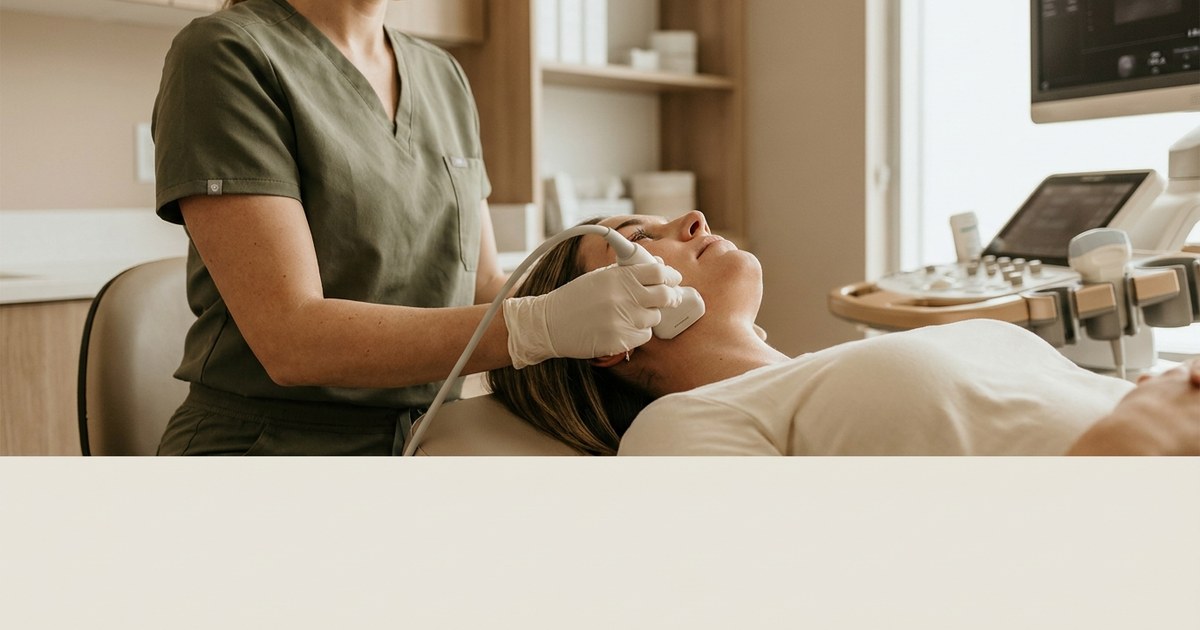

Not everyone is a good Sofwave candidate, and that's worth knowing before you book a consultation. The technology works well for specific skin concerns, but overselling it helps no one.
Who is a good candidate for Sofwave? Good Sofwave candidates are adults with mild to moderate skin laxity on the face, neck, or brow who want noninvasive tightening without surgery or downtime. Sofwave works on all skin tones, including darker skin (Fitzpatrick IV to VI), because it uses ultrasound, not laser or light energy. Poor candidates include those with severe sagging, active skin infections, or unrealistic expectations for dramatic lifting.
Sofwave has earned attention in the Twin Cities because very few providers offer it locally. At Sedona Laser, we provide comprehensive laser and skin treatments, including honest candidacy assessments for ultrasound skin tightening. But attention doesn't answer the question patients actually ask: will this work for my skin? Here's the honest assessment.
What Sofwave Treats: The Skin Concerns That Respond Best
Sofwave addresses mild to moderate skin laxity. That means early jowls, crepey neck texture, brow heaviness that hasn't progressed to severe droop, and fine lines along the jawline or lower face. The technology targets the mid-dermal layer where collagen production happens, stimulating new collagen growth over a 12-week window.
What Sofwave does not treat: deep static wrinkles, severe jowls requiring a facelift, acne scars, pigmentation issues, or profound volume loss. Ultrasound energy tightens existing tissue by rebuilding collagen structure. It does not add volume, resurface skin, or lift tissue that has descended significantly past the jawline.
This distinction matters because many patients arrive hoping for facelift-level results without surgery. That's not what Sofwave delivers. It delivers progressive tightening for patients whose skin is starting to lose elasticity but hasn't crossed into severe laxity. If you're noticing early sagging rather than established jowls, Sofwave sits in your treatment range.
Sofwave Skin Tightening in the Twin Cities: Why Sedona Is Your Only Local Clinical Option explains why candidacy assessments here carry clinical weight. We see the full spectrum of local patients and know which concerns respond and which don't.
The Collagen-Rebuild Mechanism (How Sofwave Works Without Surgery)
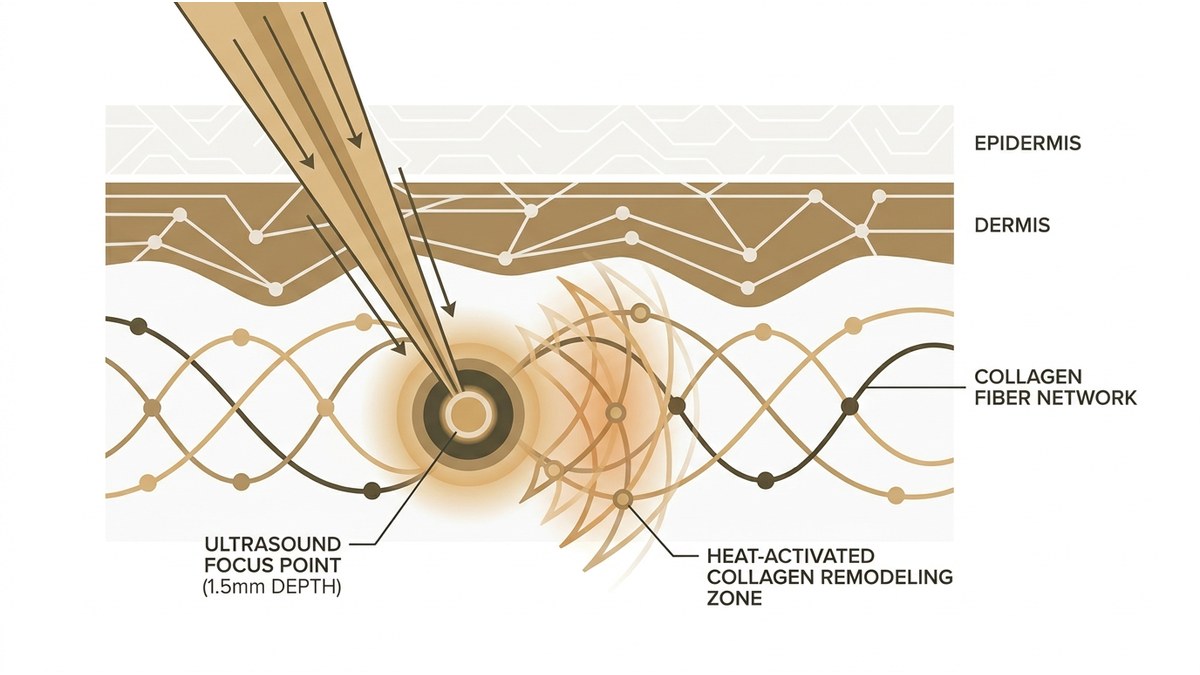
Sofwave uses microfocused ultrasound energy to heat tissue at a precise depth of 1.5mm in the mid-dermis. That thermal injury triggers the body's wound-healing response, producing new collagen over the following weeks. Results build progressively, peaking around 12 weeks post-treatment. This is not instant tightening. It's collagen remodeling that gradually firms and lifts lax tissue without cutting, injecting, or requiring recovery time. According to FDA clearance documentation, Sofwave is cleared for lifting and tightening because ultrasound depth control delivers energy precisely where collagen remodeling occurs.
Understanding hair growth cycles matters because skin biology operates on similar regenerative timelines. Just as hair follicles cycle through active growth phases, skin cells rebuild collagen in structured phases following thermal stimulus.
Who Is a Good Candidate for Sofwave? The Real Clinical Criteria
The ideal Sofwave candidate fits several clinical criteria that have nothing to do with marketing promises and everything to do with skin biology.
Age and skin maturity: Most candidates are between 35 and 65, noticing the first visible signs of elasticity loss but not yet dealing with severe structural descent. Younger patients with good skin tone typically don't need Sofwave yet. Older patients with advanced laxity often need surgical intervention for meaningful results.
Degree of laxity: Mild to moderate. That means skin that has lost some firmness but still has structural integrity. If you pinch the skin on your jawline or neck and it snaps back slowly rather than immediately, that's the range Sofwave treats. If it hangs without returning, you're past the threshold where ultrasound alone will deliver satisfying results.
Health factors: No active skin infections, no open wounds in the treatment area, no metal implants near the treatment zone, not pregnant or nursing. These are standard contraindications for energy-based devices.
Realistic expectations: This is the filtering criterion most patients underestimate. Sofwave produces progressive tightening over three months, not instant lifting. Patients who understand that collagen remodeling takes time, who are comparing Sofwave to doing nothing rather than to a surgical facelift, and who value noninvasive options succeed with the treatment. Patients expecting dramatic transformation in one session do not.
Your candidacy is best assessed in person, where a trained provider can evaluate skin thickness, laxity severity, and whether your specific concerns align with what ultrasound can achieve. Sofwave vs. RF and Laser Skin Tightening: Which Technology Is Right for You? breaks down how different modalities compare for specific skin goals.
Does Sofwave Work on All Skin Tones?
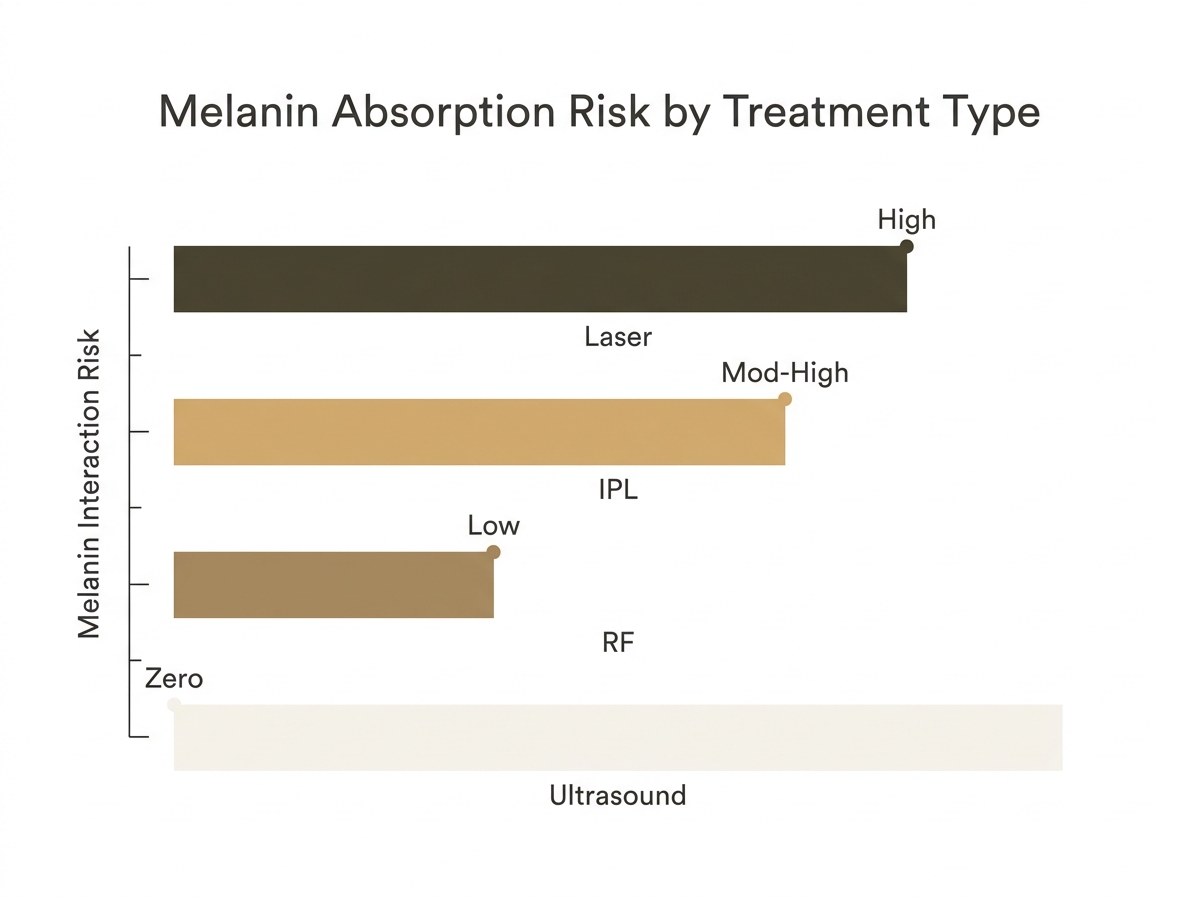
Yes. Sofwave uses ultrasound energy, not laser or light-based energy, which means it bypasses the melanin-absorption issue that makes certain laser treatments risky for darker skin. Traditional lasers work by targeting pigment (melanin) in hair follicles or chromophores in skin. Darker skin has more melanin in the epidermis, which can absorb laser energy meant for deeper targets, leading to burns, hyperpigmentation, or hypopigmentation.
Ultrasound energy doesn't interact with melanin at all. It penetrates to a fixed depth based on frequency and focus, heats the tissue at that depth, and triggers collagen production regardless of the patient's Fitzpatrick type. That makes Sofwave safe for all skin tones, from very pale (Fitzpatrick I) to very deep (Fitzpatrick VI).
This is a meaningful distinction in a market where many energy-based skin treatments carry warnings or exclusions for darker skin. According to FDA guidance on laser safety, certain laser wavelengths (like YAG lasers at 1064nm) are safer for darker skin than shorter-wavelength lasers because they penetrate deeper with less surface melanin absorption. Sofwave eliminates that concern entirely because it's not a laser. There's no light energy competing with melanin.
Who Should NOT Get Sofwave?
Honesty about poor candidacy prevents disappointment and wasted money. The following patients should not pursue Sofwave:
Severe skin laxity requiring surgical lifting. If jowls have descended significantly below the jawline or neck skin hangs in pronounced folds, Sofwave will underwhelm. Surgical intervention is the appropriate recommendation.
Active skin infections, inflammation, or open wounds in the treatment area. Ultrasound energy should not be applied to compromised skin.
Unrealistic expectations for instant or dramatic results. Collagen remodeling takes 12 weeks. Patients expecting immediate tightening or facelift-magnitude lifting will be dissatisfied regardless of clinical skill.
Metal implants or electronic devices near the treatment zone. Ultrasound energy can interact with implanted hardware. This includes facial implants, pacemakers near the treatment area, or other electronic medical devices.
Pregnancy or nursing. Standard precaution for all elective aesthetic procedures.
Certain autoimmune or connective tissue disorders. Conditions affecting collagen production or wound healing may compromise results. This requires case-by-case evaluation.
If you fall into one of these categories, a consultation will identify alternative treatments that align better with your candidacy and goals.
What to Expect at a Sofwave Candidacy Consultation
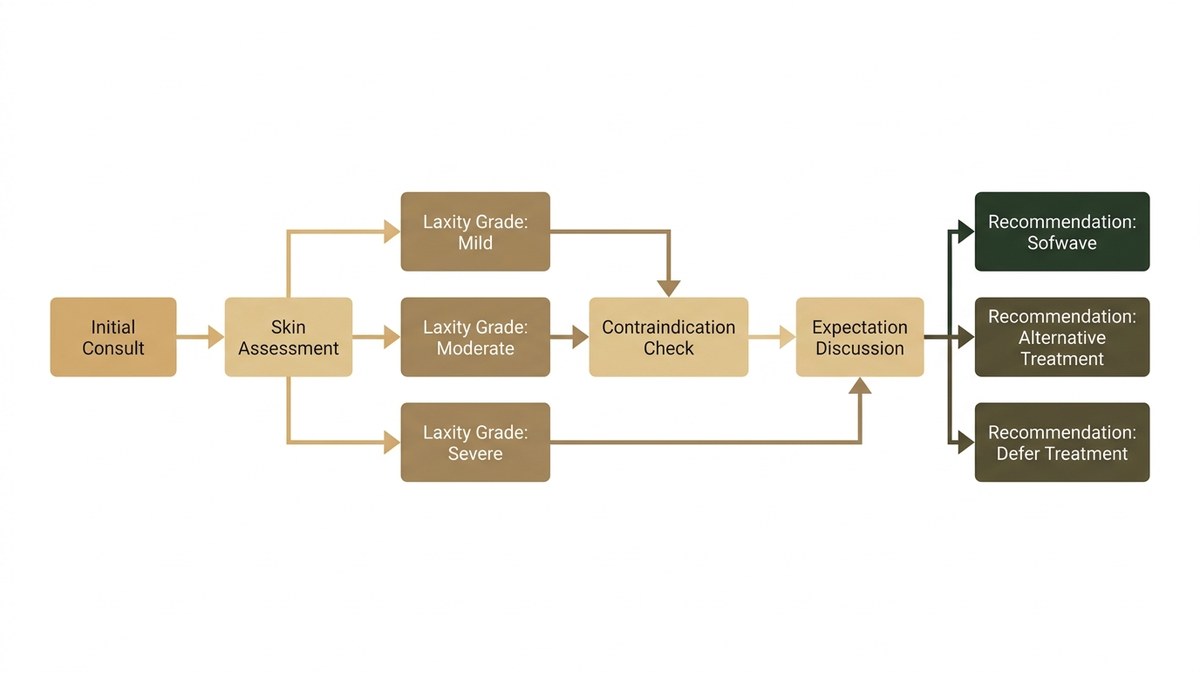
A real candidacy assessment happens in person, not over a website or in a marketing brochure. At Sedona Laser, consultations follow a structured process designed to give you an honest recommendation, even if that recommendation is "Sofwave isn't right for you."
Skin assessment: A trained provider examines your skin's thickness, laxity severity, texture, and elasticity. They're looking at whether your tissue will respond to mid-dermal ultrasound energy and whether your concerns sit within the treatable range.
Candidacy evaluation: Not every patient who walks in is a good candidate. Some need more aggressive intervention. Some need a different modality. Some need to address underlying skin health issues before pursuing tightening treatments. The consultation identifies where you fall.
Realistic outcome discussion: What can Sofwave achieve for your skin, given your age, laxity level, and collagen health? This conversation is about setting expectations that align with clinical reality, not selling a treatment.
No-pressure recommendation: If Sofwave isn't the right fit, we say so. If a different treatment serves you better, we recommend it. If you're not ready for treatment at all, we tell you. This is the opposite of upsell culture.
Many patients arrive after trying at-home devices that didn't deliver. Professional-grade technology operates at energy levels and precision depths that consumer devices cannot match. If you've struggled with consumer IPL or at-home ultrasound devices, understanding why at-home IPL devices fail explains why clinical assessment matters before investing in any skin-tightening modality.
How Skin Type and Tone Affect Your Sofwave Results
While Sofwave works safely on all Fitzpatrick types, individual results still vary based on factors beyond skin color. Age, genetics, skin thickness, baseline collagen health, and lifestyle factors (smoking, sun exposure, skincare regimen) all influence how much new collagen your body produces in response to ultrasound energy.
A 40-year-old with thick, healthy skin and minimal sun damage will typically produce more robust collagen remodeling than a 60-year-old with thin, sun-damaged skin, even if both have the same Fitzpatrick type. This doesn't mean older patients or those with compromised skin can't benefit from Sofwave. It means their results will reflect their body's collagen-production capacity, not a standardized marketing promise.
Darker skin types (Fitzpatrick IV to VI) do not experience higher risk with Sofwave because ultrasound energy doesn't interact with melanin. That's a sharp contrast to laser and IPL treatments, where darker skin types have higher melanin competing with the target tissue for energy absorption, increasing the risk of burns or pigmentation changes. Sofwave eliminates that variable entirely.
Conclusion
Sofwave candidacy comes down to three factors: the degree of skin laxity you're treating, the biological capacity of your skin to produce new collagen, and your expectations for what noninvasive ultrasound can achieve. Patients with mild to moderate laxity, realistic timelines, and an understanding that this is collagen remodeling rather than instant lifting see meaningful results. Patients outside that profile don't.
The best way to know if Sofwave is right for your skin is a free, no-pressure consultation with our team. We'll assess your skin, answer your questions, and give you an honest recommendation, even if that means Sofwave isn't the best fit. Book now to schedule your Sofwave candidacy consultation in Edina.