

Laser hair removal typically costs $90–$250 per session depending on treatment area size, with most patients needing 8–12 sessions spaced 4–6 weeks apart (according to PubMed research on laser hair removal protocols). The total laser hair removal series cost ranges from $720 to $3,000, delivering 80–90% permanent hair reduction (GoodRx treatment cost analysis). Compared to monthly waxing at $40–$60 (over $1,000 per year), the upfront cost pays for itself within two to three years, and the time saved from daily shaving compounds over a lifetime.
If you've been stuck in the cycle of shaving every day or booking wax appointments every month, the numbers start to blur. You know it's expensive and time-consuming, but the ritual feels unavoidable. Then someone mentions laser hair removal, and the first question is always about laser hair removal cost. The per-session price sounds manageable, but what does a full series actually run? Will it genuinely save money compared to what you're already spending on temporary methods? The answer depends on understanding both the clinical protocol (how many sessions you actually need) and the long-term math. For patients seeking permanent reduction across all skin tones, laser and skin treatments in Edina offer measurable ROI within three years, especially when you factor in the time and convenience you regain.
What Does Laser Hair Removal Cost Per Session?
Per-session pricing ranges from $90 for small areas (upper lip, underarms) to $250+ for large zones (full legs, back). The treatment area's size and the technology used (dual-wavelength medical-grade laser versus single-wavelength or IPL) are the main pricing factors.
The smallest zones require the least time under the laser. Upper lip, chin, or underarm treatments typically run $90–$120 per session because the surface area is minimal. Medium areas like the bikini line or lower legs cost $120–$180 per session. Large areas (full legs, full back, chest) can reach $200–$250 per session because they demand more treatment time and higher fluence settings across broader surfaces.
Technology drives the cost difference more than most patients realize. Medical-grade dual-wavelength systems use two distinct laser wavelengths: 755nm Alexandrite for lighter skin and finer hair, 1064nm Nd:YAG for darker skin tones and coarser hair. This precision costs more than broad-spectrum IPL devices, but it delivers superior safety and efficacy across all Fitzpatrick skin types. Clinics that use single-wavelength systems or IPL can charge less, but they also put darker-skinned patients at risk for burns or hyperpigmentation.
According to GoodRx pricing data, laser hair removal cost varies widely by geographic region and provider type, with most metropolitan areas falling within the $90–$250 range. The lower end often reflects single-area promotional pricing, while the upper end represents larger treatment zones or higher-cost urban markets.
When you see $90 per session advertised, ask what technology the clinic uses and whether that price applies to your specific treatment area and skin tone. If a clinic cannot name the laser model or explain why it is safe for your Fitzpatrick type, that is a red flag. Medical-grade precision is not a premium upsell; it is the clinical standard that ensures results without complications across every skin tone.
How Many Sessions Does a Full Laser Hair Removal Series Require?
Most patients need 8–12 sessions spaced 4–6 weeks apart to achieve 80–90% permanent reduction (PubMed study on treatment protocols). Hair grows in cycles; only follicles in the active growth phase (anagen) respond to laser energy, which is why multiple sessions targeting different cycles are required.
Hair growth occurs in three phases: anagen (active growth), catagen (transition), and telogen (resting). At any given moment, only about 20–30% of your hair follicles are in anagen phase. The laser can only destroy follicles that are actively growing, so a single session can never treat your entire hair population. You need to return every 4–6 weeks to catch the follicles that were dormant during your previous session but have now entered anagen.
The 8–12 session range accounts for individual variation in hair density, hormonal influences, and body area. Faces often require more sessions (10–12) because facial hair responds to hormones and regrows more persistently. Legs and underarms typically need 8–10 sessions. Some patients with hormonal conditions like PCOS may need additional maintenance sessions beyond the initial series, but the baseline protocol remains 8–12 treatments for most people.
The 4–6 week spacing is not arbitrary. Follicles cycle into anagen at predictable intervals depending on body region. Legs cycle every 4–5 weeks, bikini areas every 3–4 weeks, and faces every 4–6 weeks. Spacing sessions too close together wastes treatments because not enough new follicles have entered growth phase. Spacing them too far apart allows some follicles to complete their cycle and re-enter telogen before you catch them.
Redness and mild swelling are normal temporary effects after each session, resolving within hours to a few days (PubMed safety profile analysis). These side effects do not increase with session count, so the eighth session feels no worse than the first.
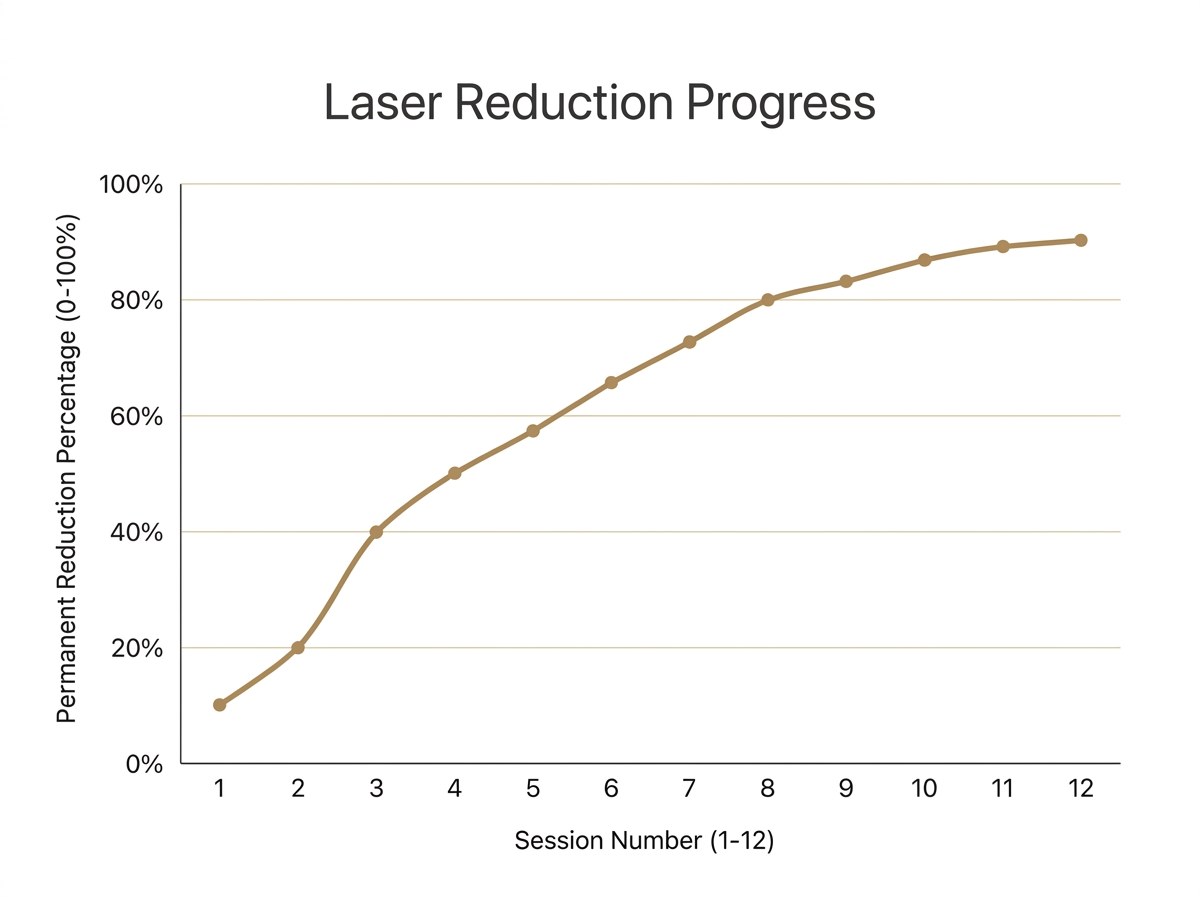
Any clinic promising permanent removal in four sessions is either using a non-clinical definition of "permanent" or making promises their technology cannot keep. Understanding the full timeline before you book prevents disappointment and helps you budget correctly for the laser hair removal session cost.
What Is the Total Investment for a Complete Laser Hair Removal Series?
The total laser series investment typically ranges from $720 (small area, 8 sessions at $90 each) to $3,000 (large area, 12 sessions at $250 each). This is a one-time clinical investment that delivers permanent reduction, not a recurring expense.
Small areas like upper lip or underarms run about $720–$960 for a full series (8 sessions at $90–$120 per session). Medium areas like bikini line or lower legs cost $960–$2,160 (8–12 sessions at $120–$180 per session). Large areas like full legs or full back reach $1,600–$3,000 (8–12 sessions at $200–$250 per session).
Many patients treat multiple areas simultaneously, which affects total investment. A common combination (underarms, bikini, lower legs) might total $2,400–$3,500 for the full series across all three zones. Some clinics offer package pricing that reduces the per-session cost when you commit to a full series upfront, but read the terms carefully. Packages that expire or penalize you for schedule changes can end up costing more if life disrupts your treatment plan.
The key distinction: this is a fixed cost with a defined endpoint. You are not signing up for a lifetime subscription. According to GoodRx pricing structure analysis, most providers structure pricing either per session or as prepaid packages, with package deals typically offering 10–15% savings versus pay-as-you-go. Once you complete the series, you achieve 80–90% reduction and may need only occasional maintenance (one session every 1–2 years) if hormonal changes trigger minor regrowth.
Compare that structure to waxing, which never ends. The $720–$3,000 you spend on laser is not matched by an equivalent annual waxing bill; it replaces decades of recurring costs.
How Does Laser Hair Removal Cost Compare to Waxing Over Time?
Monthly waxing costs $40–$60 per session, totaling over $1,000 per year. Over ten years, that is $10,000+ for temporary results. A hair removal cost comparison long term shows laser pays for itself in two to three years and eliminates the ongoing cycle.
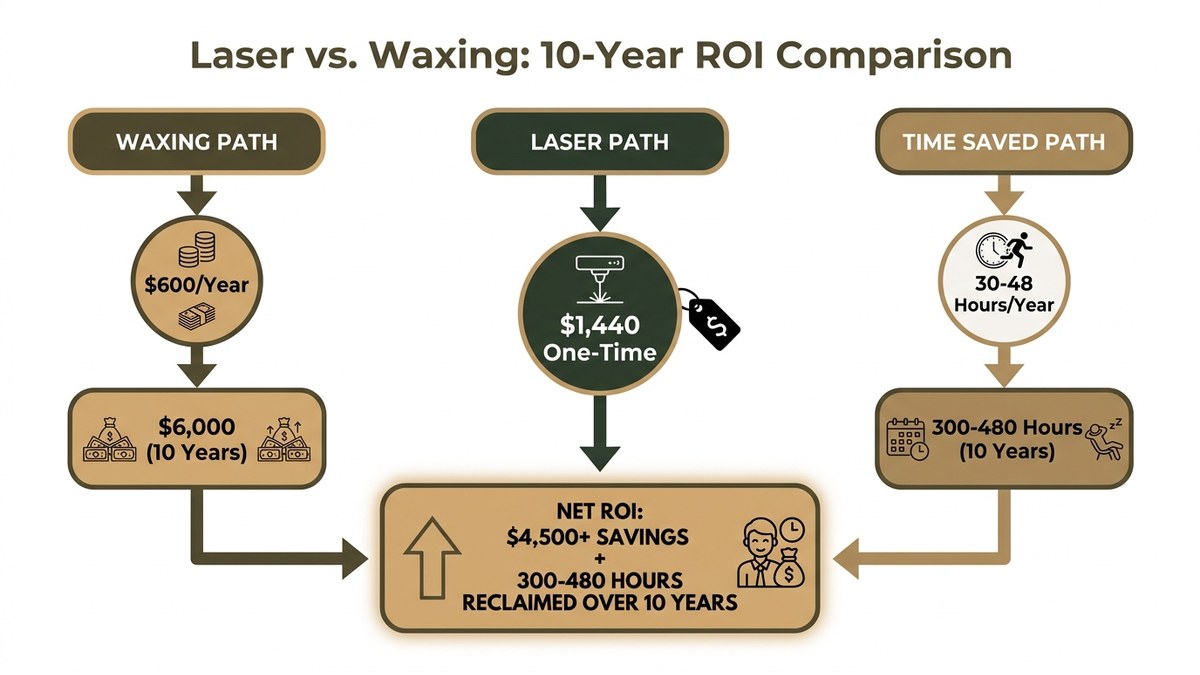
Take a single treatment area (bikini line) as an example. Waxing every four weeks at $50 per session costs $600 per year. Multiply that by ten years, and you have spent $6,000 for a method that delivers zero permanent reduction. A laser series for the same area costs roughly $1,440–$2,160 (12 sessions at $120–$180 each). By year three, you have broken even. By year ten, you have saved $4,000–$4,500.
The math becomes more compelling when you treat multiple areas. A patient waxing underarms, bikini, and lower legs every month spends approximately $120–$180 per session, or $1,440–$2,160 per year. Over a decade, that totals $14,400–$21,600. A laser series covering the same three areas costs $2,400–$3,500. The payback period is two to three years, and the lifetime savings exceed $10,000.
Waxing prices vary by region and salon type (GoodRx regional cost data), but the $40–$60 per session range holds across most U.S. metropolitan areas. Budget salons may charge $30–$40, while high-end spas exceed $70 per session for the same area. Even at the low end, the annual cost remains substantial, and the cumulative expense over a decade dwarfs the laser series investment.
Here is the year-by-year comparison for a medium-area treatment (bikini line):
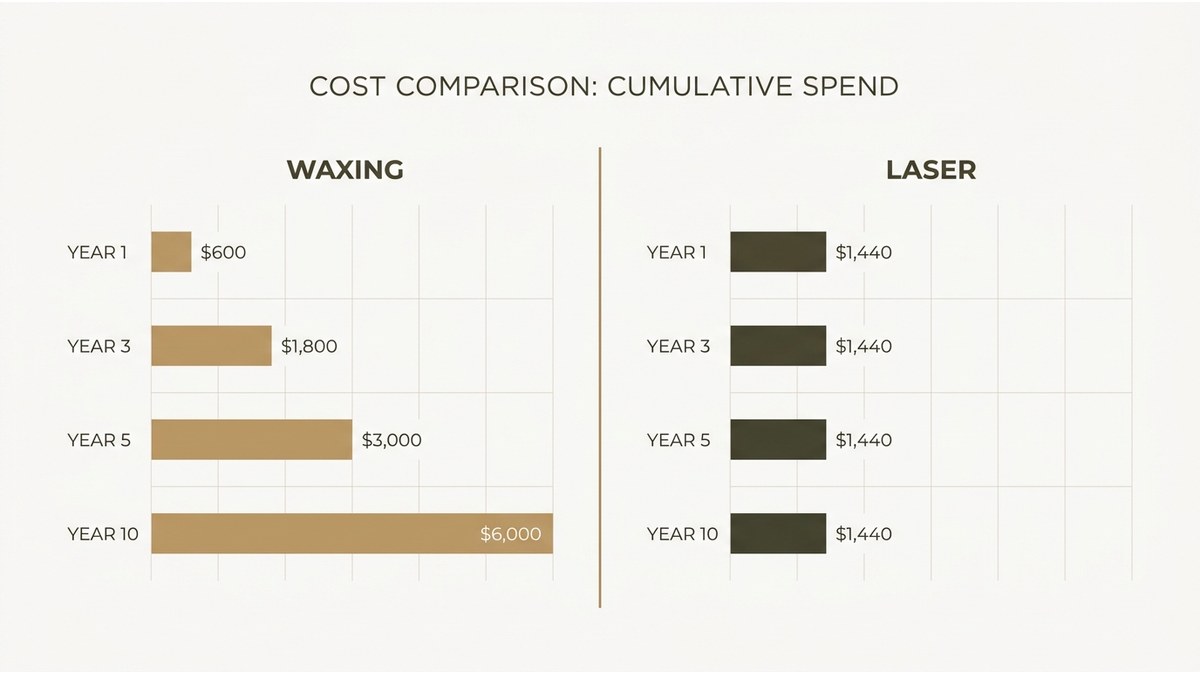
- Year 1: Waxing = $600, Laser = $1,440
- Year 3: Waxing = $1,800, Laser = $1,440
- Year 5: Waxing = $3,000, Laser = $1,440
- Year 10: Waxing = $6,000, Laser = $1,440 (plus maybe one maintenance session at $120)
The crossover happens between years two and three. After that, every year you avoid waxing is money saved and time reclaimed.
What About Shaving Costs and Time Saved?
Shaving feels free compared to waxing, but the hidden costs accumulate. Razors, shaving cream, aftershave lotion, and replacement blades add up to $100–$200 per year depending on brand preference and body area coverage. Over a decade, that is $1,000–$2,000 in product costs alone.
The real expense is time. Most people shave 3–5 times per week, spending 5–10 minutes per session. That totals 2.5–4 hours per month, or 30–48 hours per year. Over a lifetime (say, 40 years of active shaving), you spend 1,200–1,920 hours on a task that delivers zero lasting benefit. That is the equivalent of 50–80 full days, or nearly three months of your life, spent holding a razor.
The convenience factor is one of the top reasons patients cite for choosing laser over shaving or waxing (GoodRx patient preference survey). The time savings compound over decades, and the freedom from razor burn, ingrown hairs, and daily maintenance has measurable quality-of-life value.
When you frame laser hair removal as buying back those 50–80 days, the $720–$3,000 investment starts to look like a bargain. Most patients report that the mental relief of never planning their schedule around hair removal is worth more than the financial savings alone.
What Factors Influence the Price of Laser Hair Removal?
Pricing varies by treatment area size, the technology used (dual-wavelength versus single-wavelength), the clinic's expertise and location, and whether the provider offers package pricing or per-session rates.
Treatment area size is the most straightforward factor. A small zone (upper lip, chin, underarms) requires fewer laser pulses and less time, so it costs less. A large zone (full back, full legs) demands more pulses, higher total fluence, and longer sessions, which increases the price.
Technology and equipment drive the cost more than patients realize. Dual-wavelength systems like the Cynosure Elite cost hundreds of thousands of dollars and require specialized training to operate safely across all skin tones. These systems deliver both 755nm Alexandrite (for lighter skin and finer hair) and 1064nm Nd:YAG (for darker skin and coarser hair) in the same device. Clinics that invest in this technology charge more per session, but they also deliver superior safety and efficacy for patients with Fitzpatrick skin types IV through VI. Single-wavelength systems or IPL devices cost less to acquire and operate, which allows clinics to undercut on price, but they also carry higher complication risk for darker skin.
Clinic expertise and staff consistency matter. A practice that has performed thousands of procedures over decades has refined its protocols, trained its staff to recognize subtle skin reactions, and built institutional knowledge that reduces complication rates. That expertise costs money to develop and maintain, and it shows up in the price.
Geographic location affects pricing through real estate costs, regional wage levels, and local competition. Metropolitan areas with high costs of living charge more per session than smaller cities or suburban practices. According to GoodRx regional analysis, the same treatment area can vary by $50–$100 per session depending on zip code, even within the same metro region.
Package pricing versus per-session rates is the final variable. Some clinics sell prepaid packages (e.g., eight sessions for the price of six) that reduce the effective per-session cost but require upfront payment. Others charge per session with no commitment, which offers more flexibility but costs more over the full series.
The cheapest option is rarely the safest or most effective. Patients with darker skin tones especially should prioritize technology and expertise over price, because the risk of burns, scarring, or hyperpigmentation is real if the clinic uses the wrong wavelength or incorrect fluence settings.
Is Laser Hair Removal Worth the Upfront Investment?
For patients seeking permanent reduction and an end to the shaving/waxing cycle, laser hair removal delivers measurable ROI within three years and significant time savings over a lifetime. The value multiplies for those treating multiple areas or with hormonal hair growth that resists temporary methods.
The financial payback is clearest when you compare the total series cost to even three years of waxing. A $1,440 laser investment pays for itself by month 28 if you were previously waxing that area monthly at $50 per session. Every year beyond that is pure savings. Over a decade, you save $4,000–$10,000 depending on how many areas you treat.
The time savings are harder to quantify but equally real. If you spend 30–48 hours per year shaving or booking wax appointments, eliminating that routine over 30 years reclaims 900–1,440 hours of your life. That is the equivalent of nearly two months, freed up for anything more valuable than holding a razor.
The quality-of-life gains extend beyond time and money. Patients report increased confidence, elimination of razor burn and ingrown hairs, and freedom from planning vacations or swim dates around hair removal schedules. For patients with PCOS or other hormonal conditions that drive persistent hair growth, laser delivers results that waxing and shaving cannot match.
The investment is not worth it for everyone. Patients with very light or fine hair (blonde, gray, red) do not respond well to laser because the follicles lack sufficient melanin to absorb the laser energy. Patients unwilling to commit to the full 8–12 session series will see reduced results. And patients with highly variable schedules who cannot maintain the 4–6 week spacing may stretch the treatment timeline or reduce efficacy, lowering the ROI.
For the majority of patients (those with dark hair on light to medium skin, or those with access to dual-wavelength technology for darker skin tones), the upfront investment delivers compounding returns over decades. The sooner you complete the series, the sooner you start saving money and reclaiming time.
Conclusion
Laser hair removal costs $90–$250 per session, and a full series of 8–12 treatments totals $720–$3,000 depending on treatment area and technology. That upfront investment pays for itself within two to three years when compared to monthly waxing at $50–$60, and it eliminates the ongoing cycle entirely. Over a decade, the savings exceed $4,000 per area treated, and the time reclaimed from daily shaving compounds to hundreds of hours.
The value is highest for patients treating multiple areas, those with darker skin who need dual-wavelength safety, and those with hormonal conditions like PCOS that make temporary methods ineffective. The investment delivers measurable financial ROI and quality-of-life gains that extend over a lifetime.
If you are ready to stop paying for temporary results and start investing in permanent reduction, the first step is a transparent conversation about your treatment plan, total cost, and realistic timeline. Preparing for your first session takes less than 24 hours. Understanding what to expect at your first appointment removes the guesswork, and comparing wavelength options for your skin tone ensures you get the safest, most effective technology from day one.