

Most patients need 8–12 laser hair removal sessions spaced 4–6 weeks apart to achieve 80–90% permanent reduction, according to clinical outcomes documented in dermatology literature . The range exists because hair grows in cycles. Only follicles in the active growth phase absorb the laser's energy. Multiple sessions catch each follicle during its growth window, disabling it permanently over time.
Walk into three different clinics and you'll hear three different session counts. One says six. Another says eight. A third offers an unlimited package because "everyone's different." The confusion is understandable, but the biology is not negotiable. Laser Hair Removal in Edina, MN requires multiple sessions because of how hair grows, not because of how clinics price packages.
This guide explains why the laser hair removal 8-12 sessions standard exists, what determines where you fall in that range, and what to expect at each stage. You'll learn the biological reason behind the laser hair removal timeline 4-6 weeks interval, how to assess your progress, and why technology choice affects when to space laser hair removal appointments.
Why the Answer Is a Range (Not a Fixed Number)
Your hair does not grow all at once. Every follicle on your body cycles independently through three phases: anagen (active growth), catagen (transition), and telogen (resting). At any given moment, according to research published in the National Center for Biotechnology Information, only a portion of your follicles are in the anagen phase . The rest are dormant.
Laser energy targets melanin in the hair shaft and follicle. When a follicle is actively growing, the melanin is concentrated and the follicle is metabolically active. The laser's heat destroys the follicle's ability to regrow hair. When a follicle is resting, there is no active hair shaft connecting to the root. The laser has nothing to target. That follicle remains untouched during that session.
This is why one session cannot disable all your hair. The follicles in telogen during your first treatment will enter anagen weeks later. Your second session catches some of those. Your third session catches more. By session eight, you have cycled through most follicles at least once during their growth window.
The variance in total session count comes down to individual biology. Some patients have faster hair cycling rates. Others have slower cycles, requiring more time between sessions to allow dormant follicles to wake up. Body area matters: facial hair cycles approximately every four weeks, while leg hair may take six to eight weeks.
The Three Hair Growth Phases (And Why Only One Matters for Laser)
Anagen (active growth): The follicle produces a hair shaft. Melanin is abundant. The follicle is metabolically active. This is the only phase where laser energy can permanently disable the follicle. Duration varies by body area. Underarms cycle faster (weeks), while legs and back cycle slower (months). Research published in the Journal of the American Academy of Dermatology confirms that follicles must be in anagen for laser energy to produce permanent reduction .
Catagen (transition): The follicle detaches from its blood supply and begins to shrink. The hair shaft stops growing but remains in place. Laser energy has minimal effect because the follicle is no longer actively producing melanin-rich tissue. This phase typically lasts two to three weeks.
Telogen (resting): The follicle is dormant. The old hair shaft eventually sheds. The follicle remains inactive for weeks to months before re-entering anagen. Laser cannot detect or affect a resting follicle.
Because only anagen-phase follicles respond to treatment, and because different follicles cycle at different rates, multiple sessions spaced across weeks are the only way to catch each follicle during its vulnerable window.
The Standard Protocol: 8–12 Sessions Spaced 4–6 Weeks Apart
The clinical gold standard is 8–12 sessions, each spaced 4–6 weeks apart. That interval matches the average hair growth cycle for most body areas. Wait too long between sessions and follicles that were disabled begin a new growth cycle. Schedule sessions too close together and you treat the same anagen follicles twice while missing the ones still in telogen.
In our 20+ years performing laser hair removal procedures at Sedona Laser Center, we have consistently observed that patients who complete the full series achieve long-term reduction, as measured by hair counts before and after the treatment series. The dual-wavelength system we use, the Cynosure Elite™, delivers two wavelengths: 755nm Alexandrite for lighter skin and finer hair, and 1064nm Nd:YAG for darker skin tones. Research published in the National Institutes of Health database confirms dual-wavelength laser systems deliver permanent reduction when follicles are targeted during the anagen growth phase .
The spacing also varies slightly by body area. Facial hair cycles faster, which is why some practitioners recommend intervals as short as four weeks for upper lip or chin treatments. Leg hair cycles more slowly, sometimes allowing for six-week intervals. Bikini area and underarms typically fall in the middle, with five-week intervals proving optimal for most patients.
Energy settings also play a role in session count. Higher fluence (energy density) can disable more follicles per session, but only when the technician adjusts settings for your specific skin tone and hair color. Overly aggressive settings increase burn risk. Conservative settings may require additional sessions.
Why Some Clinics Say 6 Sessions and Others Say 12
The variation is not random. Four factors determine where you fall in the range.
Body area. Face and bikini areas have faster hair growth cycles and higher hormonal sensitivity. You may need the upper end of the range to catch all follicles. Legs and back have slower cycles and less hormonal influence. The Cleveland Clinic notes that body area is one of the primary determinants of total session count, with hormonally sensitive zones requiring more treatments .
Hair density and color. Coarse, dark hair responds faster because it contains more melanin. Fine or light hair takes more sessions because the laser has less pigment to target. Blonde, red, and gray hair contain minimal melanin, making them difficult or impossible to treat with standard laser systems.
Hormonal factors. Polycystic ovary syndrome (PCOS), menopause, certain medications (including some birth control formulations and corticosteroids), and other hormonal conditions drive regrowth even after follicles have been disabled. Patients with these conditions may need maintenance sessions beyond the initial series. PCOS in particular can stimulate dormant follicles to resume growth.
Technology. Medical-grade dual-wavelength lasers like the Cynosure Elite™ deliver focused energy at clinically validated wavelengths. Single-wavelength systems or IPL devices are less effective. Research published in PubMed shows that medical-grade lasers deliver superior permanent reduction compared to IPL devices, which use broad-spectrum light rather than focused laser energy . Patients who tried IPL first often need the full 12-session series with a true laser to see permanent results. Laser Hair Removal vs. IPL: Medical-Grade Precision and Why Wavelength Matters explains how wavelength precision ensures the energy reaches the follicle during that critical phase.
When a clinic promises six sessions for everyone, ask what technology they use and whether that count assumes coarse hair on a fast-cycling area.
What "Permanent Reduction" Actually Means (Not 100% Hair-Free Forever)
Permanent reduction is not the same as permanent removal. The FDA defines permanent reduction as a long-term stable decrease in the number of hairs regrowing after a treatment series. Most patients see significant long-term reduction after completing a full series of laser hair removal treatments. Some follicles remain dormant. Others produce finer, lighter hair. Occasional maintenance sessions (one per year or less) are common and normal.
This is not a shortcoming of the technology. The alternative is shaving or waxing, which disables zero follicles permanently. Laser hair removal shifts you from constant maintenance to occasional touch-ups.
Patients who achieve long-term reduction report that remaining hair is so fine and sparse that it's often invisible unless you're looking for it. Most describe their skin as "smooth" and "hair-free" even though a dermatologist performing a close examination might find a few fine hairs. Laser & Skin Treatments in Edina, MN uses medical-grade dual-wavelength systems for proven results.
How to Know If You're on Track: What to Expect Session by Session
Progress is not linear. Some patients feel concerned after session two because regrowth looks the same. Others feel discouraged at session five when one area is clearing while another shows minimal change. A milestone map keeps expectations realistic and helps you assess whether you're progressing normally.
Sessions 1–3. Shedding begins one to two weeks post-treatment. The treated hairs fall out as the follicle detaches. This is sometimes called the "peppering" phase because stubble appears to push out of the skin. Regrowth is normal at this stage. Those hairs came from follicles that were in telogen during your session. The laser did not reach them. Do not expect visible reduction yet.
Sessions 4–6. You start to notice patchier regrowth. The intervals between shaving lengthen. This is when most patients feel the shift. Underarms often show visible reduction by session five or six. Bikini and facial areas typically take longer due to hormonal influence. Many patients report that areas that previously required shaving every day now go a week or more before any stubble appears.
Sessions 7–9. Significant reduction becomes visible. Remaining hair is often finer and lighter. Some areas may appear completely clear while others still show sparse regrowth. This is normal. Different body areas cycle at different rates.
Sessions 10–12. Completion phase. Maintenance intervals widen. Some patients go months without any regrowth. Others see a few fine hairs and opt for a touch-up session.
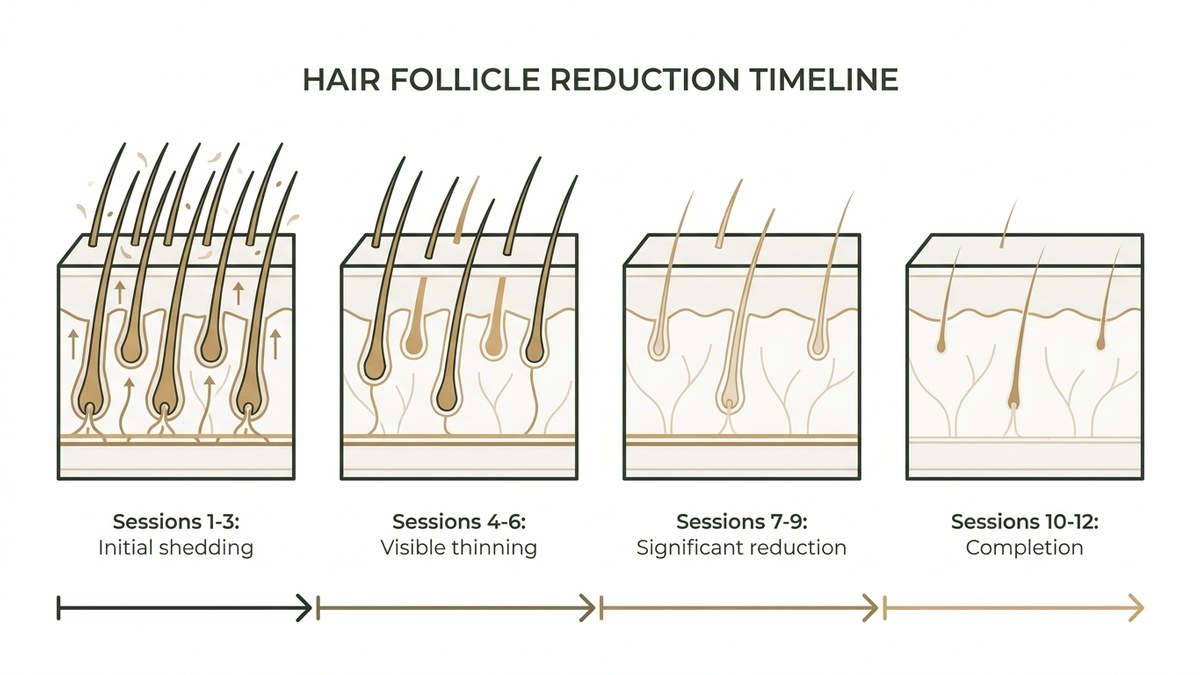
Hormone-sensitive areas like the face, bikini line, and underarms may require the full twelve sessions. Areas with less hormonal influence (legs, arms, back) often reach significant reduction earlier.
Can You Speed Up the Timeline (Or Space Sessions Further Apart)?
Patients ask whether they can schedule sessions every two weeks to finish faster. The answer is no. Scheduling more frequently does not accelerate results. It wastes sessions treating the same anagen follicles while the telogen follicles remain dormant.
Patients also ask whether they can wait eight weeks instead of six between sessions. Technically yes, but you risk losing momentum. Follicles that were on the verge of entering anagen at the six-week mark may complete a partial growth cycle and shed before your next session. Research published in the NIH database shows spacing sessions within the 4–6 week interval maximizes follicle capture during the anagen phase .
If life disrupts your schedule and you need to push a session back by a week or two, it will not derail the series. You will simply add that time to the total duration. One or two delayed sessions across a treatment series is not a problem. Consistently spacing appointments eight to ten weeks apart, however, can extend the timeline significantly.
Does Technology Change the Session Count? Medical-Grade Laser vs. IPL vs. At-Home Devices
Technology determines efficacy. Medical-grade dual-wavelength laser, IPL, and at-home devices are not interchangeable. The session count quoted by a clinic is meaningless unless you know what device they're using.
Medical-grade dual-wavelength laser (Cynosure Elite™). Eight to twelve sessions deliver the published clinical standard for long-term reduction. Safe for all skin tones because the 1064nm Nd:YAG wavelength is clinically validated for darker skin. The 755nm Alexandrite wavelength is optimized for lighter skin and finer hair. Research published in PubMed confirms medical-grade lasers deliver superior permanent reduction compared to IPL devices .
IPL devices (clinic or at-home). Broad-spectrum light, not true laser. Less precise. Lower efficacy. Not safe for dark skin because the broad spectrum increases burn risk. IPL emits light across a range of wavelengths, and only a portion of that spectrum is absorbed by melanin.
At-home "laser" devices. Weak energy output, safety-capped for consumer use. Cleveland Clinic reports at-home devices require significantly more sessions with less durable results. Many are actually IPL devices marketed with the word "laser" to sound more effective.
If you have already tried IPL or an at-home device and saw minimal results, that does not mean laser hair removal does not work. It means you used a less effective technology.
What Happens After Your Final Session: Maintenance and Long-Term Expectations
After completing the series, most patients experience lasting reduction. Some never need another session. Others schedule maintenance once every 12 to 18 months to handle sparse regrowth. Hormonal changes during pregnancy, menopause, or new medications can trigger dormant follicles. Maintenance handles this without restarting the full series.
In our experience with thousands of patients over 20+ years, those who complete the full series report years of smooth, hair-free skin with minimal to no regrowth in treated areas. Maintenance is not a sign of treatment failure. It is a normal part of long-term care for patients with hormonal influences on hair growth. Sofwave Skin Tightening in Edina, MN represents another advanced medical-grade treatment option for patients seeking comprehensive aesthetic results.
How to Choose a Clinic That Won't Waste Your Sessions
Not all clinics deliver the same results in the same number of sessions. Four factors separate effective treatment from wasted time and money.
Medical-grade dual-wavelength laser. Confirm the clinic uses a true laser, not IPL. Ask for the specific model and wavelengths. The Cynosure Elite™ dual-wavelength system delivers both 755nm Alexandrite and 1064nm Nd:YAG, ensuring safe, effective treatment for every skin tone.
Consistent technician. The same person should perform your consultation and every treatment session. Staff rotation introduces variability in technique, settings, and follow-up. When your technician sees you regularly, they can track your progress, adjust settings as your hair thins, and catch potential issues early.
Honest session count. Clinics that promise six sessions for everyone are either using weak technology or setting unrealistic expectations. A clinic that quotes the 8–12 session range based on your hair type, skin tone, and treatment area is being transparent.
Free consultation with no pressure. You should leave the consultation with a clear understanding of the technology, the timeline, and the expected outcome.
Sedona Laser Center has performed laser hair removal procedures for over 20 years using the Cynosure Elite™ dual-wavelength system.
How Skin Tone and Hair Color Affect Your Timeline
Two additional factors influence where you fall in the session range: skin tone and hair color. Both are related to melanin, the pigment that gives hair and skin their color.
Skin tone. Darker skin requires the longer 1064nm Nd:YAG wavelength, which penetrates deeper without being absorbed by melanin in the epidermis. This wavelength is slightly less efficient at disabling follicles per session compared to the 755nm Alexandrite used on lighter skin, which means patients with darker skin tones often need the upper end of the session range to achieve similar levels of reduction.
Hair color. Dark hair responds best because it contains the most melanin. Brown and black hair typically require 8–10 sessions. Light brown and dark blonde hair may need 10–12 sessions because there is less pigment to target. Red, blonde, and gray hair contain minimal melanin and respond poorly to all standard laser wavelengths.
A patient with jet-black hair on pale skin represents the ideal scenario: maximum contrast between hair and skin, allowing the technician to use higher energy settings safely. A patient with light brown hair on olive skin has less contrast, requiring more conservative settings and more sessions.
What Questions to Ask During Your Consultation
Your consultation should answer every question that affects your decision. Here are the critical ones:
If the clinic cannot or will not answer these questions clearly, find a different provider.
Conclusion: The Timeline Is Not Negotiable, But the Results Are Worth It
Eight to twelve sessions spaced 4–6 weeks apart is the clinical standard for permanent reduction, as documented in dermatology research . The range exists because of hair growth cycles, not marketing. Some patients fall at the lower end. Others require the full twelve sessions. Hormonal factors, body area, hair density, and technology all influence the final count.
The question is not whether you need eight or twelve sessions. The question is whether you want to spend the next decade shaving and waxing, or invest several months in a series that delivers lasting reduction.
Ready to start your series with a team that has performed laser hair removal for over 20 years? Sedona Laser Center uses the Cynosure Elite™ dual-wavelength system, safe for every skin tone and proven for permanent reduction. Your free consultation includes an honest assessment of how many sessions your goals will require, with no pressure and no commitment. Sofwave Skin Tightening in the Twin Cities: Why Sedona Is Your Only Local Clinical Option explains how our commitment to medical-grade technology extends across all our treatment offerings.
Call us at (952) 929-4404 to schedule your free consultation, or visit our laser hair removal page to learn more about the Cynosure Elite™ system and what makes Sedona different. Book your appointment online to take the first step toward permanent reduction and freedom from the constant cycle of shaving and waxing.
Book Your Free Consultation