

Laser hair removal is permanent hair reduction, not permanent removal. After a full series of 8 to 12 sessions, most Sedona patients reach 80 to 90 percent reduction in our own results, and the hairs that return are often finer and lighter. Some follicles stay dormant and wake later, so an occasional maintenance session is normal.
You have probably heard the word "permanent" attached to hair removal before. Maybe it came with a home device, a package deal or a waxing upsell. Maybe it held for a few weeks and then the stubble came back. If you are done with the shave, wax and thread cycle but wary of another promise that fades, the question is a fair one: is laser hair removal permanent, or is it one more claim that does not hold?
We take it seriously because we have spent 17+ years answering it. In our work with clients, and across more than 150,000 procedures at Sedona, the pattern is consistent: treatment works, and it works best when expectations are accurate. This guide covers what permanent hair reduction means, why some hair returns, how many sessions you need, what maintenance looks like and how to spot a clinic that overpromises. If you want to see the technology behind these answers, start with laser hair removal at our Edina clinic.
Is laser hair removal permanent?
Laser hair removal delivers permanent hair reduction. The FDA defines it as a long-term, stable decrease in the number of hairs regrowing after a treatment series. It does not mean every hair is gone forever, which is why honest clinics avoid the word "removal."
That wording gap trips up a lot of people. If you search for a "permanent hair removal laser," you are picturing a device that ends hair growth for good. No device does that. So is laser hair removal permanent? For most people the reduction lasts, but the honest answer is "permanent reduction," not "permanent removal." What a well-run series does is disable a large share of your follicles so they stop producing hair.
At Sedona, patients who complete a full series typically see a large drop in how much hair grows. That describes how much less hair grows. It is not a promise that you will never see another hair.
What happens to the rest? Some follicles remain dormant. They may wake months later, and when they do, they often produce finer, lighter hair. Others never return. Most patients see significant long-term reduction, and some choose an occasional maintenance session to tidy up stray regrowth.
Our certified technicians have performed over 150,000 procedures at Sedona, and the pattern holds across that experience. Results are real. They last for most people. They are not identical for everyone, because hair type, treatment area and hormones all play a part.
The device matters too. Not every product sold for hair removal is a true laser. IPL (intense pulsed light) uses broad-spectrum light, which makes it less precise and less effective, and it carries more burn risk on darker skin, as Wikipedia's overview of laser hair removal explains. We come back to that gap later in this guide.
If you are weighing laser against what you do now, read how laser compares with waxing, shaving and threading. The short version: razors and wax manage the hair you have, while laser reduces how much grows back.
Takeaway: Is laser hair removal permanent? Permanent hair reduction is a real and lasting outcome, but "gone forever for everyone" is a claim no honest clinic makes.
Why does some hair grow back?
Laser only disables a follicle that is in its active growth phase. Follicles cycle at different times, so a few dormant ones can wake up later. Hormones can also stimulate new growth. Regrowth is usually sparser and finer than before.
If it works, why isn't one session enough?
Because on any given day, only part of the hair on your body is ready to be treated. Every follicle moves through three phases:
- Anagen (active growth): The follicle produces a hair shaft. Melanin is abundant and the follicle is metabolically active. This is the only phase where laser energy can permanently disable the follicle.
- Catagen (transition): Growth stops and the follicle begins to shrink. Laser energy has little to work with here.
- Telogen (rest): The follicle sits dormant, and the old hair eventually sheds. A new hair will start later.
Dermatology research supports the point that follicles must be in anagen for laser energy to produce permanent reduction. A single session catches the follicles that happen to be in that phase and misses the rest. Different areas of the body cycle at different speeds, so no single timetable fits every part of you.
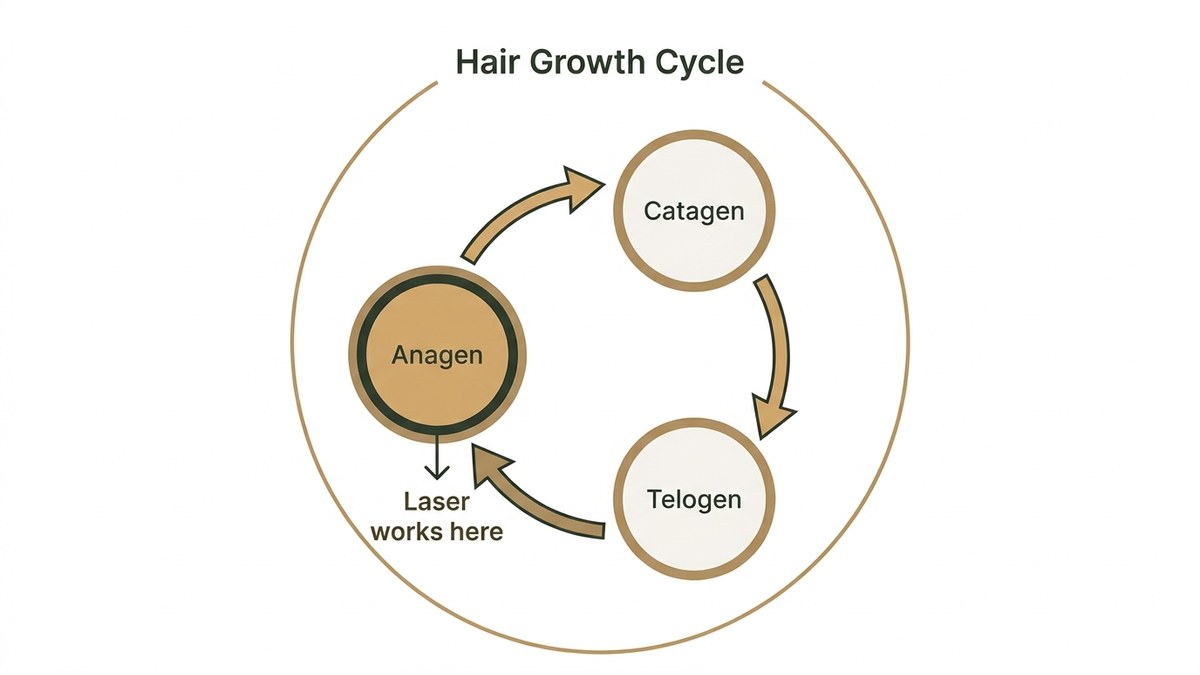
That is why a series, not a single visit, is the standard. Repeated sessions catch follicles as they enter the growth phase. For a deeper look, see how anagen, catagen and telogen phases work.
What causes regrowth after a full series?
Three things account for most of it.
Dormant follicles wake up. A follicle that sat in telogen during your whole series was never exposed to the laser in a way that mattered. When it re-enters growth later, a hair appears. So is laser hair removal permanent if follicles can wake up? For the follicles the laser disabled, yes. For the dormant ones, not necessarily, and this is the main reason an occasional maintenance session is normal.
Hormones stimulate new growth. Hormonal shifts, including conditions such as PCOS, can activate follicles that were quiet. This can happen in areas you have already treated.
The device does not suit the skin or hair. Published consensus guidelines on laser treatment in skin of color make the point that device choice and settings must be matched to skin type. A mismatch can mean weaker results or an unsafe treatment, and either one leaves you with more hair than you expected.
When hair does return, it is usually sparser, finer and lighter than before. Many patients describe it as fuzz rather than the coarse hair they started with. That is a very different problem from the one that sent you looking for laser in the first place.
Takeaway: Regrowth comes from dormant follicles, hormones and device mismatch, and it is usually finer and sparser than the original hair.
Laser hair removal long-term results: how many sessions?
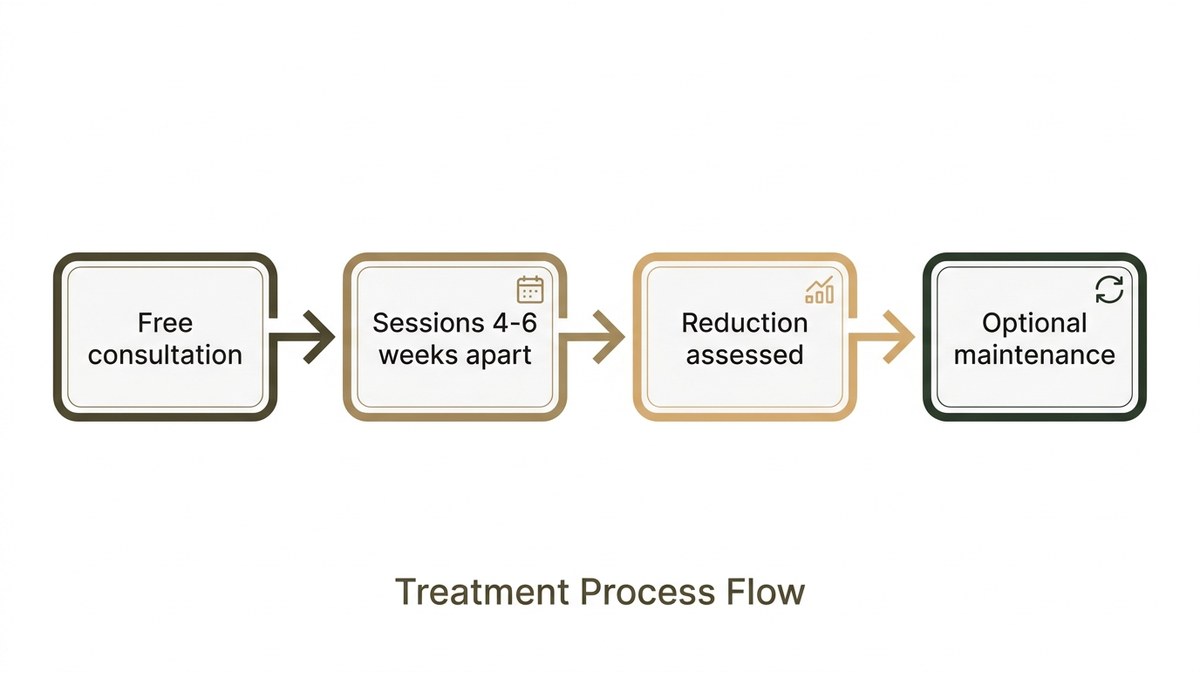
Most patients complete 8 to 12 sessions spaced 4 to 6 weeks apart. That spacing matches follicle growth cycles. Sessions placed too close together waste energy, and sessions spread too far apart let follicles slip past the laser.
The spacing is not arbitrary. Follicles move into the growth phase at predictable intervals, and those intervals depend on the body area. If we treat too soon, not enough new follicles have entered growth, and the session gains little. If we wait too long, some follicles complete their cycle and drop back into rest before we catch them. The 4 to 6 week window balances both risks for most people.
The count matters as much as the spacing. Be careful with any clinic that promises the same number of sessions to everyone. A fixed number such as six may assume fine hair on a slow-cycling area. If you have coarse hair, or you are treating an area that cycles quickly, a flat count may not be enough. Ask what technology the clinic uses and what the number assumes. A real answer depends on you.
For a closer look at the plan, a closer look at the full session timeline walks through the stages of a standard series.
Here is what the experience usually looks like:
- Early sessions. You may notice that hair grows more slowly, and some hairs shed in the weeks after treatment.
- Middle sessions. Growth thins out in patches. The hairs that return look finer.
- Late sessions. Most areas are sparse. The last sessions catch the follicles that cycled in late.
- After the series. You assess what remains and decide whether any touch-up makes sense.
A series stretches over many months, so plan for that before you start. Skipping sessions or stretching the gaps is the fastest way to lose the benefit of the work you have already done. Mild redness and swelling are normal after each session, and they resolve on their own.
Takeaway: The 8 to 12 session protocol with 4 to 6 week spacing exists to catch follicles in their growth phase, and a flat promise for everyone ignores that.
How many maintenance sessions will I need?
Many patients need none, and some choose an occasional session for stray regrowth. Hormonal conditions such as PCOS may call for more. A consultation, not a fixed number, should set your expectation, because hair type, area and hormones all play a part.
We will be direct about this. We do not publish a maintenance schedule, because no single schedule is true for everyone. Anyone who tells you "one touch-up a year" or "never again" is guessing, or selling. Is laser hair removal permanent enough that you never need a touch-up? For some people, yes. For others, no. The honest answer is that laser maintenance sessions needed after a series vary from person to person.
Here is how to think about it.
After a full series, you assess. Once you finish the 8 to 12 session protocol, give yourself time to see what grows back. Stray hairs from dormant follicles are the most common reason for a touch-up. Some patients see nothing worth treating. Others choose a short session on one area.
Hormones change the picture. Patients with hormonal conditions such as PCOS may need additional maintenance sessions beyond the initial series, though the baseline protocol of 8 to 12 treatments still applies to most people. If hormones drive your hair growth, plan for the possibility of extra sessions from the start. How laser works on PCOS and hormone-driven hair explains what to expect.
Hair type and area matter. Coarse, dense hair in a fast-cycling area is more likely to produce stray regrowth than fine hair elsewhere. A technician who has treated you before can tell you which of your areas are likely to need attention.
That last point is why we keep the same technician with you throughout the series. Someone who knows your hair can tell the difference between normal fading and a follicle that needs another pass.
What does maintenance cost over time?
We are not quoting a maintenance price in this guide. A single-area touch-up is a small fraction of a full series, and the real comparison is against what you spend on razors, wax and threading for years. Treat laser hair removal cost as an investment in fewer recurring expenses rather than as a one-time bill. For the full picture, what a full series costs over the long term breaks down price per session against long-term value.
When you book a consultation, ask directly what a touch-up would involve for your hair and your areas. A clinic that cannot answer is not a clinic that has thought about your long-term results.
Takeaway: Maintenance is individual, often small and sometimes unnecessary, and your consultation should set expectations for your hair rather than quote a number that fits no one.
Do skin tone and hormones change long-term results?
Yes. Hair thickness, color, treatment area and hormones all shape results. Skin tone mainly shapes safety: darker skin needs the 1064nm Nd:YAG wavelength to avoid burns and pigment changes. A dual-wavelength system treats the full range of skin tones.
Hair color and thickness
Laser energy is absorbed by melanin, the pigment in hair. Dark, coarse hair absorbs more and responds best. Fine hair responds, but may take a little longer to thin out. Light, gray and white hair contain little melanin, so they absorb little energy and respond least. This is a limit of the technology, not of any one clinic, and a trustworthy consultation will tell you if your hair falls in that group.
The treatment area matters as well. Areas cycle at different speeds and carry different hair densities, so two areas on the same person can reach different results.
Hormones and PCOS
Hormones can wake follicles that were quiet. Pregnancy, menopause and conditions such as PCOS can all stimulate new growth, even in areas that responded well. If hormones drive your hair, results are still worth pursuing, but plan for the possibility of added sessions. Tell us about it at your consultation so we can set expectations for your case.
Skin tone and safety
If you have been told laser is not safe for your skin, you were likely told that by a clinic using the wrong device. Is laser hair removal permanent on darker skin too? Reduction is achievable when the wavelength matches the skin, so the issue is safety, not eligibility.
Here is how the two wavelengths divide the work:
- 755nm Alexandrite suits lighter skin and finer hair.
- 1064nm Nd:YAG suits darker skin tones and coarser hair.
A recent review of hair removal in darker skin types argues that long-pulsed Nd:YAG (1064 nm) lasers are the preferred modality for darker skin, because they target follicles deeper with minimal interaction with the melanin in the surface of the skin. That lowers the risk of burns and pigment changes.
Our Cynosure Elite™ is a dual-wavelength laser (755nm Alexandrite + 1064nm Nd:YAG), so we can match the wavelength to you rather than fit you to a single device. This precision costs more than a broad-spectrum IPL device, and it delivers safer, more effective treatment across all Fitzpatrick skin types. Clinics running a single wavelength or IPL can charge less, but darker-skinned patients carry the risk.
To learn more, read why 1064nm Nd:YAG is the safe choice for darker skin and which wavelength suits your skin tone. Everyone is welcome here, whatever your skin tone, gender or background.
Takeaway: Hair type and hormones shape how much reduction you get, while skin tone shapes which wavelength keeps you safe.
Why do at-home devices and IPL fade?
At-home devices and IPL fade because they use weaker, less precise energy than a medical-grade laser. IPL emits broad-spectrum light, and only part of that spectrum is absorbed by melanin. The energy that reaches the follicle is often too low to disable it for long.
This is the cause behind most "it never worked for me" stories. Is laser hair removal permanent when you do it with a home device? Not in the way a medical-grade series is. Here is the difference.
IPL devices (clinic or at-home). IPL is broad-spectrum light, not a true laser. It is less precise and less effective. It also raises burn risk for darker skin, because the broad spectrum is not matched to the follicle.
At-home "laser" devices. These are safety-capped for consumer use, so their energy output is low. Many are actually IPL devices marketed as lasers. They often require significantly more sessions and deliver less durable results.

Wavelength precision is what makes the difference. A medical-grade laser delivers energy at wavelengths chosen for the follicle, so it reaches the target while the follicle is in its growth phase. For a full breakdown, see why wavelength precision separates laser from IPL.
None of this means you failed. If you tried a home device and the hair returned, the device was the limit. If an at-home device already let you down, the next step is a professional assessment of your hair and skin, with no pressure to commit.
Our stance is simple. We argue against the "guaranteed forever" claim, and we argue against the cynicism that grows from products that were never built to deliver. Both miss the truth: real reduction is possible with the right device.
Takeaway: Home devices and IPL fade because their light is broad and weak, which is a limit of the equipment and not of your hair.
How can I spot an overpromised claim?
Be wary of a fixed session count for everyone, "guaranteed forever" language, "FDA approved" wording, or no named device. Ask for the exact device, which wavelengths it uses, who performs treatment, and what maintenance realistically looks like.
Use this checklist before you book anywhere, including with us.
Red flags
- "Permanent removal, guaranteed." Ask any clinic "is laser hair removal permanent?" and listen to the answer. Honest clinics say permanent hair reduction and promise no outcome beyond what their protocol delivers.
- One session count for everyone. A flat number ignores hair type, area and hormones.
- No named device. If a clinic will not tell you the exact model, ask why.
- "FDA approved" for the laser. The phrase sounds stronger than it is.
- No talk of maintenance. If a clinic says you will never need another session, it is selling certainty it does not have.
Clearance versus approval
Clearance means a device met federal requirements for a stated use. It does not guarantee a safe treatment. Most laser devices reach the market through a clearance pathway that compares them to devices already on the market. Approval is a separate, tougher process reserved for higher-risk products.
Clearance also covers the device, not the person using it. A cleared laser in untrained hands, at the wrong setting or on the wrong skin tone can still burn. Provider training, settings and skin-tone matching decide safety.
Questions to ask any clinic
- What is the exact device name?
- Which wavelengths does it use, and how do you match them to my skin tone?
- Who performs my treatment, and will it be the same person each visit?
- What does the session count assume about my hair and area?
- What does maintenance look like if hair returns?
Our consultation answers these directly. It is free and without pressure. We look at your hair, your skin and your goals, name the device and wavelengths we would use, and explain what a realistic series looks like for you. You will also meet the team that treats you, and the same technician stays with you throughout the series.
If you want to see what we offer, explore Laser & Skin Treatments in Edina, MN, which covers our laser hair removal and skin tightening services.
Takeaway: A trustworthy clinic names its device, explains its wavelengths, adapts the session count to you and never promises "forever."
What realistic expectations look like
So, is laser hair removal permanent? Laser hair removal produces permanent hair reduction. After a full series, most Sedona patients see a substantial and lasting drop in hair growth. The hair that returns is often finer and lighter. Some follicles stay dormant and wake later, hormones can stir new growth, and an occasional maintenance session is a normal part of the picture for some people.
What decides your result is a short list: the device, the wavelength match, your hair, your hormones and the spacing of your sessions. What does not decide it is a bigger promise.
We built our practice on saying exactly what treatment can and cannot do. If that is the kind of answer you were looking for, the next step is a free, no-pressure consultation. We will look at your hair and skin, name the technology, and give you an honest sense of what to expect.