
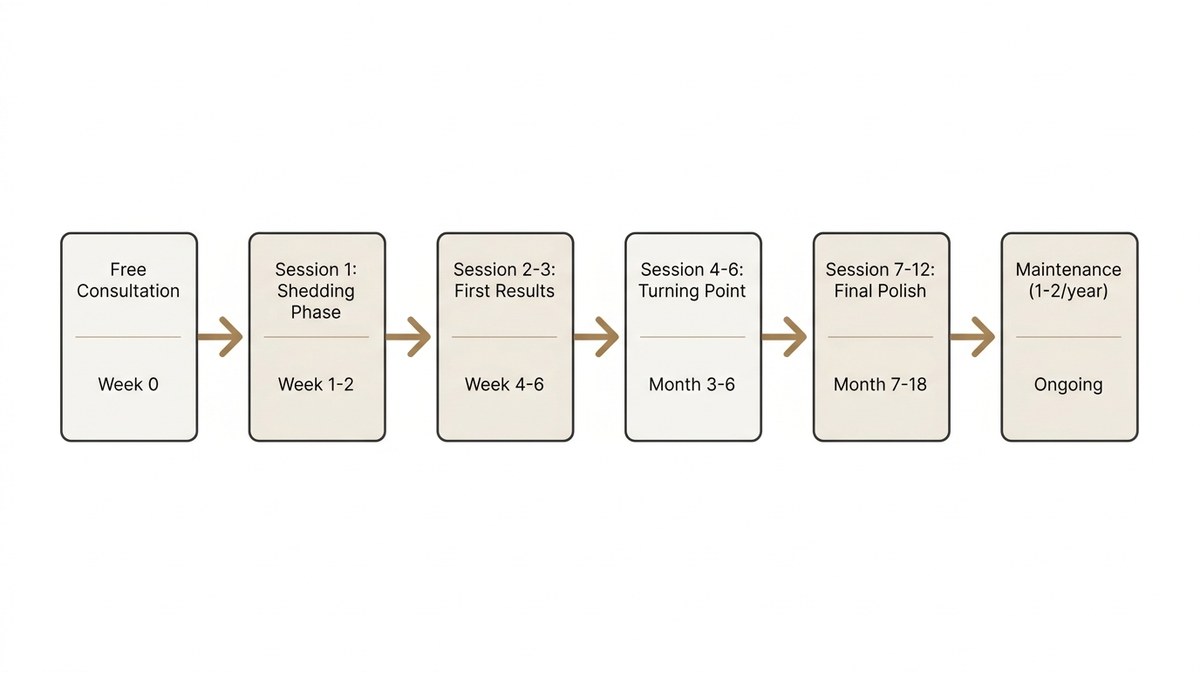
Laser hair removal results build gradually across 8–12 sessions spaced 4–6 weeks apart. After session 1, you'll see apparent regrowth within days (this is shedding, not new growth). By session 2–3, you'll shave noticeably less often. By sessions 4–6, growth becomes patchy and finer. After a full series, expect permanent reduction with occasional maintenance for residual regrowth.
If you're paying $90 per session, you deserve to know exactly when you'll see results. Not vague marketing claims about "permanent removal," but the clinical reality: what happens after session 1, session 2, session 3, and every treatment after that. Most laser clinics say "multiple sessions required" and stop there. This guide walks through the actual session-by-session progression, backed by 20+ years of clinical experience at Sedona Laser Center. Here's how to prepare for your first professional laser hair removal session and what to expect as your results build.
The difference between laser hair removal and daily shaving or monthly waxing is significant. Laser provides long-term hair reduction with no downtime, while shaving causes razor burn and ingrown hairs. Understanding the laser hair removal results timeline before your first appointment means you can plan realistically and avoid frustration from unrealistic expectations.
The Foundation: Why Laser Takes Multiple Sessions (Hair Growth Cycles 101)
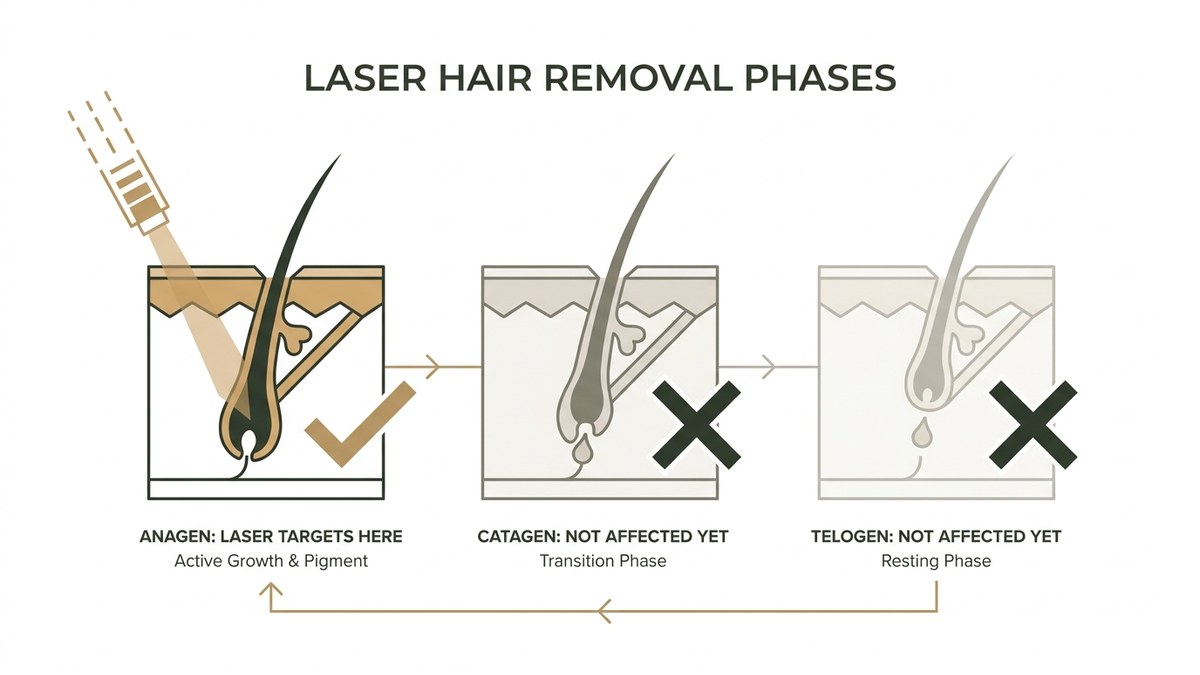
Hair grows in three distinct phases: anagen (active growth), catagen (transition), and telogen (resting). Laser energy only affects hairs in the anagen phase, when the follicle is actively producing pigmented hair. According to clinical research published in the Journal of Clinical and Aesthetic Dermatology, only approximately 20–30% of your body hair is in anagen at any given time. The rest is dormant or about to shed naturally.
This biological limitation defines why a single session cannot treat every follicle. Each session targets the active hairs at that moment. Four to six weeks later, a new cohort of follicles enters anagen, and the next session treats those. Over 8–12 sessions, you gradually catch every follicle across multiple growth cycles.
The anagen phase varies by body region. Facial hair cycles every 4–6 weeks, while leg hair cycles every 6–8 weeks. Chest and back hair in men can have cycles lasting 12–16 weeks. This variation explains why different treatment areas progress at different rates. Your clinician will adjust session spacing based on the specific zones being treated.
For a deeper explanation of how these cycles affect your treatment plan, see hair growth cycles explained: why you need multiple sessions to catch every follicle. The key takeaway: the laser hair removal session progression timeline is biological, not arbitrary.
Session 1: First Zap, Immediate Shedding, and the "Wait, It's Growing Back?" Phase
Your first session takes anywhere from 15 minutes (upper lip) to 60 minutes (full legs), depending on the treatment area. At Sedona, we use the Cynosure Elite dual-wavelength laser (755nm Alexandrite + 1064nm Nd:YAG) with integrated Zimmer Cryo 5 cooling to minimize discomfort. You'll feel a snapping sensation as each pulse treats the follicle, but there's no downtime. Most patients return to work or the gym immediately.
Within 7–10 days after session 1, you'll notice something confusing: the treated hairs appear to grow back. This is not new growth. It's the treated follicles shedding. According to Mayo Clinic guidance on laser hair removal mechanisms, laser energy damages the hair shaft and follicle, but the dead hair remains in the skin temporarily. Over the next two weeks, these damaged hairs push to the surface and fall out. By week 3, you'll see smooth skin in the treated area.
The damaged hair shaft may swell slightly as it's pushed out of the follicle, creating the appearance of thicker regrowth. You can gently exfoliate to speed shedding, but avoid picking or plucking. Let the follicles expel the damaged hairs naturally.
But here's the reality check: other follicles that were in resting phase during session 1 will begin their growth cycle soon after. By week 4, you'll see new hairs emerging. This is expected. These are the untreated follicles that were dormant when the laser passed over them. This "wait, is it working?" confusion is universal in the hair reduction per session timeline and exactly what we expect clinically.
Visible hair reduction after session 1: minimal to none. The treated hairs shed, but the overall density hasn't changed yet because most follicles were never targeted. Session 1 establishes the treatment parameters (energy settings, cooling intervals, pulse duration) that your clinician will refine as your skin responds and hair density changes.
Session 2 (4–6 Weeks Later): The First Confident Results
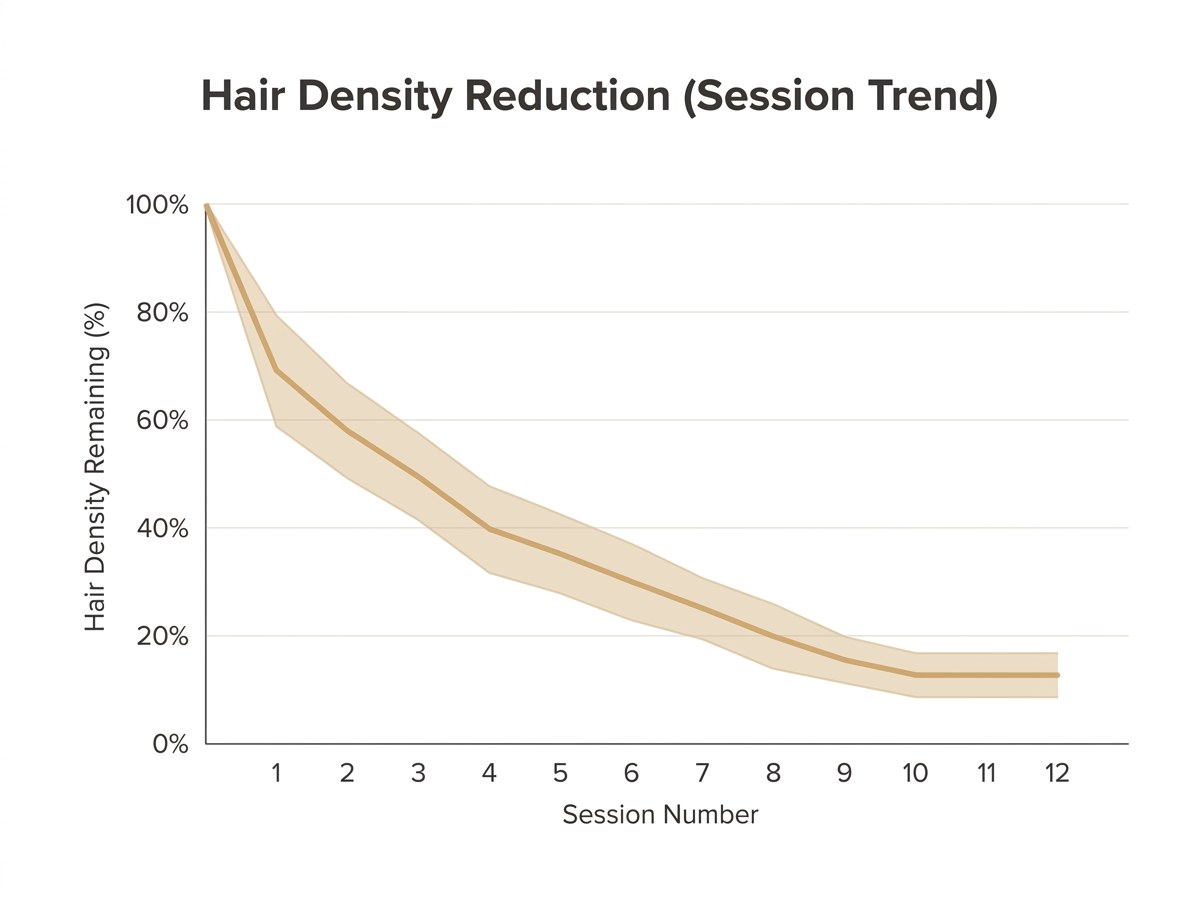
Session 2 is the morale-booster in the laser hair removal session progression. By this point, you've treated a second cohort of follicles that entered anagen since your first appointment. Most patients report shaving every 5–7 days instead of daily by session 2. The hair that does grow back is noticeably finer and slower.
This is the first tangible proof that the process works. The cumulative reduction is building. When to see laser hair removal results becomes a concrete answer here: by session 2, most patients notice reduced shaving frequency and finer regrowth texture.
At this stage, your clinician will adjust energy settings based on your skin's response from session 1. If you experienced no redness or sensitivity, energy levels may increase slightly to maximize follicle damage. If you had prolonged redness or discomfort, settings will be adjusted to improve tolerance while maintaining effectiveness.
At Sedona, we track patient progress session by session. Laser hair removal in Edina, Minnesota means 20+ years of local clinical expertise with the same licensed team. We adjust energy settings based on your skin's response, hair density changes, and any areas of patchy regrowth. This is medical-grade precision, not a one-size-fits-all protocol.
Sessions 3–4: The Turning Point (Patchy Growth and Thinner Regrowth)
Sessions 3 and 4 mark the visible turning point in the laser hair removal results timeline. Growth becomes patchy. Some areas stay smooth for two or three weeks, while others sprout fine, wispy hairs. This unevenness is normal and expected. Different follicles cycle into anagen at different times, so you're seeing the gaps where earlier sessions worked and the spots where dormant follicles are now active.
Shaving frequency drops further. Many people go a week or more between touch-ups by session 3. The density of regrowth is noticeably thinner. You'll see bald patches where entire clusters of follicles were successfully treated in earlier sessions, interspersed with areas where stragglers are still cycling through.
Coarser hair areas (men's backs, bikini zones, underarms) may lag slightly behind finer-hair zones (arms, lower legs), but the trajectory is the same. Each session catches more follicles. Coarse, dark hair actually responds well to laser because the high melanin concentration absorbs more energy. The lag is due to higher initial follicle density in these zones, not reduced effectiveness.
This is where trust in the protocol pays off. If you stop at session 3 because you're impatient, you'll leave a significant portion of follicles untreated. The reduction you've achieved so far won't reverse (treated follicles are permanently damaged), but the untreated follicles will continue their normal growth cycle.
For patients with darker skin or coarse hair, this phase is critical. The 1064nm Nd:YAG wavelength in the Cynosure Elite system safely penetrates deeper into melanin-rich skin without surface burns. We've written extensively on laser hair removal for dark skin: why 1064nm Nd:YAG is the safe, effective choice. Single-wavelength systems often turn darker-skinned patients away or deliver poor results. Dual-wavelength technology handles all Fitzpatrick types safely.
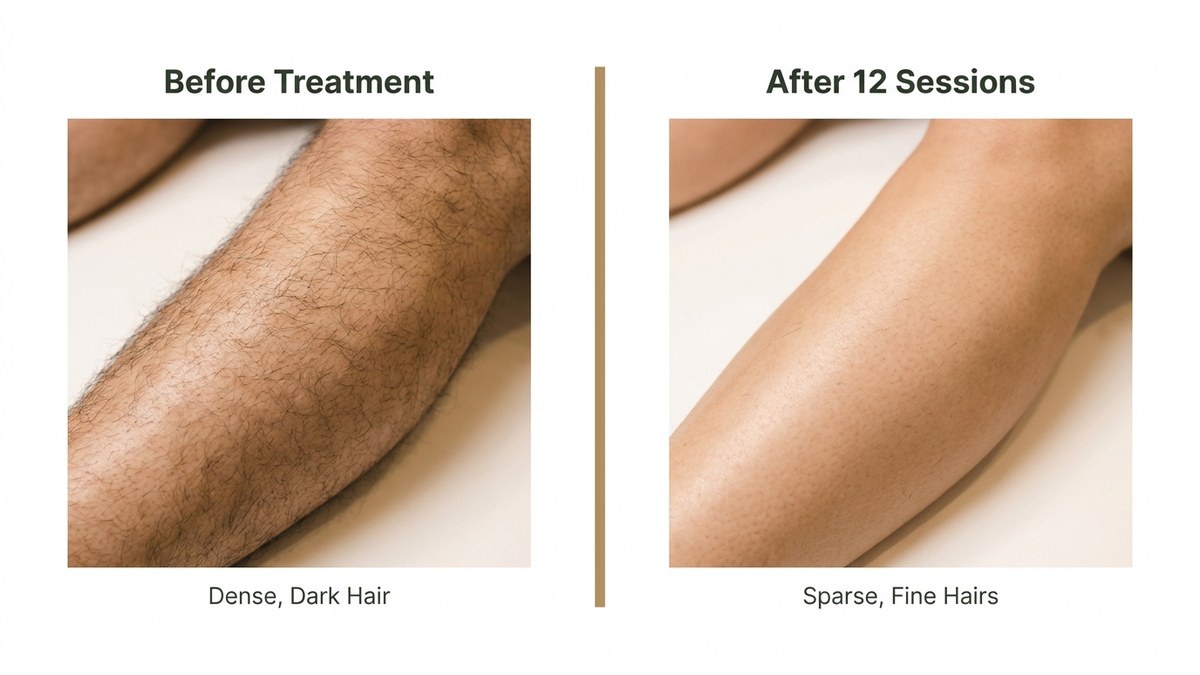
By session 4, you'll also notice a change in hair texture. The remaining hairs are not only sparser but also finer in diameter. This is because laser energy weakens follicles even when it doesn't fully destroy them. Weakened follicles produce thinner, lighter hair. Over subsequent sessions, these weakened follicles are more easily destroyed as they cycle back into anagen.
Sessions 5–8: Diminishing Returns and the Plateau Phase
By sessions 5–8, most patients see significant reduction. The dramatic "wow" moments taper off. The remaining hairs are typically finer, lighter, or concentrated in stubborn zones: chin and jawline for women, shoulders and upper back for men. These areas have higher androgen sensitivity, meaning hormonal factors can trigger persistent regrowth even after effective follicle damage.
Sessions continue to catch stragglers. Each treatment targets the small percentage of follicles still cycling into anagen. The visible impact per session is smaller now because you're chasing the last remaining follicles rather than the initial bulk. The protocol is working. You're just hitting the hardest-to-reach follicles.
This phase tests patience. The dramatic reduction you saw between sessions 1–4 slows. You might go two sessions without noticing much additional change. This is when some patients question whether to continue. The answer depends on your goals. If you're satisfied with your current reduction level and occasional regrowth, you can stop. If you want higher reduction and minimal maintenance, continue through session 8 or beyond.
Hormonal zones require particular attention during this phase. For women, chin and upper lip hair is often driven by androgens. For men, chest and back hair responds similarly. Hormonally driven hair is more persistent and may require higher total session counts or ongoing maintenance.
During sessions 5–8, your clinician may increase energy settings further, now that cumulative exposure has reduced overall hair density and lowered the risk of excessive heat buildup. Higher energy means more complete follicle destruction, particularly for the stubborn follicles that survived earlier treatments at lower settings.
Some patients stop at session 8 if they're satisfied with the reduction level. Others continue to 10 or 12 to pursue higher clearance rates. The decision depends on your goals, hair characteristics, and tolerance for occasional regrowth. At Sedona, we map a personalized plan during your consultation and adjust as you progress. Our full laser and skin treatments in Edina, MN include flexible series packages so you're not locked into a rigid session count.
Sessions 9–12: Final Polish and Maintenance Planning
Sessions 9–12 are the final polish for patients chasing higher reduction rates or treating persistent zones. If your goal was smooth bikini and underarm areas year-round, you'll likely hit that target by session 10. Full legs or back may require the full 12-session series depending on hair density and hormonal factors.
At this stage, you're targeting the most resistant follicles. These are often the deepest, the finest, or the most hormonally influenced. Each session yields smaller visible gains, but the cumulative effect pushes you toward higher overall reduction. For many patients, this final phase makes the difference between "pretty good" and "completely satisfied."
After a complete series, treated follicles are destroyed and will not regrow. This is permanent. However, not every follicle can be treated due to dormancy timing, hormonal shifts, or individual biology. According to the American Society of Plastic Surgeons' guide to laser hair removal, this phased process includes ongoing management for hormonal zones. One to two maintenance sessions per year keep results stable long-term.
Maintenance sessions are normal and expected. Hormonal areas (chin, upper lip, bikini line) may see occasional regrowth, especially during hormonal shifts like pregnancy, menopause, or thyroid changes. One to two maintenance sessions per year address any new follicles that activate due to these hormonal fluctuations.
For patients with polycystic ovary syndrome (PCOS) or other hormonal imbalances, maintenance may be more frequent. The laser still permanently destroys treated follicles, but elevated androgen levels can activate new follicles over time. This isn't treatment failure. It's the body responding to underlying hormonal signals. Managing the hormonal condition in parallel with laser treatment produces the best long-term outcomes.
What Affects Your Personal Timeline? (Skin Tone, Hair Color, Treatment Area)
Your personal laser hair removal results timeline depends on five variables: skin tone, hair color, hair thickness, treatment area, and hormonal factors. Understanding how each variable influences your results helps set realistic expectations before session 1.
Skin tone: Darker skin requires the 1064nm Nd:YAG wavelength to avoid surface burns. Standard 755nm Alexandrite lasers used by most clinics target melanin aggressively, which works well for light skin but risks hyperpigmentation or burns on darker skin tones (Fitzpatrick types IV–VI). The Cynosure Elite dual-wavelength system treats all Fitzpatrick types safely by switching to Nd:YAG for darker patients. Single-wavelength clinics often turn Fitzpatrick IV–VI patients away or use settings too low to be effective, which extends the timeline or produces poor results.
Hair color: Dark, coarse hair responds best because laser targets pigment (melanin). Black and dark-brown hair absorbs maximum energy, leading to efficient follicle destruction. Blonde, red, and gray hair contains minimal melanin, making laser less effective. Fine, light-brown hair may require more sessions (12–15 instead of 8–10) than thick, black hair to achieve the same reduction level.
Hair thickness: Coarse hair (bikini, underarm, men's facial hair) contains more melanin and responds strongly to laser. Fine hair (arms, lower legs) may require more sessions because thinner hair shafts absorb less total energy per pulse. However, coarse hair areas often have higher follicle density, which extends the timeline even though individual follicles respond well.
Hormonal factors: Polycystic ovary syndrome (PCOS), thyroid imbalances, and pregnancy can trigger regrowth mid-series or after completion. According to research published in Dermatologic Surgery, laser will still reduce the treated follicles permanently, but new follicles may activate if androgen levels remain elevated. This doesn't mean the treatment failed. It means maintenance sessions are part of your long-term plan. Women with PCOS should expect ongoing maintenance every 6–12 months.
Treatment area: Facial hair (chin, upper lip) cycles quickly (4–6 weeks) so you'll complete sessions faster, but may require more maintenance due to hormonal sensitivity. Legs clear efficiently because follicles are less hormonally driven and hair cycles are predictable. Back and chest (for men) require longer series due to higher follicle density and slower growth cycles. Bikini and Brazilian zones respond well but need careful energy management to avoid irritation on sensitive skin.
For a detailed comparison of how different technologies handle these variables, see laser hair removal vs. IPL: medical-grade precision and why wavelength matters.
Timeline Red Flags: When to Adjust Your Expectations or Switch Providers
Not all laser providers are equal. Here are the red flags that signal a problem with your provider, not the technology:
Zero visible change after 3 sessions. By session 3, you should see measurable reduction in shaving frequency and hair density. If nothing has changed, the provider is likely using settings too low to be effective, or the equipment is outdated. Reputable clinics track progress session by session and adjust protocols if expected results aren't materializing.
Burns, discoloration, or scarring on darker skin. This signals the wrong wavelength or excessive energy settings. Proper dual-wavelength systems (755nm for lighter skin, 1064nm for darker skin) prevent this. If you've experienced burns, stop treatment immediately and seek a provider with Nd:YAG capability.
Inconsistent session spacing longer than 8 weeks. Gaps longer than 8 weeks between sessions allow untreated follicles to complete multiple growth cycles without intervention, extending your total timeline unnecessarily. Proper spacing is 4–6 weeks for most body areas. If your provider routinely schedules appointments 10–12 weeks apart due to availability issues, you're not following an evidence-based protocol. Your timeline will stretch to 18–24 months instead of 9–12 months.
Pressure to buy large packages upfront without a patch test or consultation. Clinics should perform patch testing before committing to a full course. A reputable provider will test your skin's response, explain the expected timeline honestly, and offer flexible packages. Aggressive sales tactics often correlate with poor clinical outcomes because the focus is revenue, not patient results.
Using IPL instead of true laser. Intense pulsed light (IPL) systems are cheaper and less effective than medical-grade lasers. If your provider uses IPL, expect inconsistent results, longer timelines, and higher total session counts. IPL emits broad-spectrum light instead of targeted wavelengths, reducing precision.
At Sedona, we use Cynosure Elite dual-wavelength laser (755nm + 1064nm), which is clinically validated for all skin tones. If you've been turned away elsewhere or experienced poor results, we can help. Learn more about choosing the right provider before committing to a treatment series.
Real-World Timeline Example: 9-Month Series for a Full-Body Plan
Here's a composite patient journey based on our clinical data over two decades. We'll call her Sarah. She booked in January for full legs, bikini, and underarms. Her goal: stop shaving by summer and maintain long-term.
Session 1 (January): Treatment took 45 minutes for all three zones. Mild shedding over the next 10 days. Apparent regrowth by week 3. Sarah texted the clinic asking if it worked. We reassured her this was the expected shedding phase.
Session 2 (late February): Sarah reported shaving every 5 days instead of daily. First confident results. She noticed the regrowth was thinner and softer.
Session 3 (late March): Patchy growth. Legs smoother for longer periods. Bikini line still coarse but visibly thinner. Sarah skipped shaving for a weekend trip without worrying. This was the psychological turning point where she trusted the process.
Sessions 4–6 (April, May, June): Progressive reduction. By June, Sarah was shaving once every two weeks. Summer-ready ahead of schedule.
Sessions 7–9 (July, August, September): Final polish. Legs nearly clear. Bikini line had a few persistent hairs. We adjusted settings upward and continued. By September, Sarah was thrilled with the results.
Sarah stopped at session 9. She books one maintenance session every 6–8 months for any bikini regrowth driven by normal hormonal fluctuations. Total timeline: 9 months from first session to final polish. For more detail on planning your series, see how many laser hair removal sessions do you need? Timeline.
Managing Expectations: What "Permanent Reduction" Really Means
The phrase "permanent hair removal" appears everywhere in laser marketing. It's misleading. The accurate term, endorsed by the FDA and dermatology boards, is "permanent hair reduction." Understanding the difference prevents disappointment and helps you evaluate provider claims honestly.
Permanent hair reduction means the treated follicles are destroyed and will not produce hair again. This is permanent. However, not every follicle can be treated. Some are dormant during all your sessions. Some are too fine or light to absorb sufficient energy. Some are activated by hormones after your series is complete.
Patients with hormonal conditions (PCOS, thyroid disorders) will see new follicles activate over time even after successful treatment. This is not treatment failure. The original treated follicles remain destroyed. New follicles are responding to ongoing hormonal signals. Annual or biannual maintenance keeps these new activations under control.
Beware of clinics that promise "100% permanent removal" or "never shave again." These claims are either ignorant of the science or deliberately misleading to close sales. Reputable providers explain the laser hair removal results timeline honestly, set realistic expectations, and offer maintenance plans as part of the long-term relationship.
Cost Considerations: Budgeting for the Full Timeline
Understanding the laser hair removal results timeline helps you budget accurately. At $90 per session (a typical market rate), an 8-session series costs $720. A 12-session series costs $1,080. Add maintenance at 1–2 sessions per year ($90–$180 annually), and your total five-year cost is approximately $1,350–$1,800 depending on your maintenance needs.
Compare this to lifetime shaving costs. Razors, shaving cream, and replacement blades cost approximately $200–$300 per year for someone shaving daily. Over 20 years, that's $4,000–$6,000, not counting time. Waxing costs $50–$100 per session every 4–6 weeks, totaling $600–$1,200 per year or $12,000–$24,000 over 20 years.
Laser hair removal pays for itself within 2–3 years for most patients. After that, you're saving money every year for the rest of your life. The timeline requires patience, but the financial return is substantial.
Many clinics offer package pricing that reduces per-session cost. At Sedona, we structure series packages so patients get the full timeline they need without financial strain. Splitting payment across several months aligns the cost with the treatment schedule.
Avoid clinics that demand full payment upfront or pressure you into financing. Reputable providers offer pay-as-you-go options or interest-free payment plans. If a clinic pressures you to sign a contract before experiencing session 1, that's a red flag. For more on what to look for, see our guide to preparing for your first session.
Conclusion: Patience, Precision, and Permanent Reduction
Laser hair removal is a gradual, cumulative process, not a one-and-done miracle. Results build session by session: shedding and confusion after session 1, first confident reduction by session 2–3, turning point at sessions 4–6, and final polish in sessions 7–12. Understanding the laser hair removal session progression and the overall hair reduction per session timeline before you start prevents frustration and helps you stay consistent through the full series.
The timeline is biological, driven by hair growth cycles that you cannot accelerate. Spacing sessions 4–6 weeks apart aligns with follicle biology. Proper technology matters: dual-wavelength systems like the Cynosure Elite treat all skin tones safely, while single-wavelength lasers or IPL devices produce inconsistent results or turn darker-skinned patients away.
The session-by-session progression we've outlined here applies to most patients, but individual variation is normal. Your clinician will track your specific response and adjust protocols to optimize your personal laser hair removal results timeline. Factors like skin tone, hair color, hormonal status, and treatment area all influence your results. This is why medical-grade laser treatment requires licensed professionals, not technicians following a generic script.
When to see laser hair removal results is not a mystery. By session 2, you'll shave less often. By session 4, growth becomes patchy and finer. By session 8, most patients achieve substantial reduction. This is the realistic, evidence-based answer to the timeline question.
At Sedona Laser Center, we've performed over 150,000 procedures across 20+ years. The same licensed team treats you every session. No staff rotation, no pressure, no overselling. We tell you the honest timeline before you book, adjust your plan as you progress, and deliver results backed by clinical precision. Visit our laser hair removal service page to learn more about our approach and technology.
Ready to start your laser hair removal journey? Call us at (952) 929-4404 to book your free, no-pressure consultation. We'll map a personalized timeline based on your skin tone, hair type, and goals. Every journey begins with one session. Let's start yours.