
By Sedona Laser
Does laser hair removal help with ingrown hairs? Laser hair removal reduces ingrown hairs and razor bumps by damaging the follicle that produces the hair. Fewer, finer hairs mean fewer chances to curl back into the skin. Most patients need a full series of sessions for lasting hair reduction. Results vary, and a clinician should assess any painful or infected bumps.
You shave. The bumps show up. They barely heal before you shave again. If that loop sounds familiar, you are not doing anything wrong. The problem sits in the follicle, and that is exactly where laser hair removal at our Edina clinic works.
This guide to ingrown hairs laser hair removal results explains why ingrowns keep returning, what laser can and cannot do, and how to protect your skin between visits. We will stay honest. Laser reduces hair. It does not come with a guarantee.
Why do razor bumps keep coming back?
Shaving cuts hair at a sharp angle. Curly or coarse hair can then curl back into the skin and cause inflammation. As long as the follicle keeps making hair and you keep shaving, the cycle repeats.
The medical name for razor bumps is pseudofolliculitis barbae. Ingrown hairs can show up on the bikini line, underarms, neck and beard line. Curly, coarse hair is the most likely to bend back into the skin, which is why razor bumps hit curly-haired and darker-skinned people hardest.
This is not a hygiene problem. It is not a technique problem either. You can buy better razors, creams and exfoliants, and they may take the edge off. But they work on the surface. The hair supply stays the same.
The medical literature on ingrown hair prevention and longer-term options treats the follicle as the thing to address, not just the skin above it. That matches how we plan treatment in the clinic.
One caution. Bumps that are infected, painful, cystic or scarring need a clinician or dermatologist first. We do not diagnose, and laser is not the first step for those.
Takeaway: ingrowns are a hair-supply problem, so the lasting fix has to reach the follicle.
Does laser help with ingrown hairs?
Yes, for most people. Laser targets pigment in the hair and disables the follicle, so fewer hairs grow back. With fewer hairs to curl inward, bumps drop. We cannot promise every bump disappears, and results vary by person.
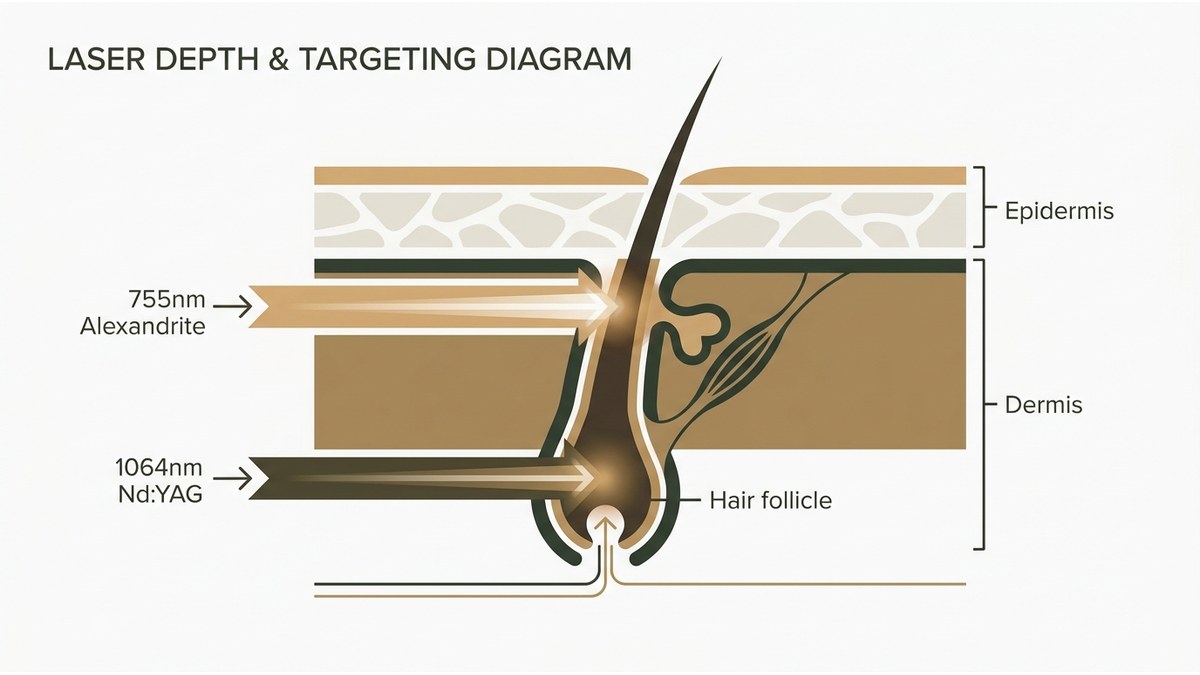
Here is the simple version. The laser sends a set wavelength of light into the follicle. The hair's pigment absorbs it. The heat damages the follicle, which then produces less hair and finer hair. Think of it as working on the supply, not the surface. That is the idea behind razor bumps laser treatment, and behind pseudofolliculitis barbae laser care in general.
If you are searching for ingrown hair prevention permanent solutions, here is the careful answer. We say "permanent hair reduction," never "permanent removal." Some people choose an occasional maintenance session for regrowth, and no clinic can honestly promise a guarantee.
We treat with the Cynosure Elite™ dual-wavelength laser, which pairs 755nm Alexandrite with 1064nm Nd:YAG. It also uses Zimmer Cryo 5 real-time cooling. Our first-party experience: 17 years and more than 150,000 procedures, and this is the approach we plan around.
You will see other pages call laser "the best solution" that "prevents" ingrown hairs. We think that overpromises. The published research on laser for ingrowns and razor bumps, such as this 2022 paper in a laser therapy journal, is worth reading in full. Our read is that laser is a reasonable option for many people. It is not a guarantee.
Takeaway: laser reduces the hair that causes ingrowns, and we state that plainly without promising a perfect result.
Is laser safe for darker, curly hair?
Yes, with the right wavelength. The 1064nm Nd:YAG wavelength passes more safely through skin pigment, which lowers burn risk. The Cynosure Elite™ pairs it with 755nm Alexandrite, so settings fit each skin tone. IPL and single-wavelength devices carry more risk.
Razor bumps hit curly-haired and darker-skinned people hardest. Those are also the people most often told that laser is not safe for them. We think that is the wrong message. The accurate message is that the device matters.
Melanin in the skin competes with the hair for laser energy. A wavelength that is absorbed heavily by skin pigment raises the chance of burns or dark marks. Nd:YAG at 1064nm is absorbed less by skin pigment, so it can reach the follicle with more margin. We cover the details in our guide to why 1064nm Nd:YAG is the safe, effective choice for dark skin.
Wavelength choice is a safety decision, not a menu option. We will not treat a patient with technology that puts their skin at risk. A dual-wavelength system lets us match the setting to your skin tone and hair type, and that applies to every skin tone, gender and background we welcome.
Research on ingrown hair management also notes that hair removal approaches aimed at the follicle are relevant for people prone to these bumps. That is the group most often left out of the conversation.
Takeaway: laser can be safe for darker skin and curly hair when the wavelength and settings are matched to you.
How many sessions stop ingrown hairs?
At Sedona, we plan on 8 to 12 sessions, 4 to 6 weeks apart. That is our clinic protocol, not a promise. Laser works best on hair in its active growth phase, so several visits are needed to catch every follicle. Bumps often ease as hair thins, though timing varies.
Hair grows in cycles. At any moment, only some of your hairs are in the growth phase the laser can reach. The rest are resting. Each visit catches a new group. Our explainer on hair growth cycles and why you need multiple sessions walks through the stages.
The same technician stays with you through the series. They learn how your skin and hair respond, and they adjust as the hair thins.
Hair thins gradually. So bumps fade gradually too. We will not promise a bump-free date. You may notice the change at a different point than someone else. For a month-by-month view, see our timeline for 8 to 12 sessions.
Studies on laser for ingrowns, like the 2022 paper above, are a reminder to set expectations by series, not by single visit. Ask us about your area at your consultation.
Takeaway: one session will not end ingrowns, but a full series steadily reduces the hair that causes them.
What should you do between sessions?
Shave, but don't wax, pluck or thread. Those methods pull the hair out of the follicle, and laser needs the hair there to target it. Use a clean, sharp razor, shave with the grain, and follow your technician's prep and aftercare steps.
A few more habits help:
- Shave gently and skip dull blades.
- Do not pick at bumps. It raises the chance of marks.
- Keep treated skin clean and out of harsh sun, as your technician advises.
- Tell your technician about any active, inflamed bumps before your visit so they can assess the area.
Our guide on how to prepare for your first professional session covers the shaving rules in detail. Mild redness is common after treatment. Zimmer Cryo 5 cooling helps with comfort during the session. To know which reactions are normal, read about common side effects and how to minimize them.
Medical guidance on preventing ingrown hairs points to reducing hair irritation and removal trauma. Skipping the wax is the easiest way to do that.
Takeaway: keep the hair in place for the laser, shave gently, and let your technician guide the rest.
Will at-home IPL fix ingrown hairs?
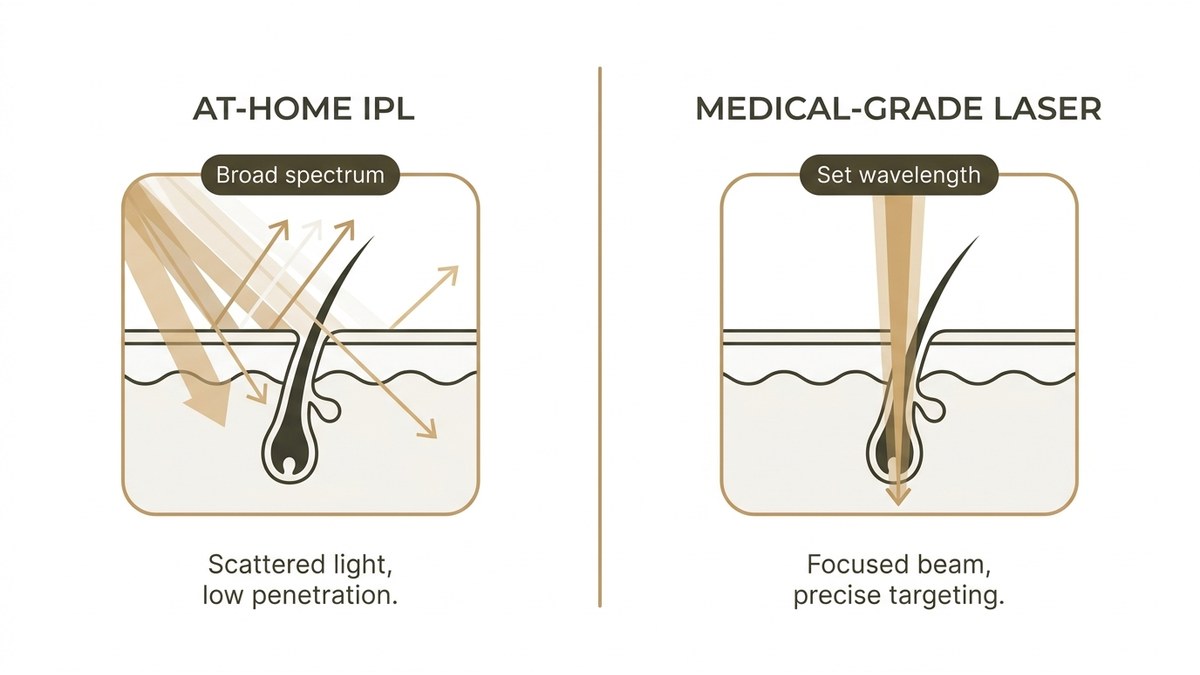
Unlikely to give lasting results. IPL uses broad-spectrum light, not a true laser beam, so it is less precise and typically gives temporary reduction. Medical-grade laser delivers set wavelengths to the follicle.
Many at-home devices are sold as "laser." They are not. IPL spreads many wavelengths across the skin. That makes it less precise, and it can be less effective and riskier on darker skin tones. If you tried a home device and saw little change, that does not mean laser will fail for you.
We break down the gap in why wavelength precision separates laser from IPL. The research on laser for these concerns, including this 2022 paper, looks at laser devices, not consumer IPL gadgets.
Takeaway: a failed at-home IPL trial tells you about IPL, not about medical-grade laser.
Ready to break the shave-bump cycle?
Here is the short version. Ingrowns come from hair that keeps growing and keeps being cut. Laser works on that supply. Plan for a full series of sessions, choose a wavelength that fits your skin, and expect gradual change rather than overnight results.
We also want to be plain about limits. Laser reduces hair. It does not guarantee smooth skin, and it is not the first step for infected or scarring bumps. See a clinician or dermatologist for those. For everyone else weighing ingrown hairs laser hair removal as a real option, a conversation with a technician is the easiest next step.
If you want to know where you stand, start with a free, no-pressure consultation. You can also browse the laser and skin treatments we offer in Edina.